
Ultimate Research Methodology Guide for Students 2026
What Are the Four Types of Research Methodology? four main types of research methodology: descriptive, correlational, experimental, and diagnostic. Research methodology is the foundation of every high-quality academic project. Whether you are writing a dissertation, thesis, research paper, capstone project, or case study, the methodology you choose determines:
- how reliable your findings are,
- how credible your academic work appears to supervisors, and
- how well you can justify your conclusions.
This makes research methodology one of the most essential—and most misunderstood—components of academic writing.
Students across UK universities often struggle to select the right methodology because:
- different textbooks classify research methods differently,
- some supervisors expect more scientific reasoning,
- others expect detailed justification aligned with research questions,
- and many students are unsure when to use qualitative vs. quantitative vs. experimental approaches.
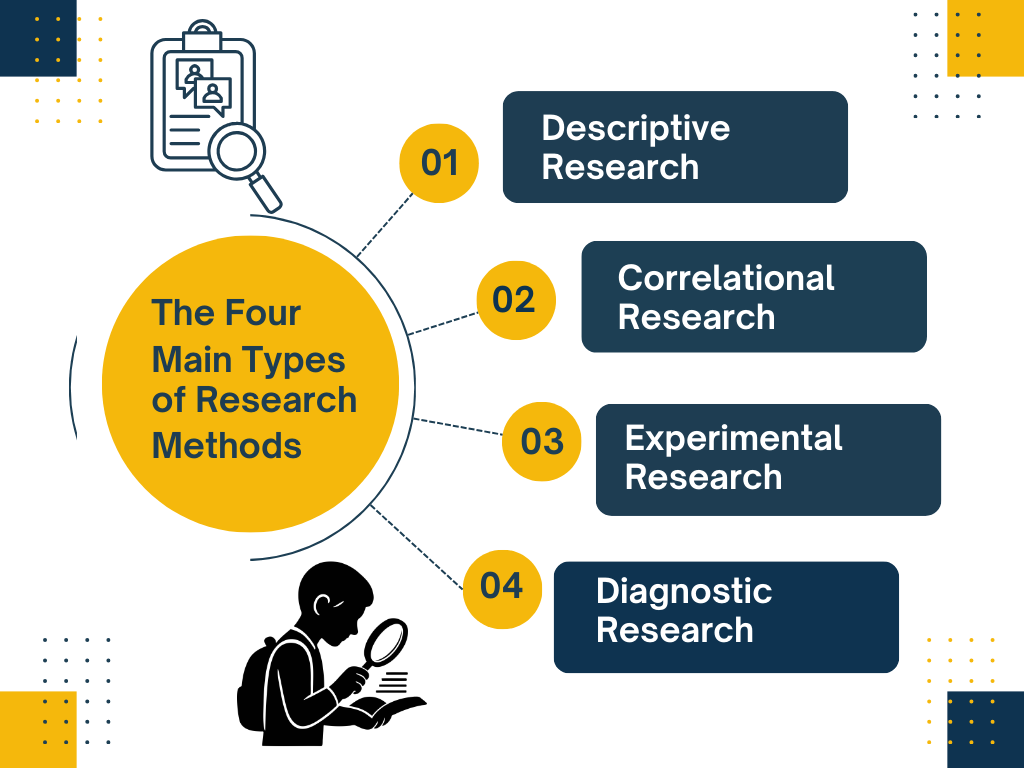
To simplify this confusion, academic researchers commonly group research methodologies into four core types, each based on its primary purpose and the kind of questions it answers:
✔ 1. Descriptive Research – “What is happening?”
Describes characteristics, behaviours, trends, or situations without manipulating anything.
Used for surveys, observations, and factual reporting.
✔ 2. Correlational Research – “How are variables related?”
Explores the relationship between variables to understand associations.
Useful for detecting patterns, trends, and connections.
✔ 3. Experimental Research – “Does X cause Y?”
Tests hypotheses using controlled experiments to establish cause-and-effect relationships.
Common in scientific and quantitative studies.
✔ 4. Diagnostic Research – “Why is this happening?”
Identifies the root causes of a problem, its contributing factors, and possible solutions.
Common in healthcare, psychology, business analysis, and organisational studies.
These four fundamental methodologies form the backbone of modern research. However, students and researchers also rely on broader classifications such as:
- Qualitative Research (experiences, beliefs, meaning)
- Quantitative Research (numbers, statistics, measurements)
- Mixed-Methods Research (combination of both)
- Study Designs such as case studies, interviews, action research, ethnography, cross-sectional studies, surveys, and focus groups
This complete guide breaks down each type of research methodology, explains when to use them, highlights the advantages and limitations, and provides real-world examples to help you make the right choice for your dissertation or assignment.
By the end of this guide, you will:
- understand exactly what each research method involves,
- know which methodology suits your research question,
- be able to justify your choice confidently in your dissertation, and
- avoid the common mistakes most students make in their methodology chapter.
This detailed explanation will help you build a stronger, more credible academic project—backed by the expert guidance of ProjectsDeal.co.uk, the UK’s #1 academic writing service trusted since 2001.
What is a Research Methodology and Why is it Important?
A research methodology is essentially the blueprint or roadmap for how your study will be conducted. It outlines the step-by-step plan for collecting, analysing, and interpreting data in order to answer your research questions accurately and effectively.
At its core, a research methodology explains:
- What methods you will use to gather data — such as surveys, interviews, experiments, observations, or case studies.
- How you will analyse that data using statistical tools, thematic analysis, or qualitative coding.
- Why you chose these specific methods and how they align with your research objectives and study design.
Think of it as your research guidebook, detailing the framework within which your entire study will be conducted. It usually includes:
- Research design (descriptive, correlational, experimental, diagnostic, etc.)
- Data collection methods (qualitative, quantitative, or mixed)
- Data analysis techniques
- Sampling strategies
- Ethical considerations
Why a Strong Research Methodology is Important
Having a well-defined methodology is crucial for several reasons:
- Ensures Reproducibility
Other researchers can follow your steps and replicate your study, validating your findings and contributing to the academic community. - Justifies Your Choices
Clearly explains why you chose specific methods, tools, and approaches, strengthening the credibility of your research. - Guides Research Objectives and Hypotheses
Helps in defining clear research questions, hypotheses, and objectives, providing a solid foundation for your study. - Identifies the Most Suitable Methods
Ensures you select the appropriate research design, sampling technique, and data collection and analysis methods for your study. - Enhances Reliability and Validity
A strong methodology reduces ambiguity, bias, and errors, allowing your findings to be trusted and applied confidently by other researchers or practitioners. - Supports Academic Standards
A structured methodology chapter demonstrates clarity, professionalism, and adherence to university and academic guidelines.
In short, a well-planned research methodology is the backbone of any successful dissertation, thesis, or research paper. It not only guides your study but also assures readers, supervisors, and examiners that your research is credible, systematic, and reliable.
What Does a Research Methodology Include?
A research methodology is a step-by-step plan for conducting your study. It explains how you will collect, analyse, and interpret data. Key components include:
- Research Design: The overall blueprint of your study (descriptive, experimental, correlational, etc.).
- Research Method: Quantitative, qualitative, or mixed-methods approach.
- Reason for Selection: Why this method is best suited for your research question.
- Research Instruments: Tools used to collect data, such as surveys, interviews, or observations.
- Sampling: How you select participants or data sources.
- Data Collection: Process of gathering information systematically.
- Data Analysis: How the collected data will be examined (statistics, coding, thematic analysis).
- Limitations: Potential challenges or constraints in your study.
- Validity & Reliability: Ensuring accuracy, consistency, and trustworthiness of results.
- Ethical Considerations: Protecting participants’ rights, consent, and confidentiality.
A clear methodology ensures your study is credible, reliable, and replicable, forming the backbone of any successful research project.
The Four Main Types of Research Methods
Below are the four foundational research types commonly used in academic and scientific research.
1. Descriptive Research (Fully Explained)
Descriptive research is one of the most widely used research methodologies in academic, scientific, and social studies. It provides a comprehensive picture of a population, behaviour, situation, or phenomenon exactly as it exists in the real world—without altering or influencing any variables.
This method is ideal when your goal is simply to observe, describe, and document facts, rather than test a hypothesis or establish causation.
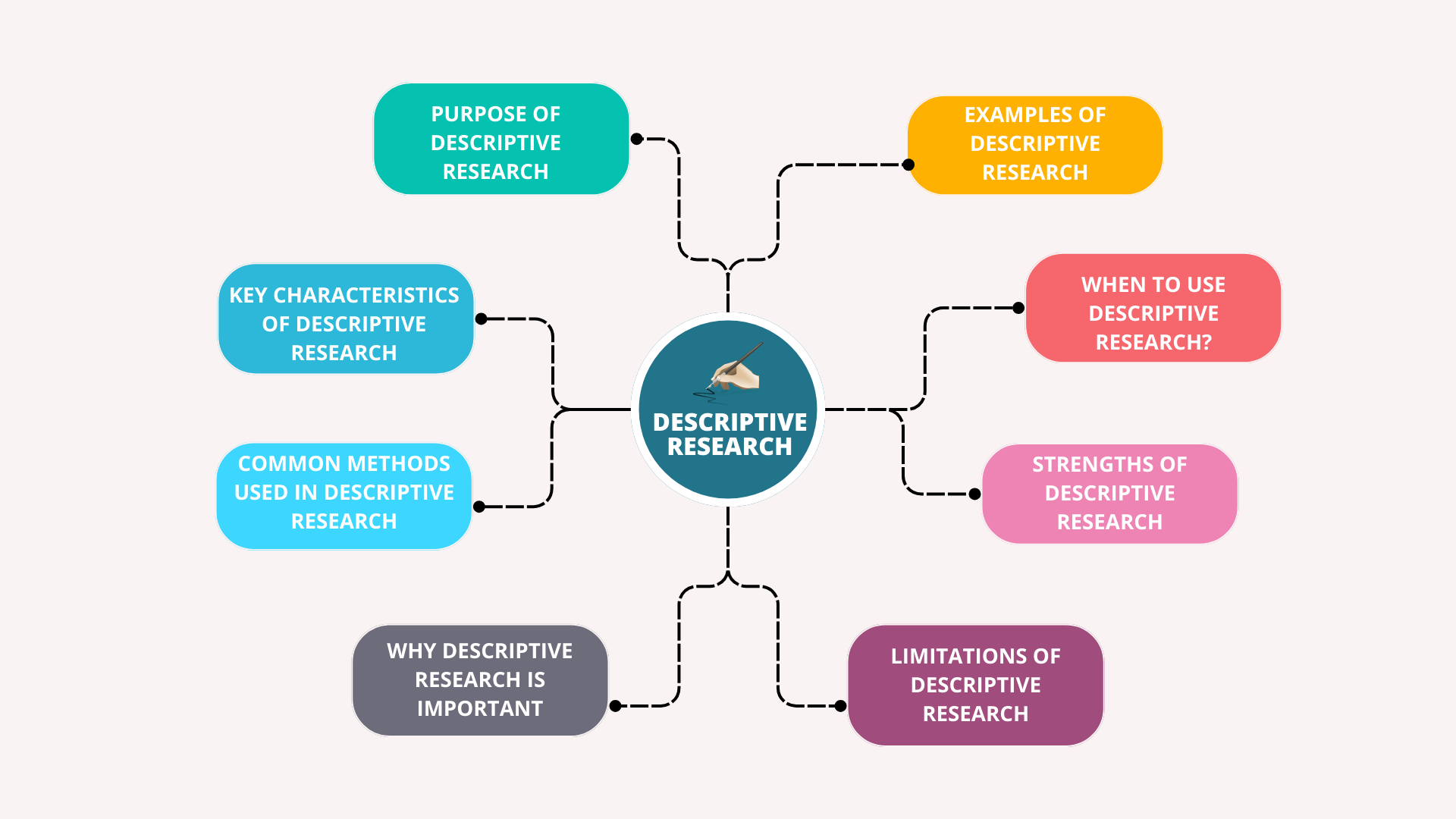
⭐ Purpose of Descriptive Research
The primary goal is to answer the question:
“What is happening?”
Researchers use descriptive research when they need a factual, accurate, and systematic representation of a particular subject. It forms the foundation for deeper research by identifying:
- current trends
- patterns of behaviour
- demographic characteristics
- opinions or perceptions
- frequencies or occurrences
- existing conditions
It does NOT explain why something happens—that’s what diagnostic or experimental research does. Instead, descriptive research focuses purely on what exists at a specific moment.
⭐ Key Characteristics of Descriptive Research
Descriptive research has several defining features:
1. Non-Manipulative
Researchers do not influence, control, or manipulate variables. They simply observe and record.
2. Natural Settings
Data is collected from real-life environments such as schools, workplaces, hospitals, online communities, or public spaces.
3. Systematic & Structured
Although it doesn’t experiment with variables, descriptive research follows a very organised and methodical approach to ensure accuracy.
4. Quantitative or Qualitative
It can involve numbers (e.g., percentage of students stressed) or qualitative descriptions (e.g., student experiences).
5. Cross-Sectional
Most descriptive studies capture data at a single point in time, but some may track changes over time (longitudinal descriptive research).
⭐ Common Methods Used in Descriptive Research
Descriptive research uses various tools to collect real-world information:
1. Surveys
- Questionnaires with structured or semi-structured items
- Used to gather opinions, behaviours, preferences, demographics
2. Observations
- Watching subjects in natural context
- Useful in psychology, behavioural studies, early childhood education
3. Case Studies
- In-depth analysis of individuals, groups, organisations, or events
- Helps uncover unique characteristics or real-life scenarios
4. Document or Content Analysis
- Analysing reports, articles, online reviews, or social media content
5. Interviews (in some descriptive designs)
- Though more qualitative, interviews sometimes contribute to descriptive objectives
⭐ Examples of Descriptive Research
Here are real-world examples from different fields:
✓ Education Example
“What are the most common challenges faced by international students studying at UK universities?”
This identifies:
- academic challenges
- cultural barriers
- housing struggles
- financial stress
✓ Business Example
“What consumer trends are emerging in online shopping in 2025?”
This describes:
- customer preferences
- buying behaviour
- popular product categories
- online payment patterns
✓ Healthcare Example
“What symptoms are most reported among patients with seasonal allergies in the UK?”
✓ Social Science Example
“What motivates young adults to participate in volunteer activities?”
✓ Technology Example
“What features do users most value in project management software?”
All these questions focus on describing what currently exists, not analysing causation.
⭐ When to Use Descriptive Research?
Descriptive research is best when you want to:
✔ Understand Current Trends
e.g., trending apps, changing customer behaviour, emerging markets
✔ Build a Foundation for Further Research
Descriptive findings often lead to correlational or experimental studies.
✔ Provide a Snapshot of a Phenomenon
At a specific time and place.
✔ Analyse Real-World Behaviours
Without interfering with them.
✔ Identify Patterns & Frequencies
Such as attendance rates, user preferences, or demographic distributions.
✔ Use Large & Diverse Samples
Surveys allow researchers to gather data from thousands of participants.
⭐ Strengths of Descriptive Research
- ✔ Easy to conduct
- ✔ Allows collection of large amounts of data
- ✔ Useful for identifying trends and patterns
- ✔ Can include both qualitative and quantitative data
- ✔ Helps in forming initial hypotheses
- ✔ Captures real-life situations accurately
⭐ Limitations of Descriptive Research
- ✘ Cannot establish cause-and-effect
- ✘ Findings may be time-specific
- ✘ Can be influenced by respondent bias
- ✘ No control over external variables
- ✘ Only describes; does not explain why something occurs
⭐ Why Descriptive Research Is Important
Descriptive research:
- builds the foundation for more advanced research,
- provides real-time insights,
- helps organisations make strategic decisions,
- creates baseline data for future comparison,
- and supports academic understanding of current phenomena.
Because of its versatility and accuracy, descriptive research is one of the most commonly used methodologies across universities in the UK.
⭐ How ProjectsDeal.co.uk Supports Students Using Descriptive Research
If you’re unsure how to design surveys, structure observations, or justify descriptive research in your dissertation, ProjectsDeal.co.uk provides expert academic guidance to help you apply the method correctly. From selecting the right research tools to writing a polished, plagiarism-free methodology chapter, our UK academic writers ensure your work is accurate, credible, and fully aligned with university standards.
2. Correlational Research
Correlational research explores the degree to which two or more variables are related. It does not determine whether one variable causes the other; instead, it identifies patterns, trends, and associations between them. This method is extremely useful when experimenting is not possible, ethical, or practical.
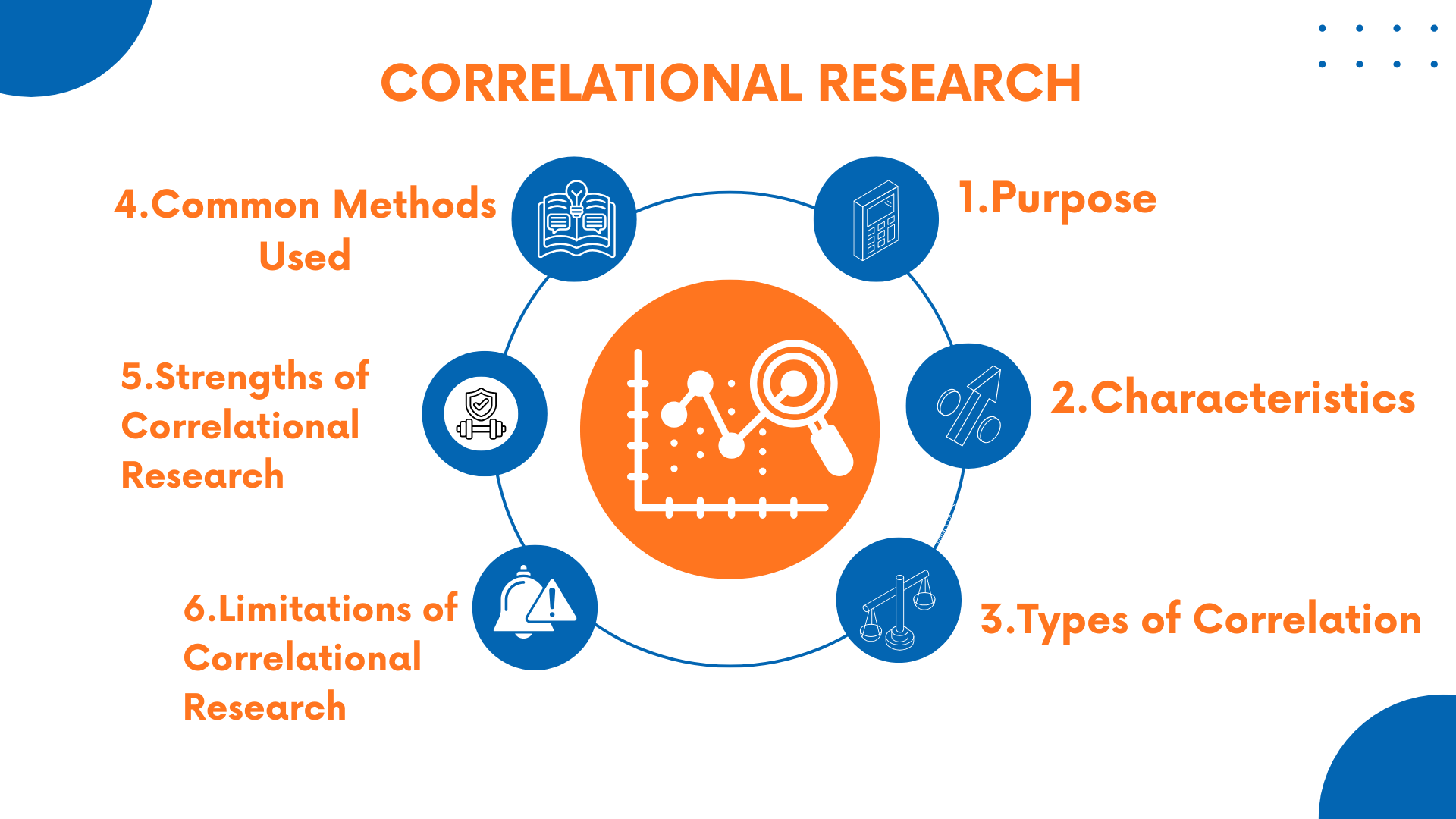
Purpose
To answer the question:
“Are these variables connected, and how strongly?”
Characteristics
- Detects statistical relationships between variables
- No manipulation of variables—researchers simply measure and compare
- Helps identify patterns that may require deeper investigation
- Often used as a foundation for predictive models
Types of Correlation
Correlational research typically measures three types of relationships:
- Positive Correlation – Both variables increase together
(e.g., more study hours → higher grades) - Negative Correlation – One variable increases while the other decreases
(e.g., more stress → lower productivity) - Zero Correlation – No relationship between variables
(e.g., shoe size and intelligence)
Common Methods Used
Correlational studies often rely on:
- Surveys & questionnaires
- Statistical analysis tools (e.g., Pearson correlation, Spearman’s rho)
- Observation-based datasets
- Secondary data sources such as government or institutional records
When to Use Correlational Research
This method is ideal when:
- The variables cannot be controlled due to ethical reasons
- You want to analyze natural relationships in a real-world setting
- You need data to predict future trends
- Conducting experiments is too expensive or time-consuming
Examples
- Analyzing the link between study hours and exam scores among university students
- Exploring the relationship between stress levels and workplace productivity
- Investigating whether social media usage correlates with anxiety levels
- Understanding whether income level relates to healthcare access
⭐ Strengths of Correlational Research
- Helps identify patterns and trends
- Useful when experiments are unethical or impossible
- Supports accurate prediction
- Quick, easy, and cost-effective to conduct
- Uses naturally occurring real-world data
- Can examine multiple variables at once
⭐ Limitations of Correlational Research
- Cannot establish cause-and-effect
- Third-variable problem (an external factor may influence results)
- Directionality issue (unclear which variable affects the other)
- Correlation may be coincidental
- Prone to misinterpretation
- Limited control over external variables
⭐ How ProjectsDeal.co.uk Supports Students Using Correlational Research
If you’re unsure how to choose variables, run statistical tests, or interpret correlation coefficients, ProjectsDeal.co.uk offers expert academic support. Our UK-based research specialists help students design strong correlational studies, analyse data using valid statistical methods, and present findings clearly and professionally in dissertations or research papers.
3. Experimental Research
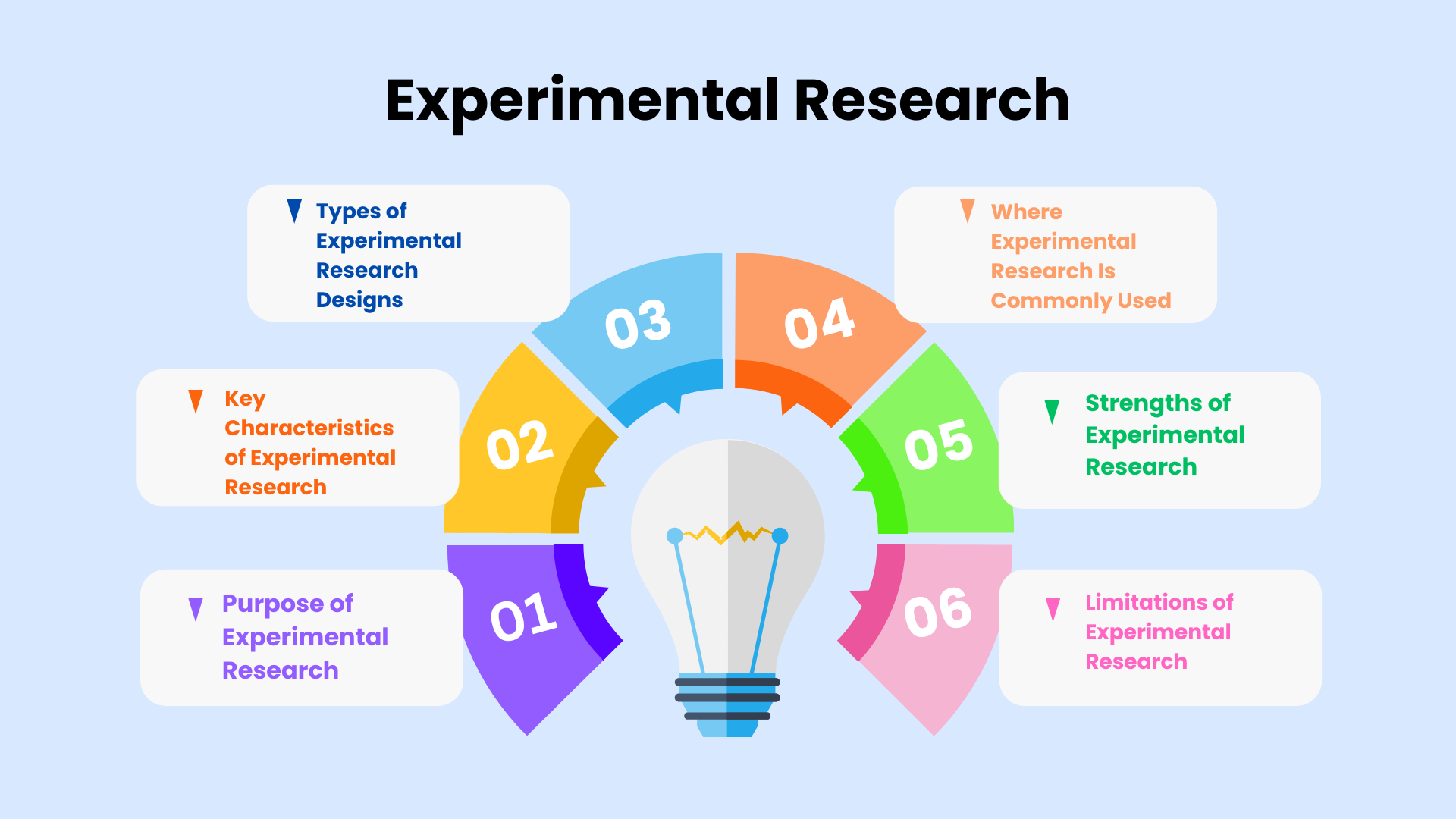
Experimental research is considered the most scientific, rigorous, and reliable research methodology. It is specifically designed to test cause-and-effect relationships by manipulating variables in a controlled environment. Because of its precision and accuracy, it is heavily used in scientific fields such as psychology, medicine, biology, and engineering.
This method helps researchers determine whether one variable (X) directly causes a change in another variable (Y) — something no other research method can confidently prove.
⭐ Purpose of Experimental Research
The main goal is to answer:
“Does X cause Y?”
Researchers use experimental methods when they want to:
- test a hypothesis,
- determine the effect of an intervention,
- understand causal relationships,
- measure outcomes under controlled conditions,
- or validate scientific theories.
⭐ Key Characteristics of Experimental Research
- Manipulation of Independent Variables
The researcher changes or introduces something (e.g., a treatment, program, or condition) to observe its effect. - Control Group vs Experimental Group
- Experimental Group: Receives the treatment or intervention
- Control Group: Does NOT receive the treatment (baseline group)
- Randomisation
Participants are randomly assigned to groups to eliminate bias and ensure fairness. - Highly Structured Design
Everything — measurement tools, procedures, environment — follows a strict protocol. - High Internal Validity
Because variables are controlled, experimental research can truly demonstrate cause-and-effect. - Use of Statistical Testing
After conducting the experiment, statistical tools (t-tests, ANOVA, regression) are used to analyse results.
⭐ Types of Experimental Research Designs
Experimental research can take several forms, such as:
1. True Experimental Design
Includes:
- Random assignment
- Control group
- Manipulated variable
Highest level of scientific accuracy.
2. Quasi-Experimental Design
Similar to true experiments but without random assignment.
Used when randomisation is not possible (e.g., classroom groups already formed).
3. Pre-Experimental Design
Simplest form; often used in pilot studies or when resources are limited.
⭐ Examples of Experimental Research
✓ Education Example
“Does using AI-based tutoring improve exam scores among university students?”
✓ Psychology Example
“What is the effect of sleep deprivation on memory recall accuracy?”
✓ Medicine Example
“Does a new drug reduce blood pressure faster than the existing treatment?”
✓ Biology Example
“How does light intensity affect plant growth?”
✓ Technology Example
“Does adding a cybersecurity prompt reduce risky online behaviour?”
All these studies test the direct effect of one variable on another.
⭐ Where Experimental Research Is Commonly Used
- Psychology
- Medicine & Clinical trials
- Nursing
- Biology & Life Sciences
- Engineering & Technology
- Neuroscience
- Pharmaceutical Research
- Nutrition & Health Studies
- STEM and laboratory-based disciplines
Whenever scientists need proof, they turn to experimental research.
⭐ Strengths of Experimental Research
✔ Establishes clear cause-and-effect relationships
✔ Highly controlled and scientifically rigorous
✔ Easy to replicate
✔ Reduces external variable influence
✔ Precise, measurable, and accurate
✔ Produces strong, convincing evidence
✔ Ideal for hypothesis testing
⭐ Limitations of Experimental Research
✘ Often expensive, time-consuming, or resource-heavy
✘ Artificial lab settings may not reflect real-world conditions
✘ Some variables cannot be ethically manipulated (e.g., harm, stress)
✘ May require specialised equipment
✘ Participant behaviour may be influenced by observation (Hawthorne effect)
✘ Limited generalisability if sample is small
⭐ How ProjectsDeal.co.uk Helps Students with Experimental Research
Designing a solid experimental study requires expertise — from defining variables to choosing control groups, writing hypotheses, conducting statistical analysis, and interpreting results clearly. ProjectsDeal.co.uk helps students develop strong experimental research designs, run accurate data analysis, and write powerful, plagiarism-free methodology and results chapters that meet UK academic standards. Whether you’re working on a lab experiment, clinical trial, or STEM project, our experts ensure your work is scientifically sound and distinction-ready.
4. Diagnostic Research
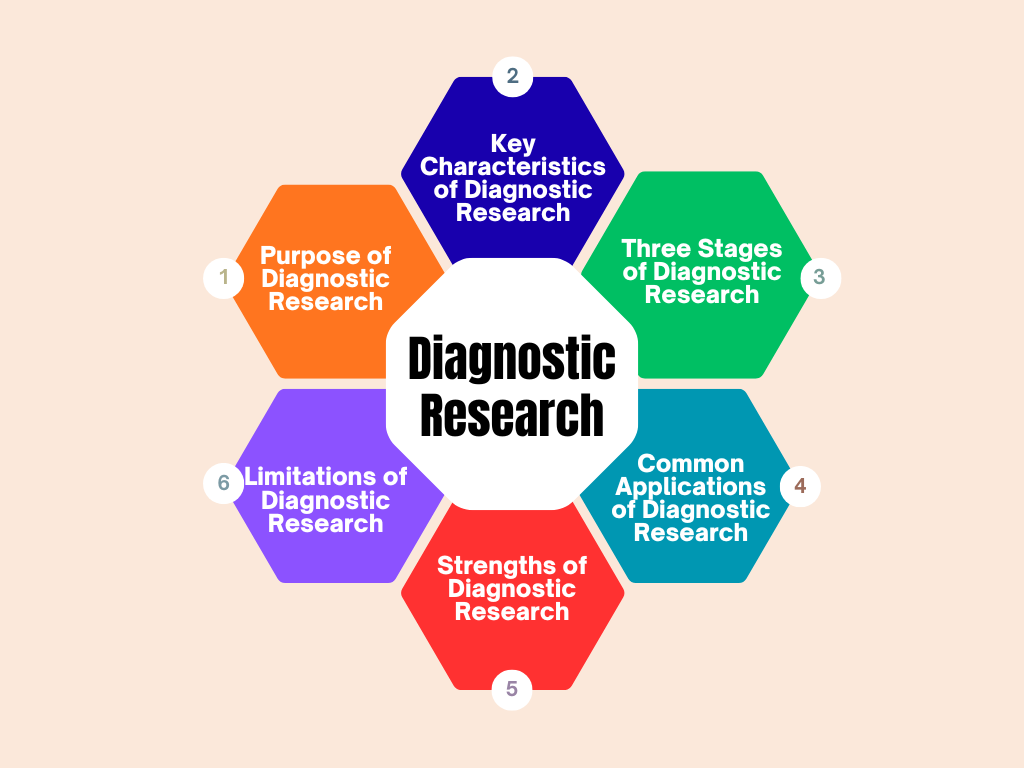
Diagnostic research is a powerful methodology used to identify the root cause of a problem, issue, or phenomenon. Rather than simply describing what exists (descriptive research) or exploring relationships (correlational research), diagnostic research focuses on why something is happening.
It is widely used in healthcare, business, education, social sciences, and management to uncover underlying issues and develop effective solutions.
⭐ Purpose of Diagnostic Research
Diagnostic research answers deeper, analytical questions such as:
- “Why is this happening?”
- “What are the underlying causes?”
- “Which factors contribute to this problem?”
- “What solutions can address the issue?”
This method goes beyond surface-level observation to understand causes, sources, patterns, and possible interventions.
⭐ Key Characteristics of Diagnostic Research
- Problem-Focused Approach
It begins with identifying a specific issue — low performance, declining sales, health symptoms, or behavioural patterns. - Multi-Method Data Collection
Diagnostic research often combines surveys, interviews, case studies, focus groups, and statistical analysis. - Cause Identification
The primary goal is to recognise contributing factors and their impact. - Solution-Oriented
Unlike descriptive research, diagnostic studies also propose actionable solutions. - Cross-Disciplinary Application
Used across healthcare, management, psychology, education, and operations.
⭐ Three Stages of Diagnostic Research
Diagnostic research typically follows a structured 3-stage process:
1. Problem Detection
- Identify that a problem exists
- Define symptoms or observable outcomes
- Determine the scope and severity
Examples:
- Low sales, high employee turnover, poor student engagement, system failures.
2. Problem Source Identification
- Analyse data to identify the true root causes
- Distinguish between symptoms vs. underlying issues
- Explore internal and external contributing factors
Examples:
- Low sales → poor customer service, weak marketing, wrong pricing
- Student dropouts → lack of interaction, poor course design, time constraints
3. Problem Solution Development
- Develop strategies, interventions, or corrective actions
- Propose recommendations
- Test or implement solutions
- Evaluate effectiveness
Examples:
- Improving customer satisfaction
- Enhancing teaching methods
- Reducing system failures through process redesign
⭐ Common Applications of Diagnostic Research
Diagnostic research is used across numerous fields:
1. Healthcare Diagnostics
- Identifying causes of patient symptoms
- Detecting disease patterns
- Evaluating treatment failures
- Root cause analysis in clinical settings
2. Business & Management
- Understanding why sales decline
- Analysing employee dissatisfaction
- Identifying causes of supply chain failures
- Diagnosing operational inefficiencies
3. Education
- Investigating why students drop out or underperform
- Identifying gaps in teaching methods
- Diagnosing learning challenges
4. Customer Experience & Marketing
- Analysing reasons for low customer satisfaction
- Understanding complaints, feedback, or retention issues
5. IT & Technology
- Diagnosing software bugs
- Analysing cybersecurity incidents
- Root cause analysis for system failures
⭐ Examples of Diagnostic Research
✓ Business Example
“What are the root causes of declining customer satisfaction in a retail store?”
Possible causes identified may include:
- slow service,
- product quality issues,
- poor staff behaviour,
- unclear return policies.
✓ Education Example
“Why are students dropping out of online learning programs?”
Possible causes may include:
- lack of interaction,
- overwhelming workload,
- unclear instructions,
- technical issues.
✓ Healthcare Example
“What factors lead to delayed recovery among post-surgery patients?”
✓ Technology Example
“What causes frequent downtime in an e-commerce platform?”
⭐ Strengths of Diagnostic Research
✔ Helps uncover true root causes
✔ Produces actionable solutions
✔ Provides deep insights beyond surface-level symptoms
✔ Supports strategic decision-making
✔ Highly useful for organisational growth and performance improvement
✔ Combines qualitative and quantitative evidence
✔ Improves system efficiency and user satisfaction
⭐ Limitations of Diagnostic Research
✘ Time-consuming and multi-layered
✘ Requires skilled interpretation and expertise
✘ Data may be difficult to collect accurately
✘ Problem may be complex with multiple causes
✘ Subject to bias if analysis is not objective
✘ Solutions may require additional testing
⭐ How ProjectsDeal.co.uk Helps Students with Diagnostic Research
Diagnostic research can be challenging because it requires both analytical depth and accurate interpretation. ProjectsDeal.co.uk helps students identify problems clearly, select appropriate diagnostic tools, analyse root causes, and develop strong, evidence-based solutions. Our expert academic writers assist with research design, data analysis, findings, and recommendations — ensuring your dissertation or thesis is well-structured, insightful, and distinction-ready.
Other Common Research Classifications & Study Designs (Fully Explained)
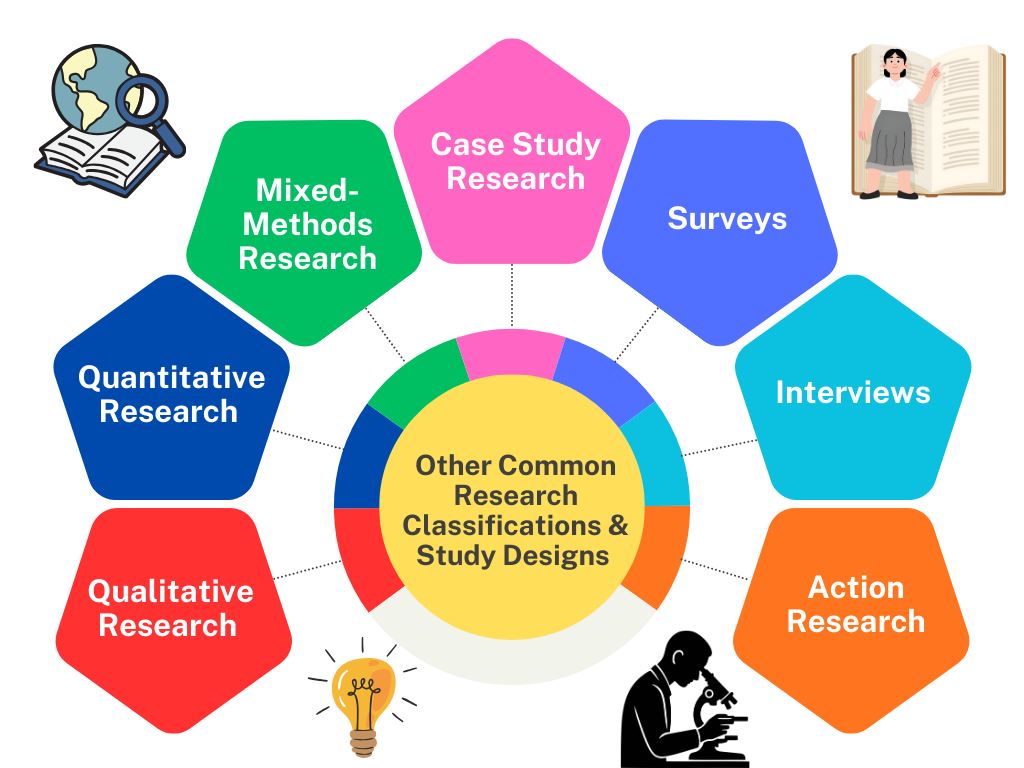
Beyond the four main research types—descriptive, correlational, experimental, and diagnostic—academic research is also widely classified based on approach, data type, and study design. These classifications are used extensively in dissertations, theses, and assignments across UK universities to structure research objectives more effectively.
Below is a detailed explanation of the most commonly used research classifications and designs.
⭐ 1. Qualitative Research (Exploratory & Interpretive)
Qualitative research focuses on understanding human experiences, emotions, behaviours, and social meanings. Instead of numbers, it deals with rich, descriptive data.
Purpose
To explore how and why people behave or feel a certain way by analysing their experiences, thoughts, and perceptions.
Key Features
- Non-numerical, text-based data
- Flexible, open-ended inquiry
- Subjective interpretation
- Deep, contextual understanding
Common Methods
- Interviews (structured, semi-structured, unstructured)
- Focus Groups
- Ethnography (immersion in a cultural or social setting)
- Observations
- Narrative & Thematic Analysis
Best For
✔ Understanding motivations and experiences
✔ Exploring new or complex phenomena
✔ Small, targeted samples
✔ Research questions beginning with “how” or “why”
✔ Research questions beginning with “how” or “why”
⭐ 2. Quantitative Research (Numerical & Statistical)
Quantitative research relies on numbers, measurements, and statistical analysis to test hypotheses and establish patterns.
Purpose
To measure variables, identify relationships, and generalise findings to a larger population.
Key Features
- Structured data collection
- Large sample sizes
- Statistical testing
- Objective and measurable results
Common Methods
- Surveys
- Experiments
- Questionnaires
- Statistical Modelling and Data Analysis
Best For
✔ Hypothesis testing
✔ Generalisable results
✔ Large datasets
✔ Questions starting with “how many”, “how much”, or “to what extent”
⭐ 3. Mixed-Methods Research (Qualitative + Quantitative)
Mixed-methods research combines both qualitative and quantitative approaches to provide a more complete and validated understanding.
Why It’s Useful
- Brings depth (qualitative) and accuracy (quantitative) together
- Cross-validates findings
- Offers stronger methodological reliability
- Provides both numerical patterns and detailed explanations
Common Designs
- Sequential (QUAL → QUANT or QUANT → QUAL)
- Concurrent (both at the same time)
- Triangulation (multiple data sources for validation)
Best For
✔ Complex research questions
✔ Multi-layered investigations
✔ Studies needing both depth and statistical accuracy
⭐ 4. Case Study Research
A case study is an in-depth, detailed examination of a single individual, group, organisation, community, event, or situation.
Purpose
To explore real-life contexts, decisions, processes, and complexities that cannot be captured through simple surveys or statistics.
Key Features
- Highly detailed
- Contextual and holistic
- Uses multiple data sources (documents, interviews, observations)
Best For
✔ Business studies
✔ Psychology
✔ Education
✔ Medical case evaluations
⭐ 5. Surveys
Surveys collect data from a defined sample to understand opinions, behaviours, preferences, trends, or demographics.
Purpose
To gather data quickly from large groups for statistical analysis.
Best For
✔ Large populations
✔ Quantitative data
✔ Polls, questionnaires, market research
Data Types
- Likert scales
- Multiple-choice questions
- Open-ended questions (optional qualitative insights)
⭐ 6. Interviews
Interviews are a widely used qualitative method for collecting rich, detailed personal insights.
Types of Interviews
- Structured: Fixed set of questions
- Semi-structured: Mix of fixed and flexible questions
- Unstructured: Free-flowing conversation
Best For
✔ Understanding feelings, experiences, motivations
✔ Sensitive or personal topics
✔ Small, focused samples
⭐ 7. Action Research
Action research is a participatory method where the researcher works collaboratively with participants to identify a problem, implement solutions, and evaluate improvements.
Used In
- Education (classroom improvements, teaching strategies)
- Community Development
- Organisational & Workplace Improvement
- Social Change Initiatives
Purpose
To create practical, real-world solutions while simultaneously studying the impact.
Key Features
- Cyclical (plan → act → observe → reflect)
- Collaborative
- Real-world application
- Immediate improvement focus
Summary Table: All Major Research Types
| Research Type | Purpose | Data Type | Best For |
|---|---|---|---|
| Descriptive | Describe what exists | Both | Social sciences, business |
| Correlational | Identify relationships | Numerical | Psychology, education |
| Experimental | Test cause-effect | Numerical | Sciences, medicine |
| Diagnostic | Find root causes | Both | Healthcare, business |
| Qualitative | Explore experiences | Textual | Humanities, social sciences |
| Quantitative | Measure variables | Numbers | STEM, business |
| Mixed-Methods | Combine insights | Both | Advanced dissertations |
| Case Study | In-depth real-world analysis | Both | Business, law |
| Surveys | Collect large data | Numbers | Market research |
| Interviews | Gather personal insights | Textual | Psychology, education |
| Action Research | Solve practical problems | Both | Education, organisations |
How to Choose the Right Research Methodology

Selecting the right research methodology is one of the most critical steps in any dissertation, thesis, or academic project. The method you choose directly affects the accuracy of your findings, the quality of analysis, and the overall success of your research.
Many students struggle with this step — but choosing the right methodology becomes easy when you understand your research questions, data needs, study goals, and university expectations.
Below is a detailed, student-friendly guide to choosing the correct research methodology for your study.
⭐ Key Factors to Consider When Choosing Your Research Method
Your research methodology should be based on the following essential elements:
1. Your Research Question
Your research question is the strongest indicator of which method you should use.
- If your question begins with “What…” → You are describing.
- If it begins with “How many / To what extent…” → You are measuring.
- If it begins with “Why…” → You are analysing causes.
- If it begins with “How / Why…” in a human-experience context → You need qualitative depth.
2. Type of Data You Need
Ask yourself:
- Do you need numbers or statistics? → Quantitative
- Do you need detailed experiences or opinions? → Qualitative
- Do you need both? → Mixed-methods
The data type is directly linked to the methodology.
3. Availability of Resources
Some research methods require more resources than others.
Examples:
- Experiments may require labs, equipment, or controlled environments.
- Surveys require access to large samples.
- Interviews take time and scheduling effort.
- Diagnostic studies need analytical tools and multiple data sources.
Choose a method that is realistic based on your access and limitations.
4. Time Constraints
Different methodologies require different time commitments.
- Descriptive surveys → quick
- Interviews or case studies → moderate time
- Experimental research → long, structured, multi-stage
- Diagnostic research → deep analysis and interpretation
Match your method with your dissertation timeline.
5. University Guidelines
UK universities often specify:
- preferred methodology types,
- word count distribution,
- required number of participants,
- ethical constraints,
- expected statistical analysis tools.
Always choose a method that aligns with your supervisor’s expectations and university standards.
6. Nature of Your Study Goals
Your aim will guide your methodology:
- Build a profile of a population → Descriptive
- Investigate connections between variables → Correlational
- Establish causation → Experimental
- Identify root causes → Diagnostic
- Explore experiences → Qualitative
- Test hypotheses or measure impact → Quantitative
- Combine strengths → Mixed-methods
⭐ Simple Rule for Choosing the Right Methodology
Here’s a very simple and clear breakdown to help you choose instantly:
✔ Want to describe what exists? → Choose Descriptive Research
To document trends, characteristics, or behaviours.
✔ Want to explore relationships between variables? → Choose Correlational Research
To determine whether variables move together.
✔ Want to prove cause-and-effect? → Choose Experimental Research
To see if one variable directly affects another.
✔ Want to identify root causes of a problem? → Choose Diagnostic Research
To understand why something is happening.
✔ Want to understand experiences or emotions? → Choose Qualitative Research
To explore motivations, perceptions, and behaviours.
✔ Want to measure, quantify, or test hypotheses? → Choose Quantitative Research
To collect numerical data and statistical results.
✔ Want both depth and accuracy? → Choose Mixed-Methods Research
To blend the strengths of qualitative and quantitative approaches.
⭐ Why Choosing the Right Method Matters
The correct methodology ensures:
✔ Accurate data
✔ Valid and reliable results
✔ Clear alignment with research objectives
✔ Strong academic credibility
✔ Higher chances of scoring a distinction
✔ Easier analysis and interpretation
✔ A well-structured dissertation methodology chapter
Your methodology is the backbone of your entire research — choosing the wrong one can weaken your entire project.
| Why Students Struggle With Methodology | How ProjectsDeal.co.uk Helps |
|---|---|
| Logical Research Justification – Many students struggle to justify why they chose a particular research methodology or design, leading to weak methodology chapters. | Expert Guidance on Research Justification – ProjectsDeal’s academic writers help you clearly explain why your methodology fits your research question, study goals, and university requirements. |
| Clear Data Collection Strategy – Students often find it difficult to decide which data collection methods (surveys, interviews, experiments, observations) to use and how to structure them. | Customized Surveys, Interviews & Experiments – Our experts design tailored surveys, interview questions, and experimental frameworks that align with your study objectives and ensure accurate, reliable data. |
| Understanding of Variables – Many students are unsure how to identify independent, dependent, or confounding variables and how to control or measure them properly. | Comprehensive Variable Analysis Support – ProjectsDeal provides guidance on selecting, defining, and measuring variables. We help with experimental, correlational, or diagnostic study designs. |
| Familiarity with Academic Writing Standards – Writing methodology chapters that meet UK academic formatting, referencing, and clarity standards can be overwhelming. | High-Quality, University-Approved Writing – Our writers produce 100% plagiarism-free methodology chapters that follow APA, Harvard, MLA, or your university’s guidelines. |
| Data Analysis Skills – Lack of experience with tools like SPSS, STATA, Excel, or qualitative coding makes analysis challenging. | SPSS / STATA / Excel Data Analysis Assistance – We help students analyse quantitative and qualitative data, interpret results accurately, and present them in clear tables, charts, and graphs. |
| Time Management & Deadlines – Students often run out of time to properly plan, conduct, and write methodology chapters. | Timely Delivery & Urgent Support – ProjectsDeal guarantees on-time delivery, even for urgent deadlines, while maintaining HD-grade quality. |
| Revision & Feedback Issues – Multiple revisions are often required, and students may struggle to implement supervisor feedback effectively. | Unlimited Free Revisions – We provide unlimited revisions until your methodology chapter meets your satisfaction and supervisor expectations. |
| Comprehensive Dissertation Support – Writing only the methodology is challenging when students need guidance across the entire dissertation. | Complete Research & Dissertation Assistance – ProjectsDeal supports you from proposal and literature review to methodology, results, discussion, and conclusion chapters, providing a seamless research experience. |
How to Write a Research Methodology with Paperpal (Quick Guide)
Writing a research methodology can be challenging, but Paperpal streamlines the process step by step:
- Start with Templates – Upload notes or a prompt, and Paperpal Outline creates a structured methodology including research design, sampling, data collection, and analysis.
- Learn from Published Research – Use ChatPDF to summarise studies, ask questions about methods, and identify gaps for your research.
- Generate a First Draft – Paperpal Write turns your notes into a complete draft, from design rationale to data collection steps.
- Validate & Cite Sources – Research & Cite finds relevant studies and formats citations automatically in APA, MLA, Chicago, and more.
- Refine with Rewrite – Paraphrase, condense, and improve academic tone while keeping technical terminology consistent.
- Final Polish with Grammar Checker – Paperpal Edit ensures correct tense, vocabulary, formatting, and academic style.
Benefit: Save time, improve quality, and create a professional, credible methodology chapter.
University Guidelines for Writing a Research Methodology
| University | Key Guidelines for Methodology Chapter | Focus Areas |
|---|---|---|
| University of Oxford & Cambridge | Rigorous justification of methodology, detailed sampling, and ethical considerations | Justification, Sampling, Ethics |
| London School of Economics (LSE) | Precise research design, statistical validity, and adherence to data analysis standards | Research Design, Statistical Accuracy |
| University College London (UCL) | Emphasize reproducibility, detailed procedural steps, and critical evaluation of methods | Reproducibility, Procedure, Evaluation |
| University of Edinburgh & University of Manchester | Clear link between research questions, methodology, and literature review | Linking Methodology to Research Questions, Literature Alignment |
| Common Guidelines Across UK Universities | Define research design, explain methodology choice, provide sampling & data analysis details, address ethics, and note limitations | Clarity, Justification, Sampling, Data Analysis, Ethics, Limitations |
Frequently Asked Questions (FAQ)
Q1. What are the 4 types of research methodology?
The four main types are:
- Descriptive Research – describes phenomena as they exist.
- Correlational Research – examines relationships between variables.
- Experimental Research – tests cause-and-effect relationships.
- Diagnostic Research – identifies the root causes of problems.
Q2. What are the 4 steps of research methods?
The typical steps are:
- Defining the research problem and objectives
- Designing the research and choosing methodology
- Collecting and analysing data
- Interpreting results and drawing conclusions
Q3. How many types of methodologies are there?
Research methodologies are broadly classified into three main types:
- Qualitative
- Quantitative
- Mixed-Methods
Some frameworks also classify research by purpose or design (e.g., descriptive, experimental, correlational, diagnostic).
Q4. What are the 4 classifications of research?
Research is often classified as:
- Descriptive
- Correlational
- Experimental
- Diagnostic
Q5. What are the 4 frameworks of research?
Common research frameworks include:
- Conceptual Framework – defines concepts and relationships
- Theoretical Framework – based on existing theories
- Analytical Framework – focuses on analysis of data
- Methodological Framework – outlines methods and procedures
Q6. What is research methodology?
Research methodology is a plan or blueprint for conducting a study. It details the research design, data collection methods, analysis techniques, and overall approach to answering research questions.
Q7. What is qualitative research methodology?
Qualitative research methodology explores human experiences, behaviours, and perceptions using textual or descriptive data. Common methods include interviews, focus groups, observations, and case studies.
Q8. What is step 4 of research design?
Step 4 usually refers to data analysis and interpretation, where collected data is examined to answer research questions and test hypotheses.
Q9. What are the 4 pillars of research?
The 4 pillars often considered essential for research are:
- Problem definition
- Literature review
- Methodology and data collection
- Analysis and conclusion
Q10. What are the 4 types of research studies?
Research studies can be classified as:
- Descriptive Studies
- Correlational Studies
- Experimental Studies
- Diagnostic Studies
Q11. What are the key research methods?
Key research methods include:
- Surveys & Questionnaires
- Interviews & Focus Groups
- Observations
- Experiments
- Case Studies
- Statistical & Thematic Analysis
Conclusion
There are four main types of research methodology, each designed to answer specific questions:
- Descriptive Research: Fact-finding and describing phenomena without manipulating variables.
- Correlational Research: Exploring relationships and patterns between variables.
- Experimental Research: Testing cause-and-effect relationships under controlled conditions.
- Diagnostic Research: Identifying the root causes of a problem and providing actionable solutions.
Alongside these, students also use qualitative, quantitative, and mixed-method approaches, as well as study designs like case studies, surveys, interviews, and action research. Choosing the right methodology ensures your research is reliable, credible, and academically robust.
Students often struggle with selecting the appropriate methodology, justifying their choices, or conducting proper data analysis. That’s where ProjectsDeal.co.uk comes in — providing expert guidance, plagiarism-free methodology chapters, HD-grade quality, and full research support tailored for UK university standards.
🎓 Achieve Academic Excellence with ProjectsDeal.co.uk
Still feeling confused about your research methodology or dissertation? Don’t stress — let the experts handle it for you! ProjectsDeal.co.uk has been trusted by UK students since 2001 and was proudly featured on Yahoo as the Best Dissertation Writing Service in the UK. 🏆
Here’s why thousands of students rely on us every year:
✔ 📝 100% Plagiarism-Free Methodology Chapters – Original, high-scoring academic work
✔ 🎓 UK-Qualified Expert Writers – Specialists with years of research & dissertation experience
✔ 🏅 HD-Grade Guaranteed Work – Tailored to your university’s marking criteria
✔ 🛠️ Custom Support – Surveys, experiments, SPSS/Excel analysis, and full dissertation help
✔ ⏳ Timely Delivery – Even for urgent deadlines
✔ 💬 Friendly Support Team – Always available to guide you
🚀 Feeling overwhelmed? Get professional help today.
💷 Order online in minutes—starting at just £49—and consider your work handled by experts!
🔗 ProjectsDeal Recognized by Yahoo as the Best Dissertation Writing Service in the UK