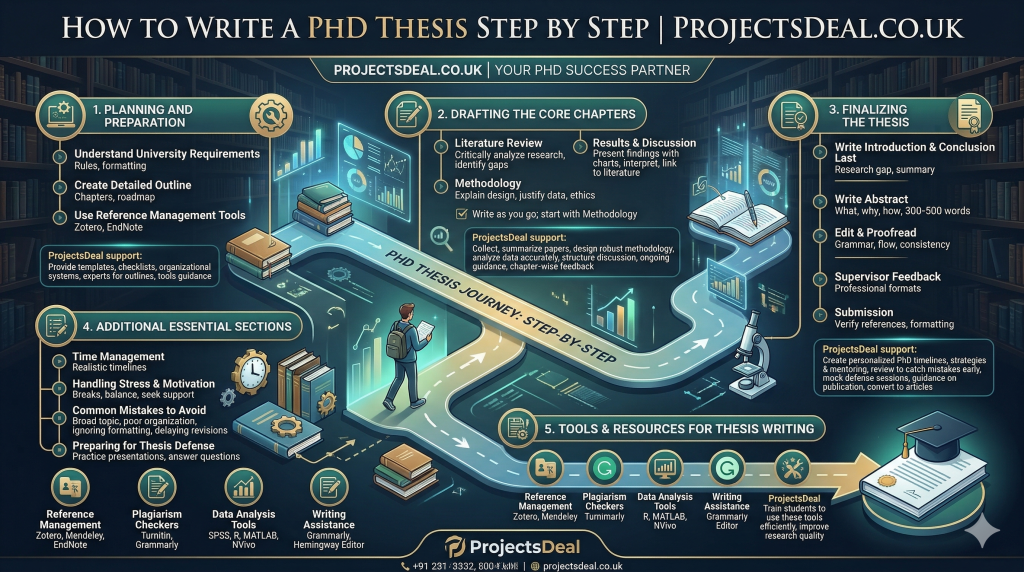

How to Write a PhD Thesis Step by Step: A PhD thesis is a piece of original research that all doctoral students must submit to complete their degree. It presents the work you conducted during your PhD and highlights the findings and conclusions you reached. Your thesis represents the culmination of three to four years of full-time study and is a demonstration of your expertise in your field.
Writing a thesis can feel daunting. With a substantial word count, the challenge of producing something new, and the prospect of defending your work in a viva, it’s easy to feel overwhelmed. This guide by ProjectsDeal.co.uk will help you understand the entire process, covering structure, research, writing, feedback, submission, and other key considerations. With focus, persistence, and the right support from ProjectsDeal.co.uk, completing your thesis is entirely achievable..
Beginning Your PhD Thesis
Start with the Literature Review
The literature review is often the first stage of your PhD thesis. It is your opportunity to demonstrate a deep understanding of existing research in your area.
- Review academic papers, books, reports, and other credible sources relevant to your topic.
- Analyze and critically assess arguments, rather than simply summarizing them.
- Highlight gaps in existing knowledge that your research will address.
- Typically forms the first chapter of your thesis, though it will be updated later as your research progresses.
ProjectsDeal.co.uk helps: We assist students in conducting thorough literature searches, organizing references, and writing a critical, well-structured literature review that lays a strong foundation for the rest of the thesis.
Structuring the Core Chapters
After your literature review, you will move onto the main chapters of your thesis. These typically include:
- Introduction – Present your research question, objectives, and the significance of your study.
- Methodology – Explain your research design, data collection, and analysis methods.
- Results – Present findings clearly, using tables, graphs, and charts.
- Discussion – Interpret results and relate them to existing literature.
- Conclusion – Summarize findings and suggest future research directions.
ProjectsDeal.co.uk helps: We provide guidance for each chapter, including writing tips, structuring arguments, data visualization support, and clarity in presentation. This ensures that each chapter communicates your research effectively and academically.
Writing and Maintaining Focus
- Write as you go: Draft sections like Methodology and Literature Review during your research to reduce final workload.
- Start with easier chapters: If you feel stuck, begin with sections you are confident about, like Methods or Results.
- Keep updating your literature review: As new studies emerge, ensure your review reflects the latest research.
ProjectsDeal.co.uk helps: We offer ongoing support for drafting, revising, and updating your chapters, so you maintain momentum and stay on track throughout your PhD journey.
Feedback and Revision
- Regular supervisor feedback ensures your thesis aligns with academic expectations.
- Peer review or mentoring can provide additional perspectives on clarity and argumentation.
- Revision cycles help refine your thesis and correct inconsistencies.
ProjectsDeal.co.uk helps: Our editors review drafts for language, structure, and argument flow, providing actionable feedback to improve the quality of your work before submission to supervisors.
Preparing for Submission and Viva
- Abstract and Summary: Summarize your research clearly and concisely.
- Formatting: Ensure adherence to university guidelines for margins, fonts, and citations.
- Viva preparation: Anticipate potential questions and practice defending your findings.
ProjectsDeal.co.uk helps: We assist in formatting your thesis according to university requirements, crafting high-impact abstracts, and even preparing you for viva questions and presentations.
Key Tips for Success
- Organize your time: Use timelines and milestones to manage your workload.
- Manage stress: Take regular breaks and maintain a healthy work-life balance.
- Stay consistent: Ensure each chapter supports your central research question.
- Use professional tools: Reference managers, plagiarism checkers, and data analysis software can save time.
ProjectsDeal.co.uk helps: We provide personalized timelines, stress management advice, and training in tools like Zotero, Mendeley, SPSS, and NVivo, ensuring your thesis process is smoother and more efficient.
Challenges of Writing a PhD Thesis
Writing a PhD thesis is a rewarding but highly demanding process. Students often face multiple challenges throughout their doctoral journey. Understanding these challenges can help you plan better and overcome obstacles effectively.
| Challenge | Description | How ProjectsDeal.co.uk Helps |
|---|---|---|
| Time Management | Balancing research, writing, and personal life over several years can be overwhelming. | Provides personalized timelines, milestone tracking, and practical advice to manage tasks efficiently. |
| Writer’s Block | Struggling to put ideas into words or start chapters can delay progress. | Offers structured writing plans, chapter outlines, and “writing blitz” techniques to overcome blocks. |
| Data Analysis & Interpretation | Handling large datasets or complex experiments can be challenging, especially in STEM or Social Sciences. | Guides students in data analysis, statistical methods, and presenting results clearly. |
| Maintaining Motivation | Long research periods can lead to fatigue, procrastination, or loss of focus. | Provides mentoring, goal-setting strategies, and regular progress support to keep students motivated. |
| Feedback Integration | Implementing supervisor or peer feedback effectively can be difficult, especially when revisions are extensive. | Assists in prioritizing and applying feedback systematically for a coherent thesis. |
| Formatting & Compliance | Meeting university formatting guidelines, word count limits, and referencing standards can be tedious. | Offers proofreading, formatting, reference management, and compliance checks for submission-ready documents. |
| Stress & Workload | The intensity of research, deadlines, and viva preparation can lead to stress and anxiety. | Provides stress management tips, workload planning, and professional support to reduce pressure. |
| Original Contribution | Ensuring the thesis provides a novel and valuable contribution can be challenging. | Guides in research gap identification, literature analysis, and framing arguments to strengthen originality. |
How to Write a PhD Thesis Step by Step | ProjectsDeal.co.uk
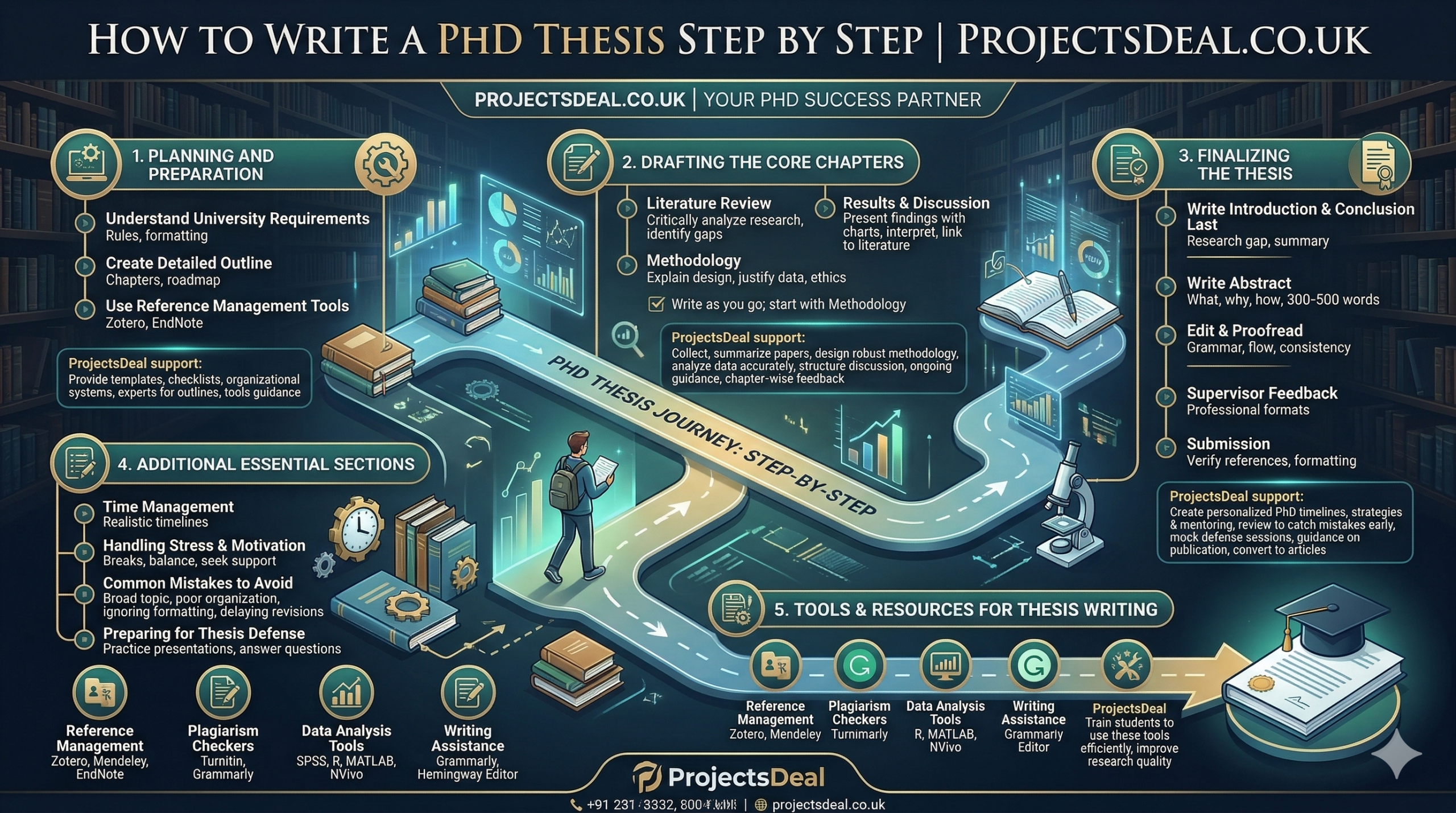
Writing a PhD thesis is a multi-stage, demanding process that requires planning, rigorous research, and consistent writing. The final drafting phase can take 6 to 12 months, depending on your research complexity. A well-structured thesis usually includes Introduction, Literature Review, Methodology, Results, Discussion, and Conclusion.
At ProjectsDeal.co.uk, we guide students through every stage, ensuring clarity, academic rigor, and timely submission.
Phase 1: Planning and Preparation
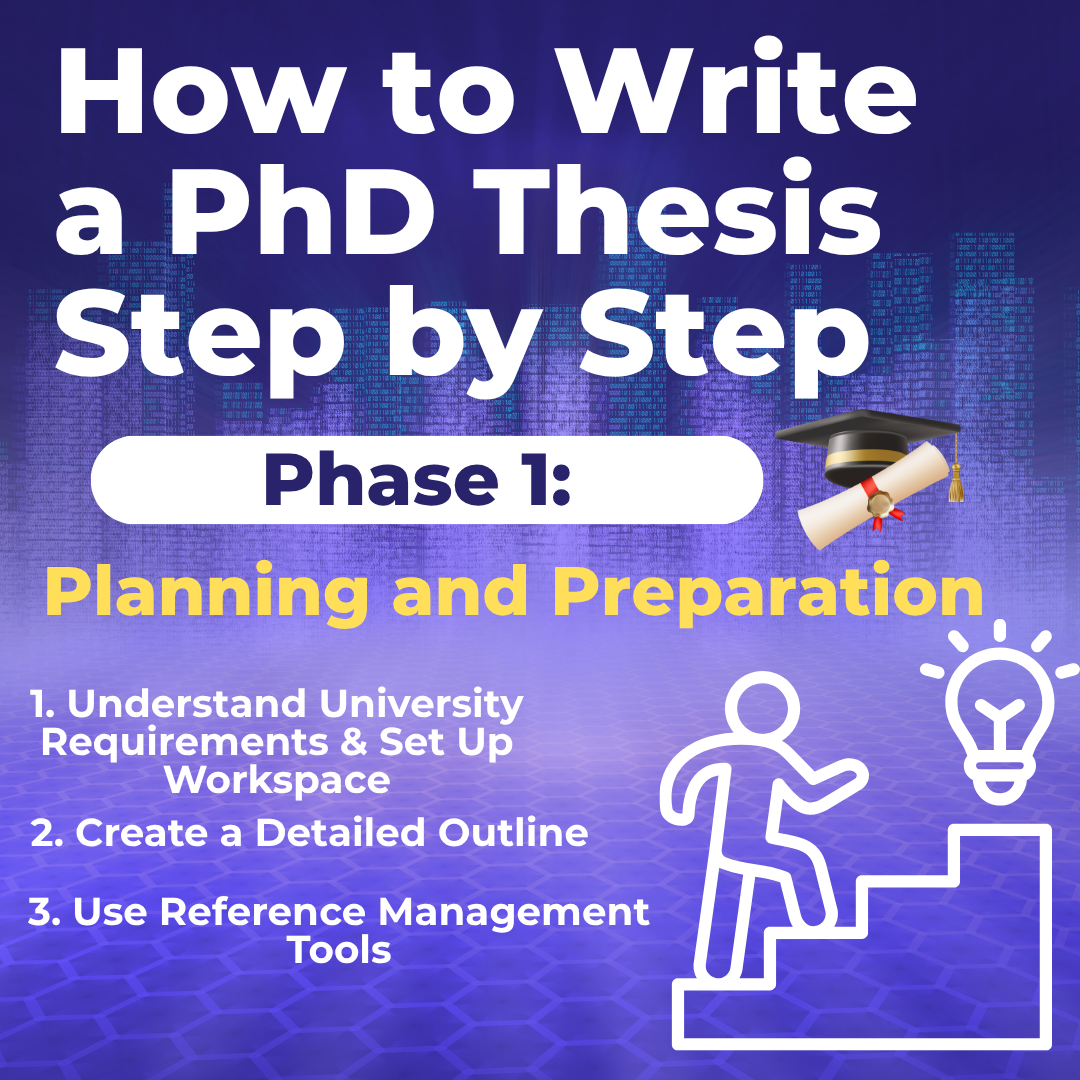
1. Understand University Requirements & Set Up Workspace
Check your university’s rules for:
- Word count (60,000–80,000 words)
- Formatting and citation style
- Submission deadlines
ProjectsDeal.co.uk helps: We provide templates, checklists, and digital organization systems so your workspace and files are optimized for smooth thesis writing.
2. Create a Detailed Outline
Break your thesis into chapters, sections, and sub-sections (3–4 levels). This roadmap makes the project manageable.
ProjectsDeal.co.uk helps: Our experts assist in creating structured outlines with chapter flow, subheadings, and logical content mapping.
3. Use Reference Management Tools
Use Zotero, Mendeley, or EndNote to track sources from the start.
ProjectsDeal.co.uk helps: We guide students on setting up reference libraries, ensuring accurate citation formatting and saving hours during the final stages.
Phase 2: Drafting the Core Chapters
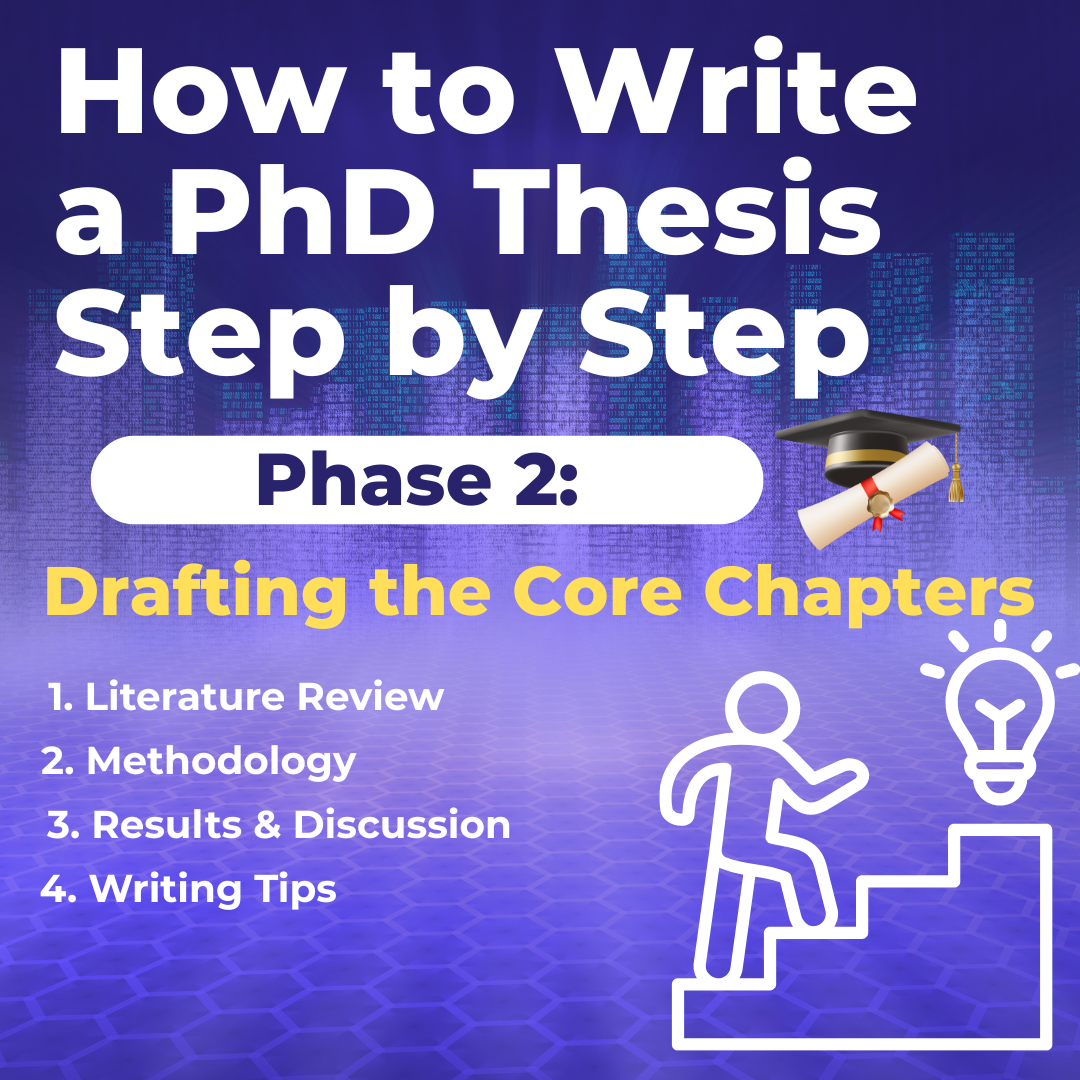
1. Literature Review
- Critically analyze existing research
- Identify research gaps
- Build a strong foundation for your research question
ProjectsDeal.co.uk helps: We assist in collecting, summarizing, and critically analyzing research papers to make your literature review comprehensive.
2. Methodology
- Explain research design and methods
- Justify data collection and analysis techniques
- Ensure ethical compliance
ProjectsDeal.co.uk helps: We help design a robust methodology and guide you in presenting it clearly and academically.
3. Results & Discussion
- Present findings with charts, tables, and graphs
- Interpret results and link them to literature
ProjectsDeal.co.uk helps: We assist in analyzing data accurately and structuring discussions that highlight your research impact.
4. Writing Tips
- Write as you go; don’t wait until the end
- Start with easier chapters like Methodology if blocked
ProjectsDeal.co.uk helps: We provide ongoing writing guidance and chapter-wise feedback to maintain steady progress.
Phase 3: Finalizing the Thesis
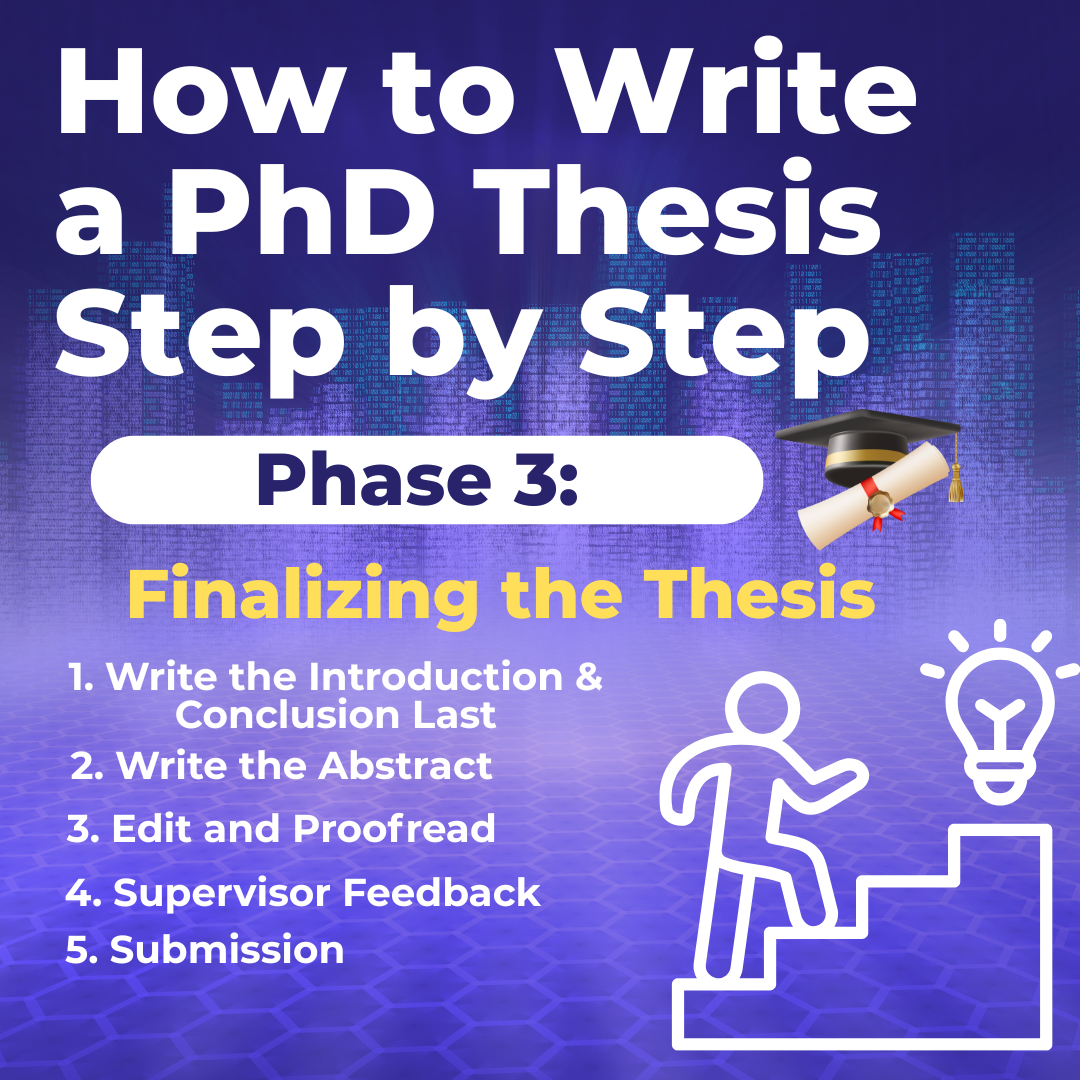
1. Write the Introduction & Conclusion Last
Introduction: Present the research gap, objectives, and thesis structure.
Conclusion: Summarize key findings, significance, and recommendations.
ProjectsDeal.co.uk helps: We craft compelling introductions and conclusions that align perfectly with your research and emphasize its contribution.
2. Write the Abstract
- A concise 300–500 word summary
- Include “what, why, how, and key findings”
ProjectsDeal.co.uk helps: We create high-impact abstracts that capture your thesis essence effectively.
3. Edit and Proofread
- Check logical flow, grammar, and consistency
- Read aloud to catch errors
ProjectsDeal.co.uk helps: Our professional editors meticulously review your thesis for language, structure, and formatting.
4. Supervisor Feedback
ProjectsDeal.co.uk helps: We format drafts professionally so supervisors can review them efficiently, reducing revisions.
5. Submission
- Verify references, figures, and formatting
- Submit in PDF or hard copy
ProjectsDeal.co.uk helps: We provide submission-ready formatting and final checks to meet university standards.
Phase 4: Additional Essential Sections
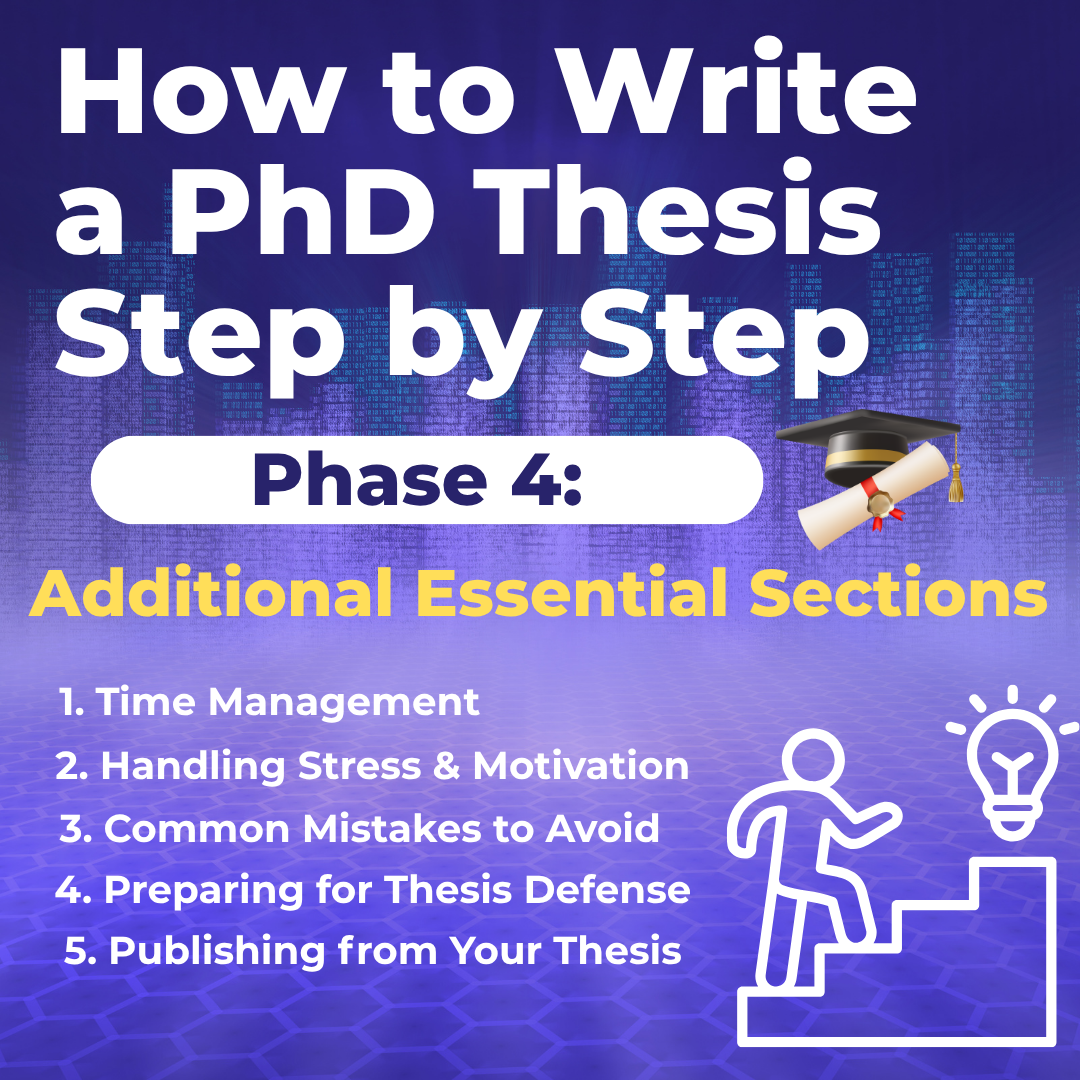
1. Time Management
- Create realistic timelines for chapters
- Allocate time for research, writing, and revisions
ProjectsDeal.co.uk helps: We help create personalized PhD timelines to meet milestones and deadlines.
2. Handling Stress & Motivation
- Take breaks to avoid burnout
- Maintain a balanced routine
- Seek support when needed
ProjectsDeal.co.uk helps: We provide strategies and mentoring to manage stress and maintain focus throughout your PhD.
3. Common Mistakes to Avoid
- Choosing an overly broad or narrow topic
- Poor organization or missing chapters
- Ignoring formatting rules
- Delaying revisions
ProjectsDeal.co.uk helps: Our experts review your work at every stage to catch and correct mistakes early.
4. Preparing for Thesis Defense
- Summarize key findings concisely
- Anticipate questions from examiners
- Practice presentations
ProjectsDeal.co.uk helps: We provide mock defense sessions, guidance on presentation slides, and tips to answer questions confidently.
5. Publishing from Your Thesis
- Identify publishable chapters or papers
- Follow journal guidelines for submission
- Ensure ethical citations
ProjectsDeal.co.uk helps: We assist in converting your thesis into journal articles or conference papers to maximize academic impact.
Phase 5: Tools & Resources for Thesis Writing
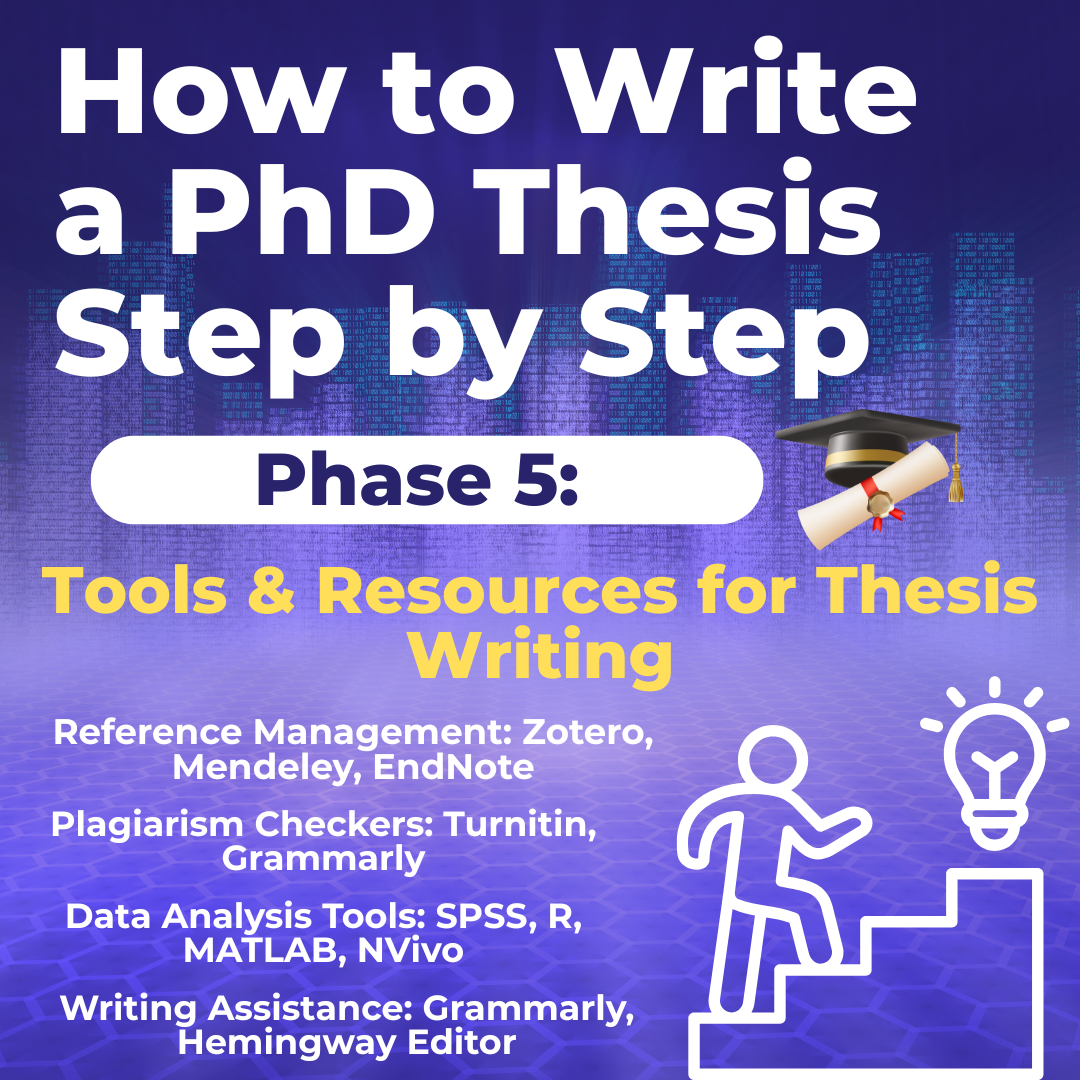
- Reference Management: Zotero, Mendeley, EndNote
- Plagiarism Checkers: Turnitin, Grammarly
- Data Analysis Tools: SPSS, R, MATLAB, NVivo
- Writing Assistance: Grammarly, Hemingway Editor
ProjectsDeal.co.uk helps: We train students to use these tools efficiently, improving research quality and saving time.
PhD Thesis vs Dissertation
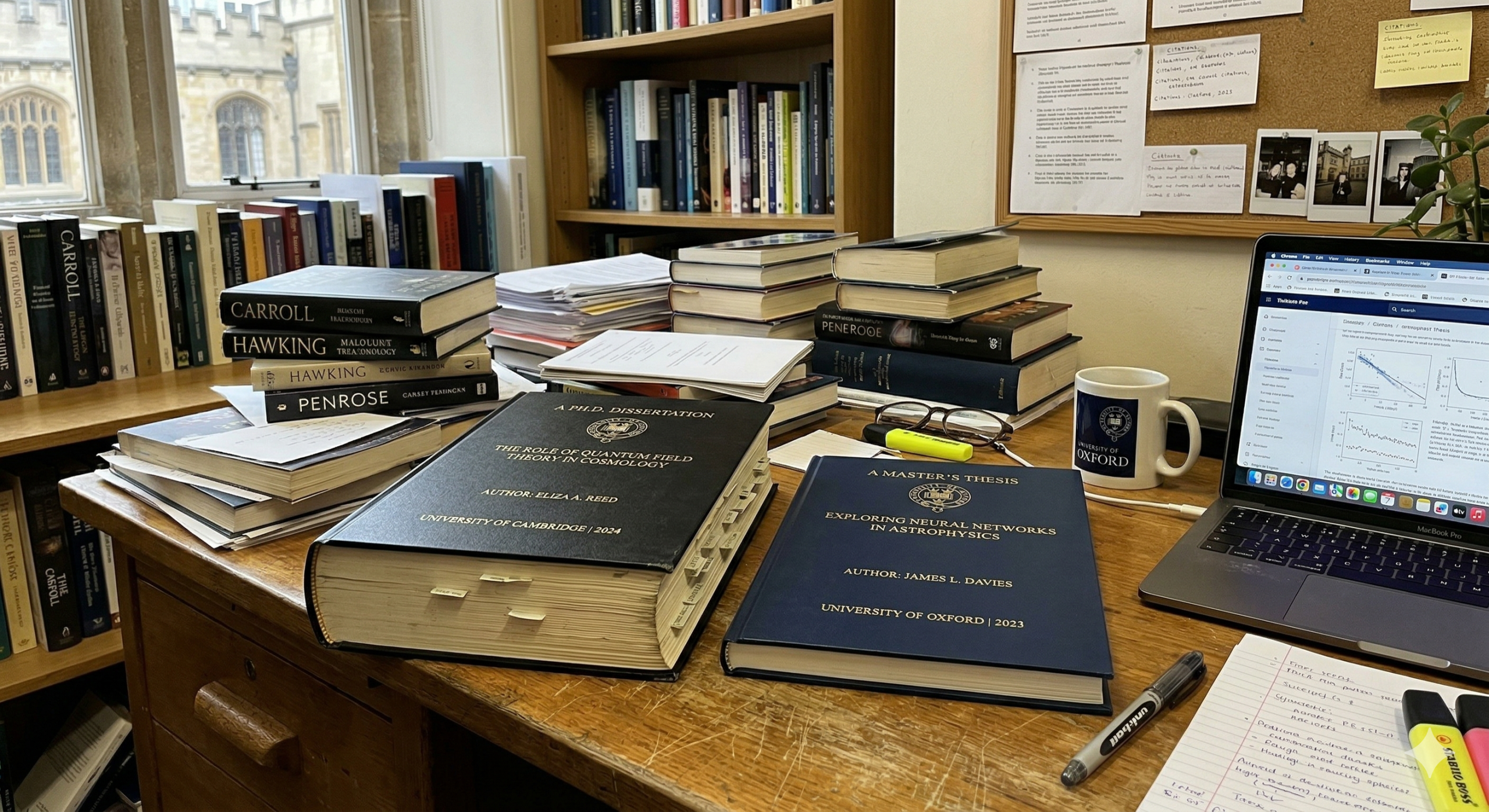
Many people use the terms ‘thesis’ and ‘dissertation’ interchangeably, but there is a subtle difference between them:
- Thesis: This represents your argument or the conclusions you’ve drawn through your research. It combines insights from existing scholarship (usually explored in your literature review) with the results of your original research. Your thesis is the idea or claim that you are trying to prove.
- Dissertation: This is the written document in which you present and justify your thesis. It lays out your methodology, findings, analysis, and discussion in a structured way that demonstrates your conclusions clearly.
In simple terms: you submit a dissertation, but it is your thesis that forms the core argument of your PhD.
This distinction also explains why most PhD writing happens after your thesis has been formulated—it’s difficult to write a dissertation before you know exactly what your research has concluded!
It’s worth noting that many universities and academics use the terms thesis and dissertation interchangeably, and both are commonly accepted when describing PhD research. Here at ProjectsDeal.co.uk, we use both terms to help students understand the relationship between their argument and their written work.
ProjectsDeal.co.uk helps: We guide students in clarifying their thesis, structuring their dissertation, and ensuring that the written document effectively proves their argument, making the entire PhD writing process clearer and more manageable.
🚀 Need Expert Help with Your PhD Dissertation?
Struggling to structure your dissertation or clearly present your thesis argument? Get professional support tailored to your academic needs.
Get PhD Dissertation Help NowPhD Thesis Structure
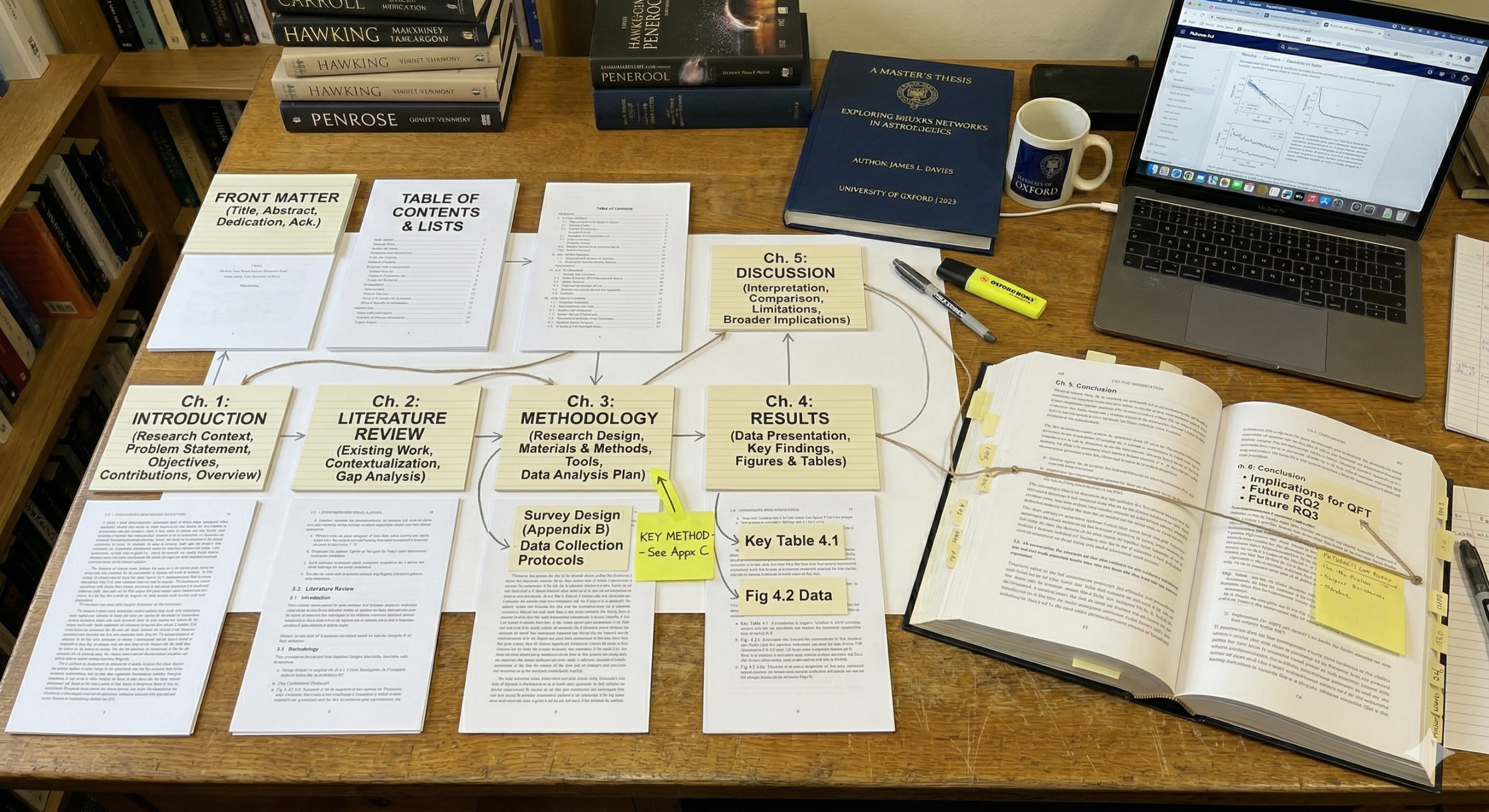
Once you’ve completed your initial literature review and conducted your original research, the next step is to organize your findings into a coherent thesis. While the exact structure can vary depending on your discipline, most PhD theses follow a broadly similar format:
1. Introduction
The introduction sets the stage for your research. It should:
- Present the key objectives of your project
- Explain why your research is significant
- Highlight the original contribution your work makes to your field
- Provide an overview of the thesis structure, summarizing the chapters and giving a “preview” of your argument
ProjectsDeal.co.uk helps: We guide students in crafting clear, compelling introductions that highlight the importance and originality of their research.
2. Literature Review
The literature review builds on your introduction and situates your research in the broader scholarly context. Key points:
- Summarize and critically analyze relevant research
- Show how previous studies have shaped your project
- Emphasize the unique aspects of your work and identify gaps in existing research
ProjectsDeal.co.uk helps: We assist in structuring, writing, and updating your literature review so it accurately reflects the current state of research while supporting your thesis argument.
3. Core Chapters
The bulk of your thesis is composed of the main chapters, where you present your findings and develop your argument. Depending on your field and research:
- Some theses include a dedicated Methodology chapter, explaining your approach and data collection process
- STEM theses may include experimental results or data analysis chapters
- Arts, Humanities, and Social Sciences theses may develop an argument across multiple chapters, combining discussion and evidence progressively
ProjectsDeal.co.uk helps: We provide support for chapter organization, writing clarity, and presenting complex data or arguments in a logical, reader-friendly way.
4. Conclusion
The conclusion wraps up your thesis, tying together your arguments and findings. Key elements:
- Restate the significance of your research
- Highlight the original contribution to knowledge
- Suggest opportunities for future research or practical applications
ProjectsDeal.co.uk helps: We assist in drafting strong, coherent conclusions that reinforce your thesis’s contribution and leave a lasting impact on readers.
5. Bibliography and Appendices
At the end of your thesis:
- Include a complete list of references (books, articles, datasets, etc.)
- Provide additional information, such as raw data, questionnaires, or supplementary materials, in the appendices
ProjectsDeal.co.uk helps: We guide students in correctly formatting references, creating bibliographies, and organizing appendices according to university guidelines.
📚 Need Help with Your Literature Review?
Building a strong literature review is essential for a successful PhD thesis. Get expert assistance in researching, structuring, and writing your review.
Get Literature Review Writing HelpHow Long is a PhD Thesis?
- PhD theses are significantly longer than undergraduate or Master’s dissertations.
- Word count limits are usually set by your university, typically 70,000–100,000 words, with most averaging around 80,000 words.
- STEM theses tend to be slightly shorter than those in Arts, Humanities, and Social Sciences.
- Check with your supervisor whether references, bibliography, and appendices are included in your word count, as policies vary between universities and departments.
ProjectsDeal.co.uk helps: We provide guidance on planning your word count, structuring chapters efficiently, and ensuring your thesis meets university requirements.
Writing Up Your PhD Thesis | ProjectsDeal.co.uk
After conducting your research and finalizing your thesis, the next step is to write up your dissertation. This final stage, often called the ‘writing-up period’, involves producing the complete document that will be submitted for your viva voce examination.
The writing-up process can vary depending on your discipline and how you approached your PhD.
Drafting and Assembling Chapters
In some fields, particularly Arts and Humanities, students may already have drafted multiple chapters or written sections of their research along the way. During the writing-up period, your task is to:
- Re-draft existing material for clarity and consistency
- Assemble chapter drafts into a coherent, flowing dissertation
- Ensure that your argument is structured logically and persuasively
Writing as you go allows you to focus on refining and integrating your ideas rather than starting from scratch.
ProjectsDeal.co.uk helps: We support students in editing and assembling draft chapters into a cohesive final dissertation, ensuring that arguments are clear, structured, and academically rigorous.
Writing From Data Collection
Alternatively, in STEM and some Social Science disciplines, students may have spent most of their PhD collecting and analyzing data. In this case, the writing-up period involves:
- Summarizing your findings clearly and accurately
- Explaining your methodology and experimental procedures
- Interpreting your results and relating them to your thesis
- Drafting your discussion and conclusion chapters
Here, the focus is on presenting your research in a persuasive and coherent way, often for the first time in written form.
ProjectsDeal.co.uk helps: We guide students in transforming raw data into polished chapters, creating charts, graphs, and tables, and writing clear analysis and discussion sections that strengthen your thesis argument.
Producing a Cohesive Argument
Regardless of your discipline, the aim of the writing-up period is to produce a final dissertation that presents your argument persuasively. This means:
- Maintaining logical flow between chapters
- Clearly linking findings back to your research questions and literature review
- Ensuring consistency in style, terminology, and formatting
ProjectsDeal.co.uk helps: Our experts review your full dissertation, checking for clarity, coherence, and academic rigor, and provide feedback to make your final submission exam-ready.
Tips for a Successful Writing-Up Period
- Set realistic goals: Break the dissertation into sections and set deadlines for each
- Maintain regular backups: Protect your work from data loss
- Seek feedback early: Share drafts with your supervisor or mentors for guidance
- Focus on clarity: Your final dissertation should communicate your argument clearly to examiners
ProjectsDeal.co.uk helps: We offer structured writing support, editing, and proofreading services to help you meet deadlines, reduce stress, and submit a professional, high-quality thesis.
PhD Thesis Feedback | ProjectsDeal.co.uk
Feedback is an essential part of the PhD process. Your supervisor will usually provide comments on:
- Each chapter draft as you write it
- The overall completed dissertation before submission
When your thesis is still a work-in-progress, feedback is an opportunity for your supervisor to:
- Ensure your research is heading in the right direction
- Offer advice on any concerns you may have regarding your methodology, analysis, or argument
- Help you refine your approach before finalizing your dissertation
Feedback sessions are usually conducted during supervisory meetings, where you can discuss your progress, ask questions, and clarify expectations.
What Supervisors Expect
While supervisors provide guidance and support, it’s important to remember that:
- They are not responsible for editing your work, so grammar, spelling, and formatting should already be correct
- They will not rewrite or condense your thesis to meet a word count
- Drafts should be as polished as possible before submission for feedback
ProjectsDeal.co.uk helps: We provide professional editing and proofreading services, ensuring your drafts are error-free, clearly written, and structured according to academic standards before you submit them to your supervisor.
Making the Most of Feedback
To get the most value from supervisory feedback:
- Prepare specific questions or concerns before meetings
- Take detailed notes during discussions
- Act on the feedback systematically, revising drafts carefully
- Keep track of suggested changes for future reference
ProjectsDeal.co.uk helps: We guide students on how to integrate supervisor feedback efficiently, prioritize revisions, and maintain a consistent writing style across all chapters.
Finishing Your PhD Thesis | ProjectsDeal.co.uk
Once you’ve completed the final draft of your doctoral thesis and it has been approved by your supervisor, the next step is to submit it for examination. At this stage, your thesis will be sent to the examiners who will assess it and conduct your viva voce (oral defense).
Submitting Your Thesis
Submitting your thesis involves several practical steps:
- Prepare enough copies for your examiners and for the university repository
- Allow sufficient time for printing and binding, especially for long documents (often 300+ pages)
- Double-check all formatting, pagination, and references before submission
ProjectsDeal.co.uk helps: We provide guidance on final formatting, proofreading, and preparing submission-ready documents, so your thesis meets university requirements and avoids last-minute issues.
The Viva Voce
Your viva usually takes place within three months of submitting your thesis. During the viva, examiners will discuss your research, ask questions, and assess your understanding of your work.
After the viva, you will receive a report from your examiners outlining potential outcomes:
- Pass: Congratulations! You have successfully completed your PhD.
- Minor Corrections: Small edits or improvements, usually with a three-month deadline.
- Major Corrections: Significant revisions or additional research may be required, typically with a six-month deadline.
Most students are asked to make minor corrections—it’s rare for a PhD to be outright failed.
ProjectsDeal.co.uk helps: We assist in reviewing examiner feedback, implementing corrections efficiently, and ensuring your final thesis meets all academic requirements.
Final Submission
After completing any required corrections, you will submit your thesis one last time, often electronically. At this stage:
- Make sure all changes have been applied
- Verify that formatting, references, and appendices are complete
- Consider whether you want to request an embargo if you plan to publish parts of your work
An embargo prevents your thesis from being publicly available for a certain period—12 months is typical, but longer may be requested if you plan to turn your thesis into a book or monograph.
ProjectsDeal.co.uk helps: We guide students in preparing the final submission, understanding embargo policies, and ensuring the thesis is ready for publication or academic repositories.
Finishing your PhD thesis is a momentous achievement. With careful planning, attention to detail, and professional support, you can confidently complete this final stage and move on to graduation and publication.
Get Thesis Conclusion Writing HelpHow ProjectsDeal.co.uk Supports Your PhD Thesis
| Thesis Stage | What You Do | How ProjectsDeal.co.uk Helps |
|---|---|---|
| Planning & Preparation | Understand university requirements, set up workspaces, and create a detailed outline. | Provides templates, planning guides, and structured outlines to organize your research efficiently. |
| Literature Review | Collect and analyze sources, identify gaps, and critically assess previous research. | Assists in sourcing materials, summarizing and analyzing studies, and writing a well-structured review. |
| Research Design & Methodology | Choose methods, collect data, and ensure ethical compliance. | Guides students in methodology selection, experimental design, surveys, and ethical approvals. |
| Drafting Core Chapters | Write introduction, methodology, results, discussion, and conclusions. | Offers chapter-wise guidance, editing, and tips for presenting arguments and data clearly. |
| Writing Up | Assemble drafts, integrate data, and produce a coherent dissertation. | Supports drafting, reorganization, and editing to ensure clarity, cohesion, and academic rigor. |
| Feedback Integration | Revise work based on supervisor comments. | Helps implement feedback, improve writing quality, and maintain consistency across chapters. |
| Finalizing & Submission | Prepare final dissertation, format correctly, and submit. | Provides proofreading, formatting, submission guidance, and ensures compliance with university requirements. |
| Viva Preparation & Corrections | Defend your thesis and make any required corrections. | Offers mock viva sessions, advice on answering examiner questions, and guidance for implementing minor or major corrections. |
| Publication & Embargo | Decide on publishing chapters or the full thesis and set embargo if needed. | Guides in publication planning, formatting for journals, and requesting embargoes to protect your work. |
PhD Thesis Word Count Guidelines by University | ProjectsDeal.co.uk
| University | Typical PhD Word Count | Notes / Guidelines |
|---|---|---|
| University of Oxford | 80,000 – 100,000 | Word count includes main chapters; references, appendices, and footnotes are usually excluded. |
| University of Cambridge | 75,000 – 100,000 | Humanities theses often reach upper limit; STEM theses tend to be shorter. |
| University College London (UCL) | 70,000 – 90,000 | Exact limits depend on department; check specific faculty guidelines. |
| University of Edinburgh | 70,000 – 90,000 | Appendices may be excluded; word count must include footnotes if required. |
| University of Manchester | 70,000 – 100,000 | Departments provide detailed guidance on chapter structure and referencing. |
| King’s College London | 70,000 – 90,000 | Word count includes main body only; figures and tables are generally excluded. |
| University of Birmingham | 80,000 – 100,000 | Students advised to consult supervisors for discipline-specific expectations. |
| University of Warwick | 70,000 – 90,000 | Word limits vary by faculty; appendices typically excluded. |
ProjectsDeal.co.uk helps: We assist students in planning their thesis to meet university word count requirements, organizing chapters efficiently, and ensuring all content complies with academic regulations.
PhD Thesis FAQs
1. What is the difference between a PhD thesis and a dissertation?
A thesis represents your argument or original contribution to knowledge, while a dissertation is the written document in which you present and justify your thesis. You submit the dissertation, but it is your thesis that forms the core argument.
2. How long should a PhD thesis be?
Most UK universities set a word count between 70,000 and 100,000 words, depending on the discipline. STEM theses are often shorter, while Arts and Humanities theses may reach the upper limit.
3. What is the typical structure of a PhD thesis?
A standard structure includes:
- Introduction
- Literature Review
- Methodology
- Results / Findings
- Discussion
- Conclusion
- Bibliography & Appendices
4. How should I plan my literature review?
Focus on analyzing and evaluating existing research, identifying gaps, and highlighting how your work contributes to the field. Avoid simply summarizing studies; aim for a critical synthesis.
5. When should I start writing my PhD thesis?
It’s best to write as you go, starting with sections like methodology and literature review, then draft the main chapters during the dedicated writing-up period, often in the third year.
6. How do I manage supervisor feedback?
Supervisors provide guidance on content, structure, and argumentation, but not grammar or formatting. Submit polished drafts, take detailed notes on feedback, and revise systematically.
7. What challenges should I expect while writing a PhD thesis?
Common challenges include time management, writer’s block, data analysis, maintaining motivation, integrating feedback, and adhering to formatting requirements.
8. How do I prepare for the viva voce?
Review your thesis thoroughly, anticipate examiner questions, and practice summarizing your arguments clearly. Consider mock viva sessions to build confidence.
9. Can I publish my PhD thesis?
Yes. Many students publish parts of their thesis in journals or books. If needed, request an embargo to delay public access, typically for 12 months, to protect your work before publication.
10. How can ProjectsDeal.co.uk help with my PhD thesis?
ProjectsDeal.co.uk supports every stage of your PhD, including planning, literature review, methodology, data analysis, chapter writing, editing, formatting, supervisor feedback integration, viva preparation, and final submission.
Final Conclusion
Completing a PhD thesis is one of the most challenging and rewarding academic achievements a student can accomplish. From planning your research and conducting a literature review, to collecting and analyzing data, writing up your findings, and finally defending your work in a viva, the process requires careful planning, perseverance, and attention to detail.
Along the way, students often face challenges such as writer’s block, time management, integrating feedback, and meeting university requirements. By understanding each stage of the process and anticipating potential obstacles, you can navigate your PhD journey more effectively and confidently.
ProjectsDeal.co.uk is here to support you at every stage:
- Guiding you through research planning and methodology
- Assisting with literature review, data analysis, and chapter writing
- Providing professional editing, formatting, and supervisor feedback integration
- Helping you prepare for viva voce and final submission
- Offering advice for publishing and managing embargoes
With expert guidance and a structured approach, completing your PhD thesis becomes not just manageable, but an opportunity to produce high-quality, original research that contributes meaningfully to your field.
Remember, a successful PhD is built on organization, persistence, and professional support. By leveraging the tools, advice, and services available at ProjectsDeal.co.uk, you can navigate every stage of your doctoral journey with confidence and clarity—ultimately achieving the academic success you’ve worked so hard for.
Ready to Take the Next Step in Your PhD Journey?
Don’t let the challenges of writing a PhD thesis slow you down. Whether you’re struggling with planning, research, writing, formatting, or viva preparation, ProjectsDeal.co.uk is here to guide you every step of the way.
✅ Professional Support for Every Stage – From literature reviews to final submission
✅ Expert Editing & Formatting – Ensure your thesis meets university standards
✅ Viva Preparation & Corrections – Confidently defend your research
✅ Personalized Guidance – Tailored advice to fit your discipline and goals
Take control of your PhD journey today and achieve the academic success you deserve.
Get Expert PhD Thesis Support Now
📞 Or contact us directly at +44-7447-882377 to discuss your requirements.
🚀 Get started today:
👉 https://projectsdeal.co.uk
🏆 Recently recognized as a top academic support provider — read more here:
👉 https://finance.yahoo.com/news/projectsdeal-co-uk-voted-best-090900913.html