Learning how to obtain phd (2026) is an essential skill for UK university students. 
📚 What You’ll Learn in This Guide
Pursuing a PhD is one of the most prestigious academic achievements—but it’s also one of the most challenging. Whether you’re a Master’s graduate looking to dive into original research or a professional aiming to enter academia, understanding the path to a PhD is essential.
In this expert guide from Projectsdeal.co.uk, we walk you through every step of the PhD journey in the UK—from application to viva—with real-world tips, solutions to common problems, and proven strategies to help you succeed.
How to obtain phd (2026): Step-by-Step Guide
🔍 What Is a PhD and Why Should You Consider It?
A PhD (Doctor of Philosophy) is the highest level of academic qualification. It demonstrates your ability to conduct independent, original research and make a meaningful contribution to your field. In the UK, a PhD usually takes 3–4 years full-time or 6–7 years part-time.
Obtaining a PhD in the UK is a significant academic achievement, and UK Government Education regularly profiles the doctoral journey and its challenges. UCAS University Admissions covers funding opportunities and research career prospects for PhD graduates. Global research trends from Prospects UK Careers and postgraduate planning advice from HESA Higher Education Data provide essential context for anyone considering a doctorate.
💬 “A PhD is not just a degree—it’s a journey into mastery.”
✅ Eligibility Criteria for PhD Programs in the UK
To apply for a PhD in the UK, you generally need:
🎓 1. Strong Academic Background
- A First Class or Upper Second-Class Honours (2:1) degree in a related field.
- A Master’s degree (optional but highly preferred in research-heavy fields).
🧠 2. Research Proposal
- Your proposal must show clear objectives, novelty, research methods, and how it contributes to the field.
📜 3. Letters of Recommendation
- 2–3 letters from academics who can validate your research potential.
📄 4. Personal Statement / Statement of Purpose
- Why you’re pursuing a PhD
- Your research interests
- How the programme fits your academic goals
🌍 5. English Language Proficiency
- For international students: IELTS 6.5–7.5 (or equivalent).
💰 6. Funding Plan
- Either self-funded or via:
- UKRI / Research Council studentships
- University-funded scholarships
- Commonwealth, Chevening or Gates Cambridge Scholarships
🏁 Step-by-Step Guide to Getting a PhD in the UK
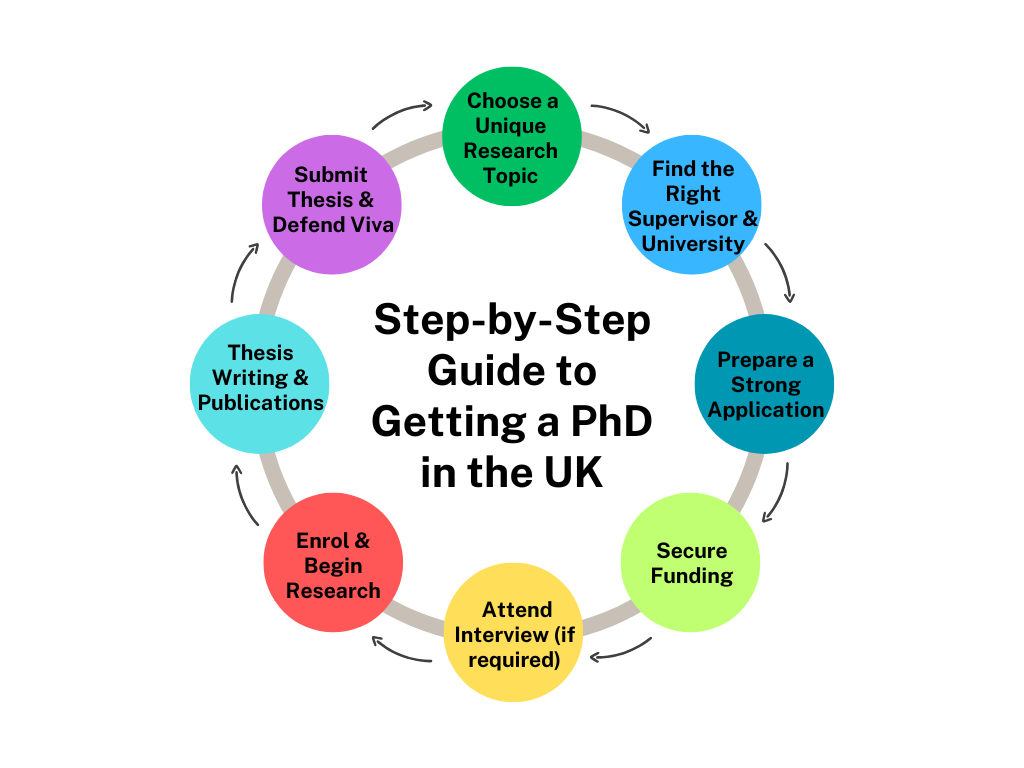
✅ Step 1: Choose a Unique Research Topic
Your research topic should be novel, feasible, and aligned with existing gaps in your field.
Tip: Browse recent journal articles or partner with Projectsdeal.co.uk to develop a winning proposal.
✅ Step 2: Find the Right Supervisor & University
Use university websites, academic networks, or let Projectsdeal match you with experts in your field.
Top UK PhD Universities:
- University of Oxford
- University of Cambridge
- UCL
- University of Edinburgh
- Imperial College London
✅ Step 3: Prepare a Strong Application
Include:
- Tailored proposal
- Academic CV
- Personal statement
- References
✅ Step 4: Secure Funding
Apply for:
- UKRI grants
- University scholarships
- Industry partnerships
Or ask Projectsdeal’s advisors to guide you through scholarship applications.
✅ Step 5: Attend Interview (if required)
Many UK PhD programmes include an online interview to discuss your proposal and fit.
✅ Step 6: Enrol & Begin Research
You’ll start with:
- Literature review
- Proposal refinement
- Ethics approval (if required)
✅ Step 7: Thesis Writing & Publications
Over the next 2–4 years, you’ll:
- Conduct primary research
- Analyse data
- Write and publish papers
- Draft your 80,000-100,000 word thesis
✅ Step 8: Submit Thesis & Defend Viva
Final step: submit and defend your thesis in a viva voce (oral exam) with 1–2 examiners.
🚨 Common Problems Faced by UK PhD Students (and Solutions)
| ❌ Problem | ✅ Solution |
|---|---|
| Vague research direction | Set SMART goals & review progress monthly with your supervisor |
| Lack of academic writing skills | Use Projectsdeal’s expert PhD writing service |
| Time mismanagement | Use Trello or Notion to set milestones |
| Funding issues | Apply early to multiple sources; consider part-time teaching |
| Stress & isolation | Join PhD networks and university support groups |
| Supervisor issues | Contact your doctoral college for mediation or support |
🏛️ Top Universities in the UK Offering PhD Programs
| University | Known for |
|---|---|
| University of Oxford | Interdisciplinary research and strong supervisor support |
| University of Cambridge | World-class faculty and international collaborations |
| Imperial College London | Engineering, Science, and Business PhDs |
| UCL (University College London) | Biomedical and Social Sciences |
| University of Edinburgh | Excellent research funding and facilities |
📊 PhD in the UK: Key Statistics & Emerging Trends (2026–2027)
🎓 How Many Students Actually Complete Their PhD in the UK?
According to recent HESA (Higher Education Statistics Agency) data:
- 💡 Around 22,000 students are awarded doctoral degrees in the UK every year.
- The PhD completion rate within 7 years is approximately 72–76%.
- The most common reasons for dropouts include lack of funding, supervisor issues, and personal burnout—most of which can be managed with proper guidance and support.
🔍 Tip: Partnering with academic support services like Projectsdeal.co.uk significantly improves thesis completion and submission quality.
🔬 Most Popular PhD Fields in the UK
According to data from UKRI and UCAS postgraduate trends:
| 📚 Subject Area | 🎓 Percentage of PhD Students |
|---|---|
| Biological Sciences | 18% |
| Engineering & Technology | 16% |
| Medicine & Allied Subjects | 14% |
| Social Sciences | 12% |
| Computer Science | 10% |
| Business & Management | 8% |
| Education | 7% |
| Law & Legal Studies | 5% |
| Arts & Humanities | 5% |
| Others | 5% |
📈 STEM subjects dominate UK PhDs, but there’s rising demand in AI, Data Science, Business Analytics, and Sustainability Studies.
Deadline Approaching? We Can Help.
Express delivery available â get your dissertation or essay completed on time. Prices from £499.
â Urgent orders accepted â Quality never compromised â 24/7 support
Get Started Now â
Want one-to-one support with your dissertation? Explore our dissertation writing service — trusted by UK students since 2001.
🔮 PhD Trends in the UK for 2026–2027
As we look to 2026 and beyond, these are the top PhD trends to watch:
🧠 1. Artificial Intelligence and Machine Learning
UK universities are expanding research in applied AI across healthcare, finance, and robotics.
🌍 2. Climate Change and Sustainability
Environmental science, renewable energy, and green technology PhDs are seeing major funding boosts.
💼 3. Business Analytics & FinTech
There’s growing demand for research in financial technology, blockchain, and behavioural economics.
🧬 4. Biotechnology and Genomics
Post-COVID medical innovation and genetic research are top choices, especially in Oxford and Imperial.
🧘 5. Mental Health and Wellbeing in Education
Psychology, pedagogy, and EdTech are seeing growing research interest—especially after the pandemic.
🎯 Projectsdeal.co.uk stays up-to-date with emerging topics and can help you select a trend-aligned, fundable research topic.
💷 PhD Cost Breakdown in the UK (2026 Estimates)
| 📌 Expense Type | 💰 Estimated Range (Per Year) |
|---|---|
| Tuition (Home Students) | £4,500 – £6,000 |
| Tuition (International Students) | £14,000 – £25,000+ |
| Living Costs (London) | £12,000 – £16,000 |
| Living Costs (Outside London) | £9,000 – £12,000 |
| Thesis Printing & Submission | £100 – £300 |
🧾 Funding Tips:
- Apply to at least 3–5 scholarships or studentships
- Look into Graduate Teaching Assistant roles
- Consider part-time work or research consultancy
- Use Projectsdeal.co.uk to write grant proposals and secure funding faster
🧠 Expert Tips from Projectsdeal.co.uk
- Start Writing Early – Don’t wait for the “perfect time”. Draft as you research.
- Use Reference Managers – Tools like Zotero or Mendeley save hours.
- Keep a Research Journal – Log ideas, decisions, and feedback weekly.
- Publish During Your PhD – Aim for 1–2 papers to boost your academic profile.
- Never Hesitate to Ask for Help – Whether it’s methodology, formatting, or writing—get expert support.
💡 Need a reliable PhD writing partner? Projectsdeal.co.uk has helped over 10,000 UK students submit flawless PhD theses.
💼 Who Can Help You Succeed? Projectsdeal.co.uk Can!
Projectsdeal is the UK’s most trusted academic writing service, offering:
- ✅ PhD Proposal Writing
- ✅ Literature Review Support
- ✅ Data Analysis (SPSS, NVivo, etc.)
- ✅ Full PhD Thesis Writing
- ✅ Proofreading & Formatting
🎯 100% Confidential | 100% Plagiarism-Free | Trusted by 115,000+ UK Students
🎓 Popular UK PhD Scholarships (With Links)
- UKRI Studentships
- Gates Cambridge Scholarship
- Commonwealth Scholarships
- University of Oxford Scholarships
- UCL Research Excellence Scholarships
❓ Frequently Asked Questions
✅ How long does it take to complete a PhD in the UK?
A full-time PhD typically takes 3–4 years in the UK, while part-time routes may extend to 6–7 years. The exact duration depends on your research field, supervisor, and funding structure.
✅ What are the qualifications needed for a PhD in the UK?
You usually need a First or Upper Second-Class Honours undergraduate degree and, preferably, a Master’s in a related subject. Strong academic references and a compelling research proposal are also essential.
✅ How do I get into a PhD programme in the UK?
To get into a PhD programme, you’ll need to submit a research proposal, academic transcripts, references, and a personal statement. Some programmes may also require an interview and proof of English language proficiency.
✅ Can I do a PhD after my Master’s degree?
Absolutely. In fact, most PhD students in the UK enter after completing a Master’s, which helps develop critical research and academic writing skills.
✅ Is a PhD shorter if I already have a Master’s degree?
Having a Master’s degree won’t necessarily shorten the PhD, but it can make you more prepared and efficient, especially during the initial research stages.
✅ Is it possible to do a PhD while working?
Yes, many UK universities offer part-time PhD options that allow professionals to balance work and research. Good time management and institutional support are key.
✅ What is the cost of doing a PhD in the UK?
Tuition fees range from £4,500 to £20,000+ per year depending on the university and subject. Scholarships, studentships, and grants are widely available—Projectsdeal.co.uk can help you apply for them.
✅ Is doing a PhD worth it after a Master’s?
Yes, if you’re passionate about research, academia, or industry innovation. A PhD can lead to high-level roles in universities, think tanks, R&D departments, and more.
✅ Who is eligible to apply for a PhD in the UK?
UK and international students with strong academic backgrounds and a viable research proposal can apply. Some universities may admit outstanding students directly after their Bachelor’s.
✅ Can I apply for a PhD without a Master’s degree?
Yes, some universities accept exceptional undergraduate students directly into PhD programmes, particularly in STEM fields. A strong research proposal and academic record are crucial.
✅ What is required to obtain a PhD in the UK?
To earn a PhD, you must complete original research, write a thesis (usually 80,000–100,000 words), and successfully defend it in a viva voce examination.
✅ What is the easiest PhD to get in the UK?
No PhD is “easy”—each requires dedication and independent research. However, some students find practice-based or professionally-oriented PhDs more manageable due to their applied nature.
✅ How challenging is a PhD?
A PhD is intellectually demanding but deeply rewarding. With the right guidance, support, and time management strategies, students can succeed without becoming overwhelmed.
📌 Final Thoughts
Earning a PhD in the UK is a rewarding but demanding journey. Planning, persistence, and the right support are key. This guide should equip you with everything you need to take your first steps toward a successful PhD experience.
If you’re looking for expert help with your PhD application, proposal development, or thesis writing, don’t hesitate to reach out to Projectsdeal.co.uk—the UK’s most trusted academic writing service.
📲 Chat with us on WhatsApp: +44-7447-882377
📰 Read how we were voted the Best Academic Writing Service in the UK: Yahoo Finance Article
Need Help With Your Dissertation?
Our expert writers have helped thousands of students achieve top grades. Dissertations from £499 with free revisions.
â First-class quality guaranteed â On-time delivery â 100% plagiarism-free
Order Your Dissertation Now âReady to Get Started? Talk to an Expert Today
Thousands of UK students trust ProjectsDeal to deliver high-quality academic work on time. Get a free consultation and see how we can help you succeed.
No obligation. Free consultation. Trusted by students at Russell Group universities across the UK.
Need Expert Academic Help?
ProjectsDeal provides trusted dissertation, thesis, and essay writing support for UK university students. Get matched with a specialist in your subject area.