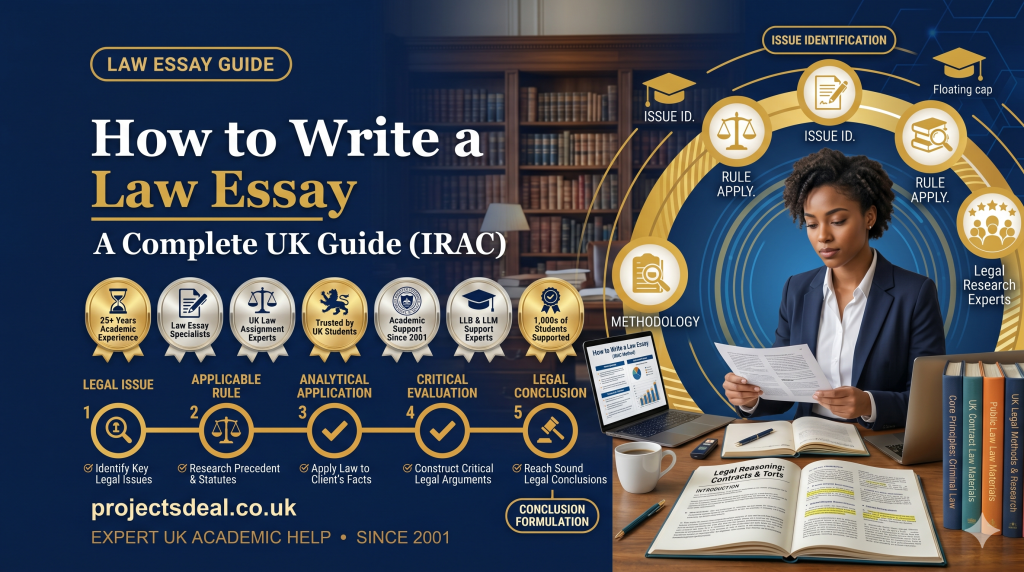
Learning how to write a law essay is an essential skill for UK university students. Law essays demand a particular kind of rigour: precise use of authority, clear legal reasoning, and the ability to apply the law to facts rather than just describing it. UK law students are marked on analysis and application, not memorised content. This complete guide explains the difference between essay and problem questions, the IRAC method, how to use cases and statutes as authority, and how to reference correctly in OSCOLA.
How to write a law essay: Step-by-Step Guide
Essay Questions vs Problem Questions
Law assessments come in two forms. Essay questions ask you to analyse or critique an area of law. Problem questions give a fictional scenario and ask you to advise on the legal position. Each needs a different approach, and confusing them is a common error.
For further guidance on how to write a law essay uk, visit the academic writing skills guidance — a trusted resource for UK students and graduates.
The IRAC Method
For problem questions, use IRAC:
✓ Issue — identify the legal question.
✓ Rule — state the relevant law (cases, statutes).
✓ Application — apply the law to the facts.
✓ Conclusion — state the likely legal outcome.
Application is where most marks are won or lost.
Using Authority Correctly
Every legal proposition must be supported by authority — a case, statute or regulation. Cite the specific case and explain the principle it establishes, then show how it applies. Vague references to “the law” without authority score poorly.
Structuring a Law Essay Question
For essay questions, use a clear introduction stating your argument, body paragraphs that analyse and critique the law with authority, engagement with academic commentary and counter-views, and a reasoned conclusion. Analysis and evaluation matter far more than description.
Referencing in OSCOLA
UK law typically uses OSCOLA (the Oxford Standard for Citation of Legal Authorities), which uses footnotes rather than in-text citations. Cite cases, legislation and secondary sources in the precise OSCOLA format and check your faculty's requirements.
Common Mistakes to Avoid
✓ Describing the law instead of applying it.
✓ Propositions with no authority.
✓ Treating a problem question like an essay.
✓ Ignoring counter-arguments and academic debate.
✓ Incorrect OSCOLA referencing.
Tips for a Higher Grade
Identify the right question type, use IRAC for problems, support every point with authority, apply the law to the facts in detail, engage with academic commentary, and reference precisely in OSCOLA.
Frequently Asked Questions
What is a law essay?
An academic piece that analyses or critiques an area of law, or applies the law to a scenario in a problem question.
What is IRAC?
A method for legal problem questions: Issue, Rule, Application, Conclusion.
What is the difference between an essay and a problem question?
An essay analyses an area of law; a problem question asks you to advise on a fictional scenario.
What is legal authority?
A case, statute or regulation that supports a legal proposition.
What is OSCOLA?
The Oxford Standard for Citation of Legal Authorities, the footnote-based referencing style used in UK law.
How do I cite a case?
Give the case name and citation, then explain the principle it establishes; format it in OSCOLA.
How do I apply the law to facts?
Take each legal rule and explain precisely how it operates on the specific facts given.
Should I include academic commentary?
Yes — engaging with scholarly debate strengthens an essay question answer.
How long is a law essay?
As the brief requires; depth of analysis and application matters more than length.
What is the most important skill in a law essay?
Applying the law to facts and arguments rather than merely describing it.
Related Study Guides
How to Write an Essay • How to Write a Critical Essay • How to Write a Case Study • How to Write an Argumentative Essay
UK students who master how to write a law essay uk gain a significant advantage in their academic career. Whether you are in your first year or final year, understanding how to write a law essay uk thoroughly will improve your overall academic performance and help you achieve better grades.
In summary, how to write a law essay uk is a fundamental aspect of UK higher education. By dedicating time to understanding and practising how to write a law essay uk, students can significantly improve their academic performance and develop skills that will serve them throughout their careers.
Want expert guidance on your next essay? Explore our essay writing service — trusted by UK students since 2001.
The Role of Cases and Statutes in Law Essays
Legal authority is the foundation of any credible law essay. UK law students are expected to demonstrate not only a theoretical understanding of legal principles but a practical command of the cases and statutes that give those principles their authoritative content. The ability to cite, apply, and critically analyse legal authority is one of the core competencies assessed throughout an LLB degree and postgraduate law programmes.
When using case law in a law essay, always cite the full case name and year on first mention: Donoghue v Stevenson [1932] AC 562. Subsequent references can use an abbreviated form (Donoghue or Donoghue v Stevenson). Explain what the case established and why it is relevant to the point you are making—do not simply cite cases without analysis. The strongest law essays engage with the reasoning of key judgments, identifying what ratio decidendi was established and what its implications are for the question under discussion.
Obiter dicta—remarks made by judges that were not necessary to the decision—do not have binding authority but can be influential, particularly when made by senior judges in significant cases. Demonstrating awareness of this distinction—and of the hierarchy of courts that determines which decisions bind which courts—shows markers that you understand the doctrine of precedent as a living, operational feature of the English legal system rather than as an abstract concept.
When citing statutes, use the short title and year: Human Rights Act 1998. Refer to specific sections using the abbreviation ‘s’ or ‘ss’: s 3(1) or ss 3–4. Do not quote statutory language at length without analysis—instead, paraphrase the relevant provision and identify its legal effect. OSCOLA, the referencing system used in most UK law schools, provides specific guidance on how to cite Acts, statutory instruments, EU regulations, and international treaties.
Academic Commentary and Secondary Sources in Law Essays
While case law and statute are the primary sources of law, academic commentary—journal articles, textbooks, monographs, and law commission reports—plays an important role in law essays, particularly in assessments that ask you to engage with debates about the current state, development, or reform of the law.
The leading UK law journals—the Modern Law Review, the Oxford Journal of Legal Studies, the Cambridge Law Journal, and the Law Quarterly Review—publish peer-reviewed academic commentary on developments in English law and are the most authoritative secondary sources for law essays. Recent articles on your specific topic are particularly valuable for demonstrating currency and engagement with ongoing scholarly debate.
Law commission reports and government consultation papers are also valuable secondary sources, particularly for essays that address law reform questions. These documents represent the state’s own assessment of the law’s adequacy and the direction of proposed change, and engaging with them signals engagement with the policy dimension of legal analysis.
Use secondary sources to support and contextualise your argument, not to substitute for engagement with primary legal authority. A law essay that relies primarily on textbook summaries of cases rather than the cases themselves will typically receive lower marks than one that engages directly with the judicial reasoning. If you need professional support writing a law essay that engages effectively with legal authority and academic commentary at the standard expected by UK law schools, expert legal writing assistance from qualified law graduates can help you produce analytically rigorous, correctly referenced work.
Need Expert Academic Help?
ProjectsDeal provides trusted dissertation, thesis, and essay writing support for UK university students. Get matched with a specialist in your subject area.