Nursing essays are a central component of undergraduate and postgraduate nursing programmes across UK universities, assessed at every stage from Year 1 to Master’s level. They require students to combine clinical knowledge, critical analysis, reflection on practice, and engagement with professional and ethical frameworks in a way that few other disciplines demand. This guide explains what UK nursing assessors are looking for and how to write a nursing essay that earns the highest possible marks.
What Makes a Nursing Essay Different
A nursing essay differs from a conventional social science or humanities essay in several important ways. First, it typically requires the integration of professional frameworks — most importantly, the Nursing and Midwifery Council (NMC) Code (2018) — as well as clinical guidelines, evidence-based practice principles, and reflection on clinical experience. Second, it routinely engages with a specific patient scenario or case study, requiring you to apply theoretical knowledge to a concrete clinical situation. Third, it demands an understanding of the ethical and legal dimensions of nursing practice, including patient confidentiality (under the Data Protection Act 2018 and the NMC Code), informed consent, duty of care, and the Mental Capacity Act 2005.
UK nursing programmes are governed by NMC standards, and your essays must demonstrate that you understand and can apply these standards in practice. Your assessors are not only marking your academic writing skills — they are also assessing your professional development and your readiness to practise safely and compassionately as a registered nurse.
Understanding the Essay Brief and Assessment Criteria
Before writing a single word, read your essay brief and assessment criteria carefully and repeatedly. Nursing essay briefs are often specific about the clinical scenario, patient population, or practice context you must address, and assessors will penalise you for answering a different question — however well-written your response. Common nursing essay task types include case study analyses, reflective essays on clinical placement experiences, literature reviews on a clinical topic, critical evaluations of care interventions, and policy analysis essays examining the impact of health policy on nursing practice.
Most UK nursing programmes provide detailed marking criteria that specify the proportion of marks awarded for different components, such as clinical knowledge and application (typically 30–40%), critical analysis and evidence-based reasoning (25–35%), professional and ethical awareness (15–25%), and academic writing and referencing (10–20%). Understanding how marks are distributed helps you allocate your writing time and analytical effort appropriately.
Using Evidence-Based Practice in Your Nursing Essay
Evidence-based practice (EBP) is the integration of the best available research evidence with clinical expertise and patient values, and it is the gold standard for nursing care in the UK. In your nursing essay, this means that every clinical claim or recommendation you make should be supported by evidence drawn from high-quality, current, and credible sources.
The hierarchy of evidence in nursing and healthcare research places systematic reviews and meta-analyses at the top (in particular, Cochrane Reviews), followed by randomised controlled trials, cohort and case-control studies, expert consensus guidelines (such as those from NICE — the National Institute for Health and Care Excellence), and then lower levels of evidence. When selecting sources for your nursing essay, prioritise sources from the most appropriate level of the evidence hierarchy for the claim you are making. NICE guidelines and NHS clinical pathways are particularly important in UK nursing essays, as they represent the national standard of care against which nursing practice is assessed.
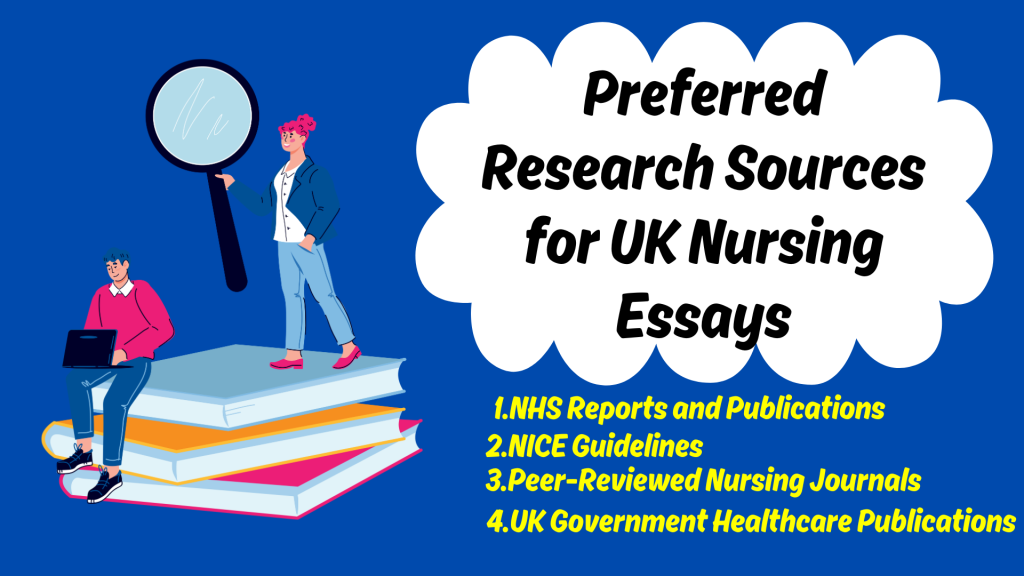
Your university library will provide access to key nursing and health research databases including CINAHL (Cumulative Index of Nursing and Allied Health Literature), MEDLINE, PsycINFO, and Cochrane Library. For UK-specific clinical guidance, the NICE website (www.nice.org.uk), NHS England publications, and Public Health England (now UKHSA) reports are essential resources.
Applying Professional and Ethical Frameworks
Every nursing essay at UK universities should demonstrate your understanding of the professional and ethical frameworks that govern nursing practice. The NMC Code (2018) — centred on the four principles of prioritising people, practising effectively, preserving safety, and promoting professionalism and trust — is the foundational professional document for UK nursing practice, and you should be able to cite and apply it accurately.
Ethical principles commonly applied in nursing essays include the four principles of biomedical ethics (Beauchamp and Childress): autonomy (respect for patients’ right to make informed decisions), beneficence (acting in the patient’s best interests), non-maleficence (avoiding harm), and justice (fair distribution of healthcare resources). These principles provide a useful analytical framework for examining the ethical dimensions of patient care scenarios in your essays.
Legal frameworks that may be relevant depending on your essay topic include the Mental Capacity Act 2005 (governing decision-making for patients who lack capacity), the Children Act 1989 and 2004 (safeguarding children in healthcare settings), the Data Protection Act 2018 and UK GDPR (patient confidentiality and information governance), and the Equality Act 2010 (addressing discrimination in healthcare). Always ensure that any legal or regulatory references are current and specific to the UK — not to other jurisdictions.
Want expert guidance on your next essay? Explore our essay writing service — trusted by UK students since 2001.
Structuring a Nursing Essay Effectively
A well-structured nursing essay guides the reader logically from your introduction through your analysis to your conclusion. The exact structure will depend on the essay type and brief, but most nursing essays at UK universities follow a clear three-part architecture.
The introduction should establish the context of your essay, introduce the central topic, define any key terms, outline the scope of your discussion, and end with a clear thesis or aim statement. If you are working with a patient scenario, the introduction should introduce it briefly (using a pseudonym to protect patient confidentiality, with a statement such as “In accordance with the NMC Code (2018) and the Data Protection Act 2018, the patient’s name has been changed to maintain confidentiality”). The body develops your analysis systematically, with each paragraph addressing a distinct aspect of the topic in accordance with the PEEL paragraph structure (Point, Evidence, Explanation, Link). The conclusion synthesises the key points of your analysis, restates your thesis in light of the discussion, and may suggest implications for nursing practice or areas where further research is needed.
Common Weaknesses in UK Nursing Essays and How to Address Them
Several weaknesses appear repeatedly in UK nursing essays and account for the difference between a 2:2 and a 2:1 or First-class mark. The most common is description without analysis: summarising a patient’s condition or a nursing intervention without critically evaluating the evidence base for that intervention or examining the professional or ethical implications. A second common weakness is inadequate use of evidence: citing textbooks rather than primary research, or using outdated guidelines that have been superseded by more recent NICE guidance. A third weakness is failure to apply professional frameworks: discussing patient care without reference to the NMC Code or relevant ethical principles, which gives the essay an overly generic or purely academic feel rather than a professionally grounded one. Finally, poor referencing — inconsistent application of the referencing system, missing in-text citations, or a reference list that does not match the citations in the text — is an avoidable error that costs marks in every marking criteria.
How Projectsdeal Helps Nursing Students
Our team includes specialist academic writers with nursing and healthcare backgrounds who understand the professional standards, clinical frameworks, and academic conventions that UK nursing essays require. Whether you need help structuring a case study analysis, applying the NMC Code to a clinical scenario, finding and integrating evidence from NICE guidelines or Cochrane Reviews, or ensuring that your essay meets the academic standards of your nursing programme, we provide expert, subject-specific support.
Frequently Asked Questions
Do I need to use the NMC Code in every nursing essay?
The NMC Code (2018) is the foundational professional document for nursing practice in the UK, and most nursing essays — particularly those involving patient care scenarios, ethical dilemmas, or professional practice issues — will benefit from direct reference to it. However, whether it is required depends on the specific brief. For essays that are more purely clinical (e.g., examining the pharmacology of a particular medication) or more quantitative (e.g., a statistical analysis of patient outcomes), the NMC Code may be less central, though professional values should still inform your writing throughout.
How do I maintain patient confidentiality in a nursing essay?
When referring to real patients from your clinical placement in a nursing essay, you must anonymise all identifying information, including names, exact locations, dates, and any details that could identify the individual. Use a pseudonym (e.g., “referred to as John for the purposes of this essay”) and include a brief statement explaining why you have done so, with reference to the NMC Code (2018) and the Data Protection Act 2018. In some cases, your university may advise against using real patient scenarios at all, in which case composite or fictional scenarios may be used instead.
What sources should I use in a nursing essay?
Prioritise peer-reviewed journal articles from nursing and healthcare databases (CINAHL, MEDLINE, Cochrane Library), NICE clinical guidelines, NHS England and Public Health England/UKHSA publications, and the NMC Code and Standards. Textbooks are useful for foundational concepts but should be supplemented with current primary research. Aim for sources published within the last five to seven years, and always check whether NICE guidelines have been updated recently before citing them. Avoid Wikipedia, general health websites (including NHS Choices for clinical guidance), and any sources that are not credible and peer-reviewed.
How should I approach a reflective nursing essay?
Reflective nursing essays most commonly use the Gibbs Reflective Cycle (1988), Driscoll’s Model (1994), or Johns’ Model of Structured Reflection (2000). Whichever framework you use, ensure that your reflection moves beyond description of what happened to genuine critical analysis of why things happened as they did, how relevant theory and evidence inform your understanding of the event, and what you will do differently in future practice. Always anonymise patient details in accordance with NMC Code requirements and your university’s guidelines.
How important is academic writing style in a nursing essay?
Academic writing style is assessed as a distinct component in most nursing essay marking criteria. Key requirements include writing in the third person (unless the essay is explicitly reflective), using formal register (avoiding contractions and colloquialisms), applying your referencing system consistently and accurately, structuring paragraphs using the PEEL framework, and writing with clarity and precision. Spelling and grammar errors, inconsistent referencing, and poor paragraph structure all reduce your mark, even when the clinical and analytical content is strong.
Related Study Guides
You may also find these guides helpful: How to Write a Nursing Essay: A Complete UK Guide, How to Write a Reflective Essay Using the Gibbs Reflective Cycle, Harvard Referencing: A Complete UK Guide, and How to Write a Literature Review.
Need Expert Academic Help?
ProjectsDeal provides trusted dissertation, thesis, and essay writing support for UK university students. Get matched with a specialist in your subject area.