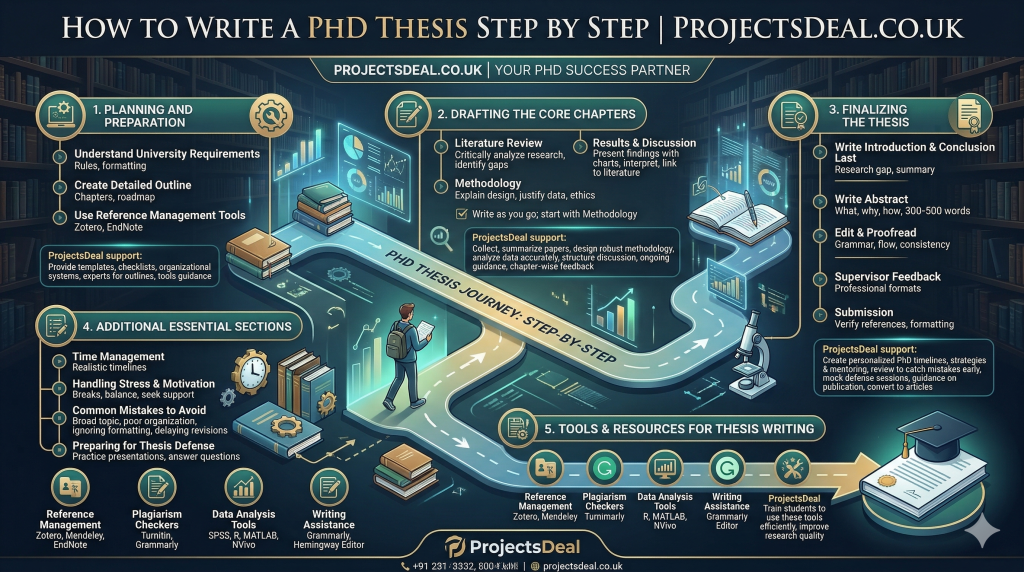
Learning how to write a phd thesis is essential for every UK doctoral candidate. Writing a PhD thesis is one of the most demanding intellectual undertakings in academic life. For UK doctoral students, the thesis represents three to four years of original research, rigorous analysis, and sustained scholarly writing—assessed by a panel of external examiners in an oral examination (viva voce) that determines whether you will be awarded the degree. This step-by-step guide explains how to approach and complete your PhD thesis in 2026, from initial planning through to final submission.
Understanding What a UK PhD Thesis Requires
A PhD thesis in the UK is a substantial piece of original research, typically between 70,000 and 100,000 words (though word limits vary considerably by discipline and institution). The thesis must make an original contribution to knowledge—a requirement that distinguishes doctoral work from Master’s and undergraduate research. The contribution does not need to overturn existing paradigms; it can extend, refine, or apply existing knowledge in a novel and meaningful way.
UK theses typically comprise the following chapters: an introduction establishing the research context and questions; a literature review surveying and critically evaluating existing research; a methodology chapter explaining and justifying the research design; results or findings chapters presenting the data or analysis; a discussion chapter interpreting findings in relation to the literature; and a conclusion summarising the contribution and identifying directions for future research. Some disciplines, particularly in the sciences, split findings across multiple results chapters, while humanities theses may integrate literature review and analysis more fluidly.
Step 1: Develop a Focused Research Question
The quality of your research question is the single most important determinant of your PhD thesis’s success. A strong research question is specific enough to be researchable within the constraints of a doctoral project, significant enough to justify three to four years of investigation, and genuinely original in the sense that it addresses a gap that existing research has not yet filled.
Developing your research question requires extensive engagement with the existing literature in your field. You must know the terrain well enough to identify where the map is incomplete, inaccurate, or contested. Your supervisory team will be an invaluable resource at this stage, and it is worth investing significant time in the first few months of your PhD to read widely and discuss potential questions with your primary supervisor before committing to a direction.
Step 2: Conduct Your Literature Review
The literature review chapter of a PhD thesis is more extensive and more analytically sophisticated than that of a Master’s dissertation. It must survey a substantial body of scholarship—potentially hundreds of sources—and synthesise it into a coherent narrative that identifies the key theoretical debates, empirical findings, and methodological approaches in your field, and positions your own research in relation to them.
Use systematic database searching (via Web of Science, Scopus, JSTOR, and discipline-specific databases) to build your literature base, and supplement keyword searches with citation tracking—following references in key papers to identify foundational and related works. Keep meticulous records of every source you access using reference management software such as Zotero or EndNote. A PhD literature review is a living document that you will return to and update throughout the research process.
Want one-to-one support with your dissertation? Explore our dissertation writing service — trusted by UK students since 2001.
Step 3: Design and Execute Your Research Methodology
Your methodology must be rigorously justified in relation to your research question. At doctoral level, UK examiners expect not only a description of the methods used but a sophisticated engagement with the epistemological and ontological assumptions underpinning your research design. Quantitative, qualitative, and mixed-methods approaches each carry different philosophical commitments and methodological standards, and your thesis must demonstrate awareness of these.
If your research involves human participants, ethics approval from your institution’s research ethics committee is mandatory. For research conducted within or in collaboration with the NHS, Health Research Authority (HRA) approval and NHS REC review may also be required. Begin the ethics approval process as early as possible—delays can significantly compress your data collection window and knock your project timeline off course.
Step 4: Analyse Your Data and Write Your Findings
Data analysis is the phase of the PhD during which you transform raw information—whether interview transcripts, survey responses, experimental results, archival documents, or textual sources—into findings that advance knowledge in your field. Choose an analytical approach that is appropriate to your data type and your research question, and apply it rigorously and consistently.
Write your findings chapters as you analyse, rather than waiting until all analysis is complete. Writing in parallel with analysis helps you identify gaps that require further investigation and produces a richer, more integrated account of your research. Your supervisors can review draft chapters iteratively, allowing you to refine your work before committing to a complete draft.
Step 5: Complete the Discussion and Conclusion
The discussion chapter is where your PhD thesis makes its intellectual contribution most explicit. It interprets your findings in relation to the existing literature—confirming, challenging, extending, or complicating what previous research has established—and articulates the implications of your research for theory, practice, methodology, or policy in your field.
The conclusion should state your original contribution to knowledge clearly and directly. Examiners in the viva will ask you to articulate this contribution, and your thesis conclusion is where you demonstrate your ability to do so with scholarly confidence. Acknowledge the limitations of your research honestly, and identify productive directions for future investigation.
Step 6: Prepare for Submission and the Viva
Before submitting your thesis, ensure that it has been thoroughly proofread and that all formatting requirements specified by your institution have been met. These typically include requirements about font size and style, line spacing, margin widths, and the binding of physical copies. Most UK universities now require or permit electronic submission via an institutional repository, and some require a physical bound copy for the library in addition.
Prepare for your viva by re-reading your thesis in its entirety and identifying the passages most likely to attract examiner questions. Prepare clear, confident answers to standard viva questions, including how you would summarise your research in five minutes, why you chose your methodology, what the main limitations of your study are, and what your research contributes to the field. Practising with your supervisor or a peer in a mock viva will significantly reduce anxiety and improve your performance on the day.
If you need expert support at any stage of the PhD thesis process—from developing your research proposal and literature review through to editing your final draft and preparing for the viva—professional academic writing support from qualified doctoral researchers can provide the guidance and expertise you need to complete your thesis to the highest standard.
Frequently Asked Questions
How do you understand what a UK PhD thesis requires?
A PhD thesis in the UK is a substantial piece of original research, typically between 70,000 and 100,000 words (though word limits vary considerably by discipline and institution).
How do you develop a Focused research question?
The quality of your research question is the single most important determinant of your PhD thesis’s success. A strong research question is specific enough to be researchable within the constraints of a doctoral project, significant enough to justify three to four years of investigation, and genuinely original in the sense that it addresses a gap that existing research has not yet filled.
How do you conduct your literature review?
The literature review chapter of a PhD thesis is more extensive and more analytically sophisticated than that of a Master’s dissertation. It must survey a substantial body of scholarship—potentially hundreds of sources—and synthesise it into a coherent narrative that identifies the key theoretical debates, empirical findings, and methodological approaches in your field, and positions your own research in relation to them.
How do you design and execute your research methodology?
Your methodology must be rigorously justified in relation to your research question. At doctoral level, UK examiners expect not only a description of the methods used but a sophisticated engagement with the epistemological and ontological assumptions underpinning your research design.
How do you analyse your data and write your findings?
Data analysis is the phase of the PhD during which you transform raw information—whether interview transcripts, survey responses, experimental results, archival documents, or textual sources—into findings that advance knowledge in your field.
Need Expert Academic Help?
ProjectsDeal provides trusted dissertation, thesis, and essay writing support for UK university students. Get matched with a specialist in your subject area.