Your Complete 2026 Guide to Choosing Between a Literature Review and a Systematic Review
The Difference Between a Systematic Review and a Literature Review: Research is the backbone of academic excellence, shaping the credibility, depth, and originality of any dissertation, thesis, or research project. One of the most critical decisions students face early in their academic journey is choosing the right review method. This choice determines not only how you gather evidence, but also how strong, structured, and impactful your findings will be.
Among all research approaches, the Systematic Review and the Literature Review are the two most commonly used—and most misunderstood. Many students assume that both serve the same purpose: summarising existing literature. However, this is far from the truth.
Although both methods involve evaluating published studies, they differ significantly in:
- Purpose (broad exploration vs. focused evidence)
- Structure (narrative vs. protocol-driven)
- Methodology (flexible vs. highly structured)
- Search strategy (selective vs. comprehensive and systematic)
- Analysis techniques (descriptive vs. meta-analytic)
- Strength of evidence (moderate vs. highest in research hierarchy)
Understanding these differences is essential—not only to meet academic requirements, but also to strengthen the credibility of your research, improve your grades, and ensure your dissertation stands out.
Since 2001, ProjectsDeal.co.uk, recognised as the UK’s #1 Academic Writing Service, has helped over 100,000 students across top universities successfully navigate the complexities of academic research. Our team of PhD-qualified research experts assists students in producing high-quality, plagiarism-free, and well-structured systematic reviews, literature reviews, and full dissertations.
Drawing from decades of academic experience and thousands of successful research projects, this comprehensive guide will walk you through everything you need to know about:
- What a Literature Review actually is
- What makes a Systematic Review different
- Core differences in structure, depth, and methodology
- Real examples and use cases
- Strengths and limitations of each
- How to choose the right method based on your topic
- Professional recommendations from expert academic writers
Whether you’re a first-time researcher or preparing an advanced Masters/PhD dissertation, this blog will equip you with the knowledge to confidently choose the right approach—and execute it with academic excellence.
Table of Contents
- What Is a Literature Review?
- What Is a Systematic Review?
- Key Differences Between a Literature Review and a Systematic Review
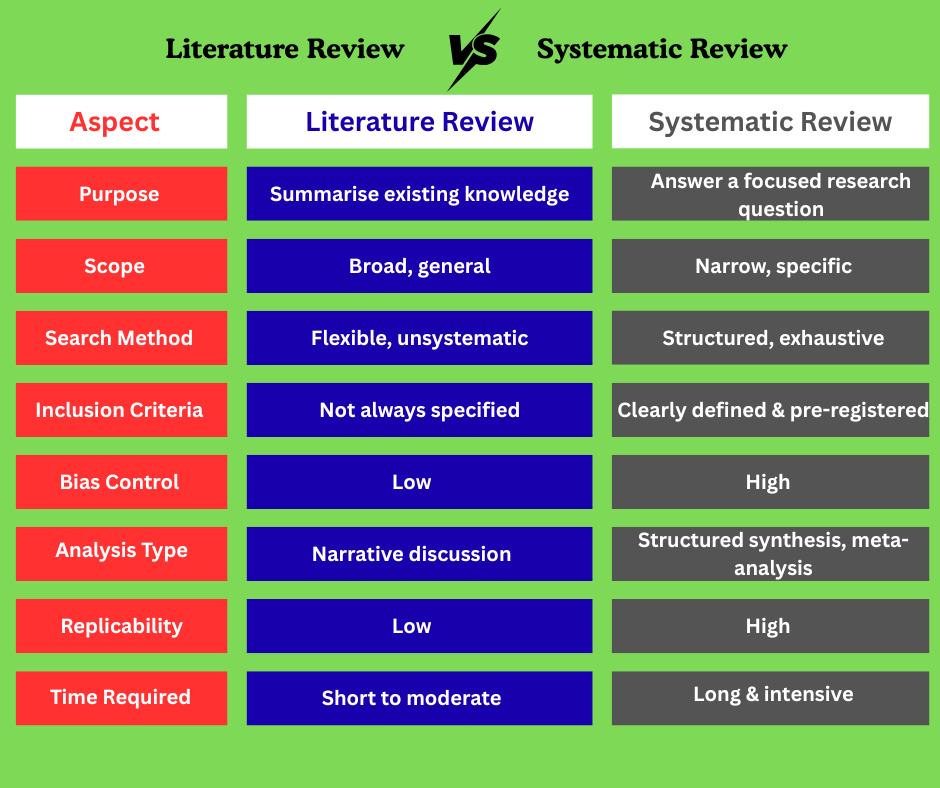
- Systematic Review vs Literature Review: Comparison Table
- Which One Is Better for Your Dissertation?
- Examples of Research Suitable for Each Type
- Steps Involved in a Literature Review
- Steps Involved in a Systematic Review
- Benefits & Limitations of Each
- Expert Tips from ProjectsDeal Researchers
- How ProjectsDeal.co.uk Can Help You
- Conclusion
What Is a Literature Review?
A literature review provides an overview of the existing knowledge on a particular topic. It summarises and evaluates previous research but does not follow a strict, predefined method. The search for studies may be thorough, yet it is not intended to be completely exhaustive. This type of review is often referred to as a narrative review.
Literature reviews generally take a topical or thematic approach, presenting the material in the form of a discussion. The aim is not precision or replicability, but rather to show the author’s understanding of the subject and place their work within the context of existing research. Because the process is flexible, it does not usually attempt to minimise or control author bias.
Findings in a literature review are typically described in narrative form, rather than through statistical analyses. The focus is on interpretation, critical insight, and explanation rather than quantitative results.
When Is It Appropriate to Do a Literature Review?
A literature review is suitable when the goal is to provide background knowledge, explore existing ideas, or understand the current state of research on a topic. Most students have written some form of literature review before—it is a fundamental component of academic work ✍🏽. Literature reviews often appear in the introduction of dissertations, essays, and research papers to establish context and offer an overview of what is already known. They are also commonly used to highlight gaps in existing studies and show where further research is needed 📚.
Key Attributes
- Literature reviews follow a thematic or narrative approach
- They do not require predefined inclusion or exclusion criteria
- They do not aim to answer a highly specific or clinical research question
- The conclusions may be shaped or influenced by the author’s interpretation and perspective
What Is a Systematic Review?
A systematic review answers a clearly defined research question by collecting and analysing evidence that meets a set of pre-established criteria. It follows a structured and transparent process designed to minimise bias and provide the strongest possible conclusion.
The process begins with a focused research question and a detailed protocol outlining how the review will be conducted. A review team then performs a comprehensive search across multiple databases using a highly sensitive search strategy. All retrieved studies are screened for eligibility based on specific inclusion and exclusion criteria—usually by at least two independent reviewers to ensure accuracy. Once eligible studies are selected, the reviewers extract the necessary data and assess the quality or risk of bias in each study. The final stage involves synthesising the data and presenting the results in an organised, systematic manner.
The findings of a systematic review can be reported in different ways depending on the nature of the evidence. Some systematic reviews include a meta-analysis, which provides a statistical summary of the results. Others use a narrative synthesis to present the findings in descriptive form.
When Is It Appropriate to Do a Systematic Review?
A systematic review is appropriate when you want to answer a focused research question—especially one related to the effectiveness, impact, or outcomes of a specific intervention, treatment, or method. In fields such as healthcare, psychology, nursing, and evidence-based practice, systematic reviews often follow the PICO framework, which helps structure the question clearly:
👥 Population – Who is being studied?
💊 Intervention – What treatment or approach is being tested?
🔄 Comparison – What is the intervention compared against?
📏 Outcome – What results or effects are being measured?
For example, a systematic review title built around PICO might look like:
“Online cognitive behavioural therapy (intervention) versus face-to-face therapy (comparison) for reducing anxiety symptoms (outcome) in young adults (population).”
Key Attributes
- Systematic reviews follow predefined, structured methods
- The methodology is explicit, detailed, and fully replicable
- The review team critically assesses study quality and aims to minimise all forms of bias
- Conclusions are based strictly on the evidence collected, not the author’s opinion

Systematic Review vs Literature Review: Complete Comparison Table
| Feature | Literature Review | Systematic Review |
|---|---|---|
| Purpose | Provides a general overview of existing research on a topic, summarising key findings, trends, and gaps in knowledge. | Designed to answer a specific, focused research question using all available evidence in a structured and unbiased manner. |
| Scope | Broad and exploratory, often covering multiple themes or aspects of a topic. | Narrow and targeted, focusing on a clearly defined question or outcome. |
| Search Method | Flexible and unsystematic; studies are selected based on relevance or interest rather than exhaustive criteria. | Highly structured and comprehensive; uses pre-defined search strategies across multiple databases to ensure no relevant studies are missed. |
| Inclusion Criteria | Not always specified; selection depends largely on the author’s judgment. | Clearly defined and pre-registered before starting the review; strict inclusion and exclusion criteria are applied. |
| Bias Control | Lower control over bias; conclusions may be influenced by the author’s perspective or selective study inclusion. | High control of bias through standardised methods, multiple independent reviewers, and transparent procedures. |
| Analysis Type | Narrative discussion and descriptive synthesis; summarises trends, theories, and findings without statistical aggregation. | Structured synthesis, often including meta-analysis to statistically combine results; data interpretation follows strict protocols. |
| Replicability | Low; another researcher following the same topic may select different studies and reach different conclusions. | High; methods are explicitly documented and reproducible, allowing others to repeat the process and obtain similar results. |
| Time Required | Usually short to moderate; can be completed relatively quickly depending on the topic. | Long and intensive; involves multiple stages including protocol development, exhaustive searches, screening, data extraction, and synthesis. |
| Common in | All academic disciplines, including humanities, social sciences, and general sciences. | Most common in healthcare, clinical medicine, psychology, nursing, and other evidence-based disciplines. |
| Evidence Strength | Provides moderate strength evidence; useful for theoretical understanding, background, and identifying research gaps. | Provides the strongest level of evidence in research; highly valued for evidence-based practice and clinical decision-making. |
Which One Should You Choose?
Choosing between a literature review and a systematic review depends on your research goals, topic, discipline, and the level of evidence required. Each method serves a different purpose and is suited to specific academic situations.
Choose a Literature Review if:
- Your research is exploratory:
If your goal is to gain a broad understanding of a topic or explore multiple perspectives without focusing on a single, highly specific research question, a literature review is ideal. - Your topic is broad:
Literature reviews work best when covering general themes, theories, or concepts across a wide range of studies. They allow you to summarise trends and highlight areas for future research. - You are building a theoretical framework:
Literature reviews help identify key theories, models, and debates in your field, providing a strong foundation for your own research design. - You’re not required to follow strict protocols:
If your university or project does not demand a rigid, reproducible methodology, a literature review allows flexibility in selecting sources, themes, and structure.
Choose a Systematic Review if:
- You need strong, evidence-based results:
Systematic reviews are ideal for producing reliable conclusions that can inform policy, clinical decisions, or practical applications, due to their structured methodology and bias minimisation. - You have a clearly defined research question:
If your research aims to answer a focused question—such as evaluating the effectiveness of an intervention—a systematic review ensures all relevant evidence is included and analysed systematically. - Your university requires an advanced research method:
Many higher-level academic programs, especially in healthcare, psychology, and social sciences, require systematic reviews to demonstrate rigorous research skills and high-level critical analysis. - You’re working in evidence-based fields:
Systematic reviews are widely used in healthcare, nursing, psychology, and other disciplines where decisions must be based on the best available evidence. They provide transparent, reproducible, and highly credible results that are valued in both academia and practice.
This approach ensures students select the right review method for their dissertation or research project, saving time and improving the quality of their work.
Pro Tips from ProjectsDeal.co.uk
- Define your question clearly: Focused questions lead to stronger reviews.
- Use credible sources: Rely on peer-reviewed journals and trusted databases.
- Organise your research: Reference managers like Zotero or EndNote make synthesis easier.
- Critically analyse, don’t just summarise: Highlight gaps, trends, and connections.
- Stay updated: Include the latest studies to maintain relevance.
- Seek expert help when needed: ProjectsDeal.co.uk ensures high-quality, plagiarism-free reviews with professional guidance.
Examples of Research Topics Suitable for Each Review Type
Choosing the right review type often depends on the nature of your research topic. Below are examples to guide you:
Literature Review Example Topics
Literature reviews are ideal for broad, exploratory research where the goal is to summarise existing knowledge, identify trends, and highlight research gaps.
- The impact of social media on student motivation:
Explore various studies, theories, and perspectives on how social media influences learning behaviour and academic engagement. - The evolution of digital marketing strategies:
Examine trends, case studies, and theoretical models in digital marketing over time, highlighting changes in consumer behaviour and business strategies. - Theoretical models of leadership in organisations:
Analyse existing leadership theories, compare their application in different organisational contexts, and identify gaps for future research. - Employee engagement and job satisfaction across industries:
Summarise research exploring factors that influence engagement and satisfaction, highlighting patterns and inconsistencies.
Systematic Review Example Topics
Systematic reviews are best suited for focused research questions where evidence is synthesised to answer a specific query, often in evidence-based or clinical fields.
- The effectiveness of Cognitive Behavioural Therapy (CBT) in treating depression:
Collect and analyse all relevant clinical trials to determine the overall efficacy of CBT for patients with depression. - The impact of online learning on academic performance:
Examine multiple studies comparing online and traditional learning outcomes to draw evidence-based conclusions on effectiveness. - The role of nutrition in childhood obesity prevention:
Synthesize research on dietary interventions and programs to evaluate which approaches are most effective in reducing obesity risk among children. - The effect of mindfulness interventions on workplace stress:
Review clinical and organisational studies to determine the impact of mindfulness programs on employee stress levels.
Steps Involved in a Literature Review
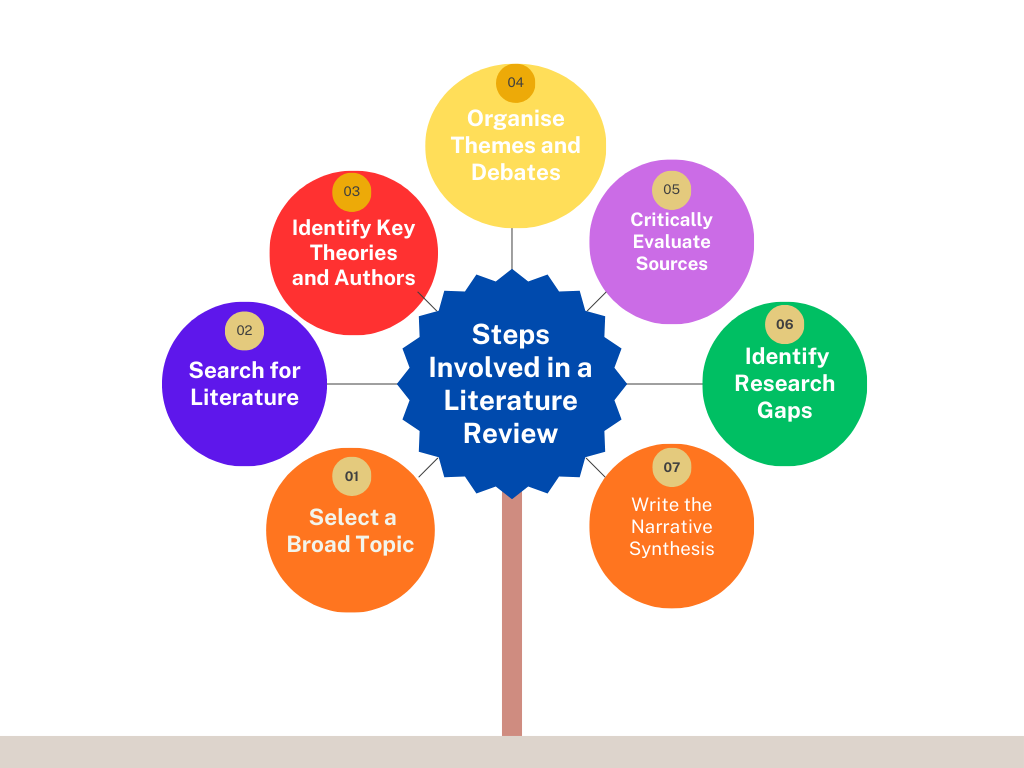
Conducting a literature review involves a systematic yet flexible approach to explore existing knowledge on a topic. Below are the key steps to follow:
1. Select a Broad Topic
Choose a topic that is sufficiently broad to explore various studies, theories, and perspectives, yet focused enough to remain manageable. Consider your research goals, academic requirements, and personal interest.
2. Search for Literature
Use academic databases such as Google Scholar, Scopus, Web of Science, and PubMed to find relevant studies, articles, and books. Ensure you include recent and credible sources, and take note of seminal papers that have shaped the field.
3. Identify Key Theories and Authors
Determine the main theoretical frameworks, concepts, and leading scholars related to your topic. This helps in building a strong foundation and situates your research within the existing academic discourse.
4. Organise Themes and Debates
Group the literature into themes, trends, or debates. This could be chronological, methodological, or thematic, depending on the focus of your review. Organising the material clearly helps highlight patterns, agreements, and contradictions.
5. Critically Evaluate Sources
Assess the quality, credibility, and relevance of each source. Consider the study design, methodology, sample size, and findings. Identify strengths and weaknesses rather than just summarising the content.
6. Identify Research Gaps
Look for areas where evidence is limited, inconsistent, or contradictory. Highlighting these gaps demonstrates the need for further research and provides direction for your own study.
7. Write the Narrative Synthesis
Combine the findings into a coherent, narrative discussion. Summarise key trends, compare and contrast viewpoints, and critically analyse the literature. Ensure your review flows logically and clearly demonstrates how your research fits into the broader academic context.
Steps Involved in a Systematic Review

Conducting a systematic review requires a highly structured and methodical approach to ensure transparency, reproducibility, and reliability. Below are the key steps:
1. Define a Focused Research Question (PICO Format)
Start with a clearly defined research question to guide the review. In healthcare and evidence-based fields, the PICO framework (Population, Intervention, Comparison, Outcome) is often used to structure the question precisely.
2. Develop and Register a Protocol
Create a detailed protocol outlining the methods you will follow, including search strategy, inclusion/exclusion criteria, and data extraction methods. Registering the protocol in databases like PROSPERO ensures transparency and prevents duplication.
3. Conduct an Exhaustive Search Across Multiple Databases
Perform a comprehensive search using multiple databases (e.g., PubMed, Scopus, Web of Science) and additional sources to ensure all relevant studies are included. Use well-defined search terms, Boolean operators, and filters to capture the full scope of literature.
4. Apply Strict Inclusion & Exclusion Criteria
Screen all retrieved studies against predefined criteria to determine eligibility. This ensures consistency and reduces bias by clearly specifying which studies are considered relevant for the review.
5. Use PRISMA to Screen Studies
Follow the PRISMA (Preferred Reporting Items for Systematic Reviews and Meta-Analyses) guidelines to document the study selection process. PRISMA diagrams visually show how many studies were included, excluded, and the reasons for exclusion.
6. Extract Data Using Standardised Forms
Collect relevant information from each study using structured data extraction forms. This includes details such as study design, participants, interventions, outcomes, and key findings. Standardised forms maintain consistency and accuracy.
7. Assess Quality of Studies
Evaluate the methodological quality and risk of bias in each study using standard tools such as CASP (Critical Appraisal Skills Programme) or AMSTAR. This step ensures that conclusions are based on high-quality evidence.
8. Synthesize Results (Qualitative or Meta-Analysis)
Combine the extracted data to draw meaningful conclusions. Depending on the type of data, synthesis can be narrative (qualitative) or statistical (meta-analysis). Meta-analysis allows for a quantitative summary of findings across multiple studies.
9. Report Findings Transparently
Present results clearly and transparently, including methodology, study characteristics, quality assessment, and synthesized findings. Transparency ensures the review is reproducible and trustworthy, making it valuable for academic and clinical decision-making.
Benefits & Limitations of Each Review Type
| Review Type | Benefits | Limitations |
|---|---|---|
| Literature Review | ✔ Easy to conduct ✔ Good for beginners ✔ Provides a broad understanding of the topic ✔ Helps identify research gaps | ✖ Can be subjective ✖ Not easily replicable ✖ Provides a lower level of evidence |
| Systematic Review | ✔ Minimises bias ✔ Provides strong scientific evidence ✔ Transparent and reproducible ✔ Often publishable in top journals | ✖ Time-consuming ✖ Requires advanced research skills ✖ Not suitable for very broad topics |
Expert Tips from ProjectsDeal.co.uk Researchers
Conducting high-quality literature and systematic reviews can be challenging. Our team of expert researchers shares practical tips to help you create reviews that are structured, reliable, and academically impressive:
1. Define a Sharp Research Question
Start with a clearly focused research question. A well-defined question guides your search, narrows your scope, and ensures your review stays on track. For systematic reviews, frameworks like PICO (Population, Intervention, Comparison, Outcome) can help structure your question effectively.
2. Follow PRISMA Guidelines for Systematic Reviews
Systematic reviews must be transparent and reproducible. Use PRISMA guidelines to document your search strategy, study selection process, and data synthesis. This ensures credibility and makes your work publishable in high-impact journals.
3. Use Referencing Tools Effectively
Organising sources is crucial. Tools like Zotero, EndNote, and Mendeley help you manage citations, avoid plagiarism, and streamline referencing, saving you time and effort.
4. Organise Sources Using Thematic Coding
Group studies based on themes, methodologies, or outcomes. Thematic coding allows you to synthesise findings clearly, spot trends, and identify gaps in the literature.
5. Don’t Rely on a Single Database
Searching only one database can result in missing key studies. Explore multiple sources like Google Scholar, Scopus, PubMed, and Web of Science to ensure your review is comprehensive.
6. Move Beyond Descriptive Writing
Avoid just summarising studies. Critically analyse each source by evaluating strengths, weaknesses, and relevance. Highlight contrasts, gaps, and patterns to make your review insightful and authoritative.
7. Stay Updated
Research evolves rapidly. Always include the latest publications from the last 5 years to keep your review current and relevant.
By following these tips, you can produce literature and systematic reviews that are well-structured, evidence-based, and academically robust—helping you achieve top grades with confidence.
How ProjectsDeal.co.uk Helps Students with Reviews
| Service Feature | How It Helps with Literature Reviews | How It Helps with Systematic Reviews |
|---|---|---|
| 100% Plagiarism-Free Research | Ensures all sources are properly referenced and originality is maintained, giving students confidence in academic integrity. | Guarantees that all extracted studies and synthesized data are original and correctly cited, maintaining the highest standards of research ethics. |
| Expert Writing by PhD Researchers | Guides students in summarising, analysing, and synthesising literature effectively. | Supports creation of structured systematic reviews, including protocols, data extraction, and critical evaluation. |
| Timely Delivery | Helps students meet deadlines for dissertations, essays, and assignments without compromising quality. | Ensures complex systematic reviews are delivered on time, even with exhaustive searches and detailed analyses. |
| Unlimited Free Revisions | Allows refinement of narrative synthesis, organisation of themes, and critical evaluation until it meets academic standards. | Enables updates to methodology, PRISMA diagrams, or data synthesis based on feedback or supervisor requests. |
| Perfect PRISMA Diagrams & Protocols | N/A (mainly for systematic reviews, but guidance can be given for literature mapping). | Provides professionally prepared PRISMA flow diagrams, pre-registered protocols, and stepwise documentation for transparency and reproducibility. |
| HD Grade Assurance | Helps produce a well-structured, critical, and insightful literature review that meets university standards. | Ensures systematic reviews are comprehensive, methodologically sound, and of publishable quality, aiming for top grades. |
| Dedicated 24/7 Support Team | Offers expert guidance, answering queries about themes, theories, or structure of the review. | Provides ongoing support for complex tasks such as database searches, inclusion/exclusion criteria, and synthesis methods. |
| Full Writing, Proofreading & Editing Support | Refines language, flow, and formatting to create a polished narrative review. | Assists in drafting, revising, and formatting systematic reviews, including tables, graphs, and meta-analysis outputs. |
Frequently Asked Questions (FAQ)
1. What is the difference between a systematic review and a literature review?
A literature review provides a broad, narrative overview of existing knowledge, identifying trends, theories, and gaps. A systematic review answers a specific research question using a structured, transparent, and reproducible methodology, often including meta-analysis.
2. Can you use a systematic review for a literature review?
Yes, a systematic review can be included as part of a literature review to provide high-quality, evidence-based insights. However, a full literature review usually covers broader topics and is more narrative in nature.
3. What is the difference between a systematic literature review and a narrative literature review?
A systematic literature review follows a structured, reproducible process to answer a specific question. A narrative literature review (also called a traditional literature review) is more flexible, summarising and synthesising literature without strict protocols.
4. What are the 5 C’s of literature review?
The 5 C’s are:
- Cite – Properly reference all sources.
- Compare – Discuss similarities and differences across studies.
- Contrast – Highlight conflicting findings or debates.
- Critique – Assess strengths, weaknesses, and limitations of studies.
- Conclude – Summarise gaps and how your research fits in.
5. How to identify a systematic review?
A systematic review can be identified by its:
- Clear research question (often using PICO)
- Detailed search strategy across multiple databases
- Predefined inclusion/exclusion criteria
- Transparent and reproducible methodology
- Often follows PRISMA guidelines
6. Can a dissertation be a systematic review?
Yes, a dissertation can be based entirely on a systematic review, especially in fields like healthcare, psychology, or social sciences, where evidence-based analysis is required.
7. What are the 5 rules for writing a literature review?
- Define a clear research topic or question
- Search comprehensively across multiple sources
- Organise literature thematically or chronologically
- Critically evaluate and synthesise findings
- Identify gaps and justify your research
8. What are the 7 steps of a systematic review?
- Define a focused research question (PICO)
- Develop and register a protocol
- Conduct a comprehensive search
- Apply inclusion/exclusion criteria
- Screen studies using PRISMA
- Extract and analyse data
- Synthesize results and report transparently
9. Can a single author write a systematic review?
Yes, a single author can write a systematic review, but it is recommended to have at least two reviewers during screening and quality assessment to minimise bias.
10. What are the two main types of literature reviews?
- Narrative (Traditional) Literature Review – Broad, thematic, and descriptive.
- Systematic Literature Review – Structured, reproducible, and evidence-focused.
11. What are the limitations of systematic reviews?
- Time-consuming and resource-intensive
- Requires advanced research skills
- Not suitable for very broad topics
- May be limited by the availability and quality of existing studies
12. What is another name for a literature review?
A literature review is also known as a narrative review, traditional review, or narrative literature review, depending on the methodology used.
Conclusion
The key difference between a literature review and a systematic review lies in their purpose and approach. A literature review provides a broad, narrative overview of existing research, summarising trends, theories, and debates, whereas a systematic review offers a rigorous, evidence-based answer to a specific research question using structured, transparent, and reproducible methods.
A literature review is ideal for exploratory research, building theoretical frameworks, and gaining a general understanding of a topic. It helps identify knowledge gaps, compare different perspectives, and situate your research within the broader academic context.
In contrast, a systematic review is best suited for research requiring strong evidence, such as clinical, healthcare, or social science studies. It involves a detailed search strategy, strict inclusion and exclusion criteria, quality assessment, and structured synthesis, ensuring results are credible, unbiased, and replicable.
Choosing the right type of review depends on your research goals, topic specificity, and academic requirements. Selecting the correct method not only improves the quality of your work but also ensures it meets university or publication standards.
For students aiming to achieve top grades, meet tight deadlines, and produce high-quality, plagiarism-free work, ProjectsDeal.co.uk provides expert support. Our PhD-qualified team can assist with:
- Drafting and structuring literature reviews
- Conducting systematic reviews with PRISMA-compliant protocols
- Data extraction, synthesis, and critical analysis
- Proofreading, formatting, and final editing
With ProjectsDeal.co.uk, you can confidently submit reviews that are academically robust, well-structured, and tailored to university standards—helping you achieve academic excellence with confidence and ease.
🎓 Achieve Top Grades with ProjectsDeal.co.uk 🎓
Struggling with your dissertation or research project? Don’t risk low grades or missed deadlines. ProjectsDeal.co.uk – the UK’s most trusted academic writing service since 2001 and proudly 🏆 voted the best academic support provider – is here to help you succeed.
✅ 100% Plagiarism-Free Work
✅ Written by PhD Experts
✅ ⏰ Timely Delivery Every Time
✅ 🔄 Unlimited Free Revisions
✅ 🎯 High Distinction (HD) Grade Assurance
Get professional, well-structured, and original literature or systematic reviews—easily order online for just £49 💷 and have your work handled by experts.
🚀 Secure your top grades now: 📄 Literature Review Writing Services UK