How to Write a Dissertation in 3 Months: A Practical UK Guide (2026)
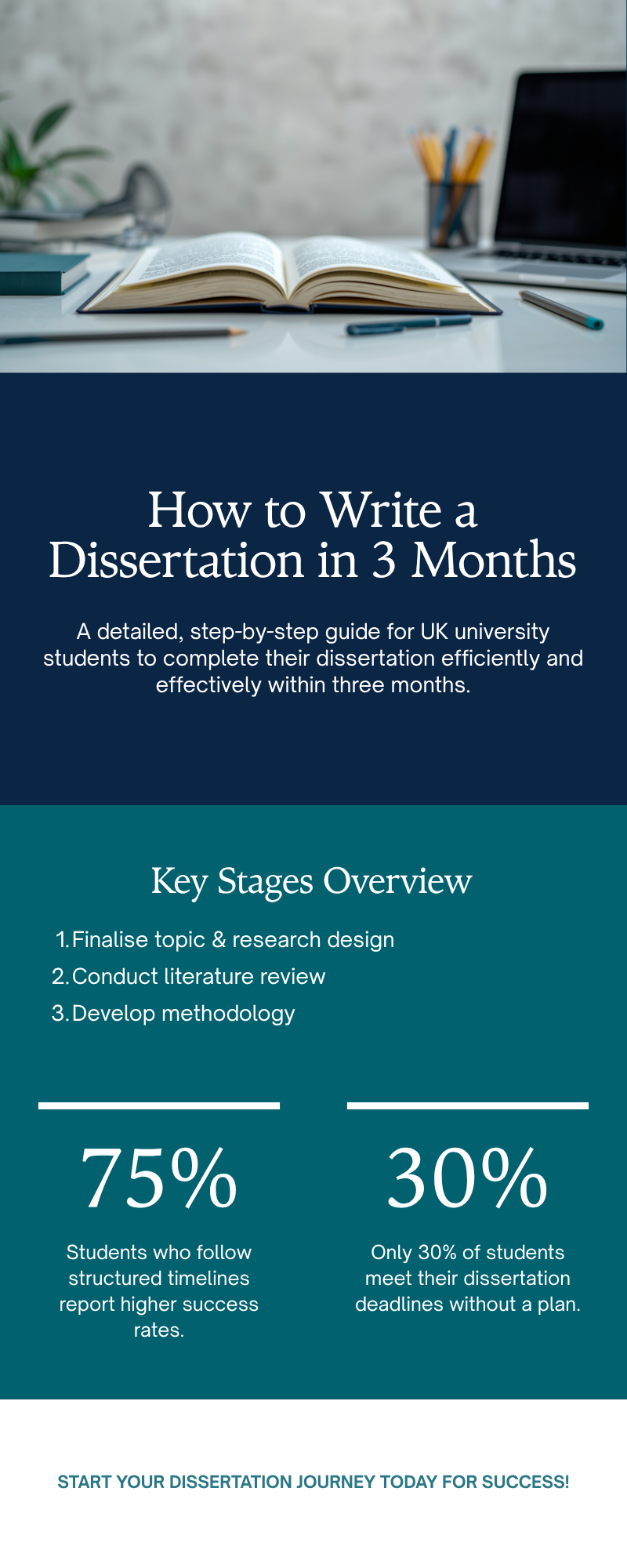
Three months is a realistic and achievable timeframe for completing a UK university dissertation — and for many students, it reflects the actual time available between the start of their dissertation module and the submission deadline. The key is structured planning, consistent daily progress, and resisting the temptation to research indefinitely before beginning to write. This guide gives you a practical 12-week plan.
The 12-Week Dissertation Plan
Weeks 1–2: Finalise Topic and Research Design
Use the first two weeks to finalise your dissertation topic and confirm your research question with your supervisor. Conduct an initial search of the literature to confirm that sufficient academic sources exist to support your review, and draft a research proposal or outline that your supervisor can provide early feedback on. By the end of Week 2, you should have a confirmed research question, a clear methodology, and a preliminary bibliography of 20–30 sources.
Weeks 3–5: Literature Review
Devote Weeks 3–5 to intensive reading and literature review writing. Read 5–8 sources per week, taking structured notes as you go. Begin writing your literature review in Week 4, organising sources thematically rather than summarising them one by one. Aim for a complete first draft of your literature review by the end of Week 5. A first draft does not need to be perfect — it needs to be complete enough for your supervisor to review and provide meaningful feedback.
Week 6: Methodology Chapter
Write your methodology chapter in Week 6. Cover your research philosophy, approach, design, data collection methods, analysis strategy, and ethical considerations. At undergraduate level, aim for 1,500–2,000 words; at postgraduate level, 2,000–3,500 words. Send your draft methodology to your supervisor alongside your literature review draft for combined feedback.
Weeks 7–8: Data Collection and Analysis
If conducting primary research (interviews, surveys, experiments), carry out data collection in Week 7 and begin analysis in Week 8. For literature-review-based dissertations, use these weeks to complete any remaining reading and begin writing your findings chapter. This is the most intellectually demanding phase — break your daily target into specific, achievable tasks (“analyse three interview transcripts” or “write 400 words on Theme 2”) to maintain momentum.
Weeks 9–10: Findings, Discussion, and Conclusion
Write your findings and discussion chapters in Weeks 9–10. Remember: the findings chapter presents what you found without interpretation; the discussion interprets your findings in the context of your literature review and addresses limitations. Complete your conclusion by the end of Week 10. Your conclusion should synthesise your main arguments into a direct answer to your research question and outline recommendations for future research.
Week 11: Introduction, Abstract, and Front Matter
Write your introduction in Week 11 — after all other chapters are complete. Your introduction will be more accurate and more effective if written last, as it introduces the dissertation you actually wrote. Then write your abstract (150–300 words for undergraduate, 250–500 words for postgraduate). Complete your table of contents, acknowledgements, and list of figures and tables.
Week 12: Editing, Proofreading, and Submission
Reserve Week 12 entirely for editing, proofreading, referencing verification, and formatting. Read the complete dissertation from introduction to conclusion to check argument flow. Verify every in-text citation against the reference list. Check formatting consistency. Submit at least 24 hours before the deadline to allow for any technical issues.
Key Strategies for Staying on Track
- Write daily: 500 words per day produces 10,500 words in 21 working days. Even 300 words — under 30 minutes of focused writing — adds up to a full dissertation chapter in two weeks.
- Start writing before you feel ready: Many students delay writing because they feel they need to read more. Begin writing at the end of Week 3 even if your reading is incomplete — writing reveals the gaps in your knowledge more clearly than reading alone.
- Meet your supervisor regularly: Aim for a supervision meeting every 2–3 weeks. Bring specific questions and draft sections to each meeting.
- Prioritise your dissertation: During the 12-week period, your dissertation should be your academic priority. Other commitments should be managed around it, not the other way around.
Frequently Asked Questions
What is the minimum time needed to write a good dissertation?
Three months is achievable for a 10,000–15,000-word undergraduate or postgraduate dissertation, provided you follow a structured plan and write consistently. Some students complete strong dissertations in 8–10 weeks; others need 4–5 months. The key variables are: how quickly you can identify and access appropriate sources; how efficiently you write first drafts; and how effectively your supervisor’s feedback redirects your effort. Do not confuse “achievable in three months” with “easy in three months” — the timeline requires discipline and consistent effort.
What should I do if I fall significantly behind schedule?
Communicate with your supervisor immediately. Do not wait until the week before submission to reveal a significant problem. Your supervisor may be able to advise on scoping your dissertation down, applying for a deadline extension through your institution’s mitigating circumstances process, or prioritising certain chapters over others. A supervisor who knows about a problem in Week 6 can help you recover; a supervisor told about it in Week 11 may have limited options. Proactive communication is always better than delayed disclosure.
Related Study Guides
- How to write a dissertation in 3 months (detailed guide)
- What are the chapters in a dissertation?
- 5 important dissertation writing tips
- Dissertation methodology guide
Managing the Middle Weeks: Literature Review and Methodology
Once your proposal and research question are confirmed, the middle phase of a compressed three-month dissertation timeline typically involves completing your literature review and finalising your methodology. These two chapters are closely interrelated: the literature review establishes what is already known and identifies the gap your research addresses, while the methodology explains how you will address it.
For students working within a tight deadline, a focused literature review is more valuable than a wide-ranging one. Rather than attempting to survey every publication in your field, identify the thirty to fifty most directly relevant sources and engage with them in depth. Use systematic searching techniques—database searches in JSTOR, Scopus, or Web of Science using key terms from your research question, combined with reference-list tracking from key papers—to build a manageable and representative body of literature.
Write your literature review thematically rather than source by source. Organising the discussion around the main debates, concepts, and findings in the field demonstrates synthesis—a higher-order skill than summary. A thematic structure also makes it easier to identify and articulate the specific gap or question that your research addresses, which is the central purpose of the chapter.
Finalise your methodology chapter by week five or six. The methodology should clearly justify your research design, explain your data collection approach, and address ethical considerations. If you are conducting primary research, ensure that any required ethics approval from your institution is secured during the early weeks—delays here can compress your data-collection window severely.
The Final Sprint: Data Analysis, Writing Up, and Submission
The final four to five weeks of a three-month dissertation are typically the most intensive. During this phase, you will be conducting or completing data collection, analysing your findings, drafting the results and discussion chapters, and completing the introduction and conclusion. Managing this phase without burning out requires both discipline and strategic prioritisation.
Draft your results chapter before your discussion chapter. The results section presents what you found, as objectively as possible; the discussion interprets those findings in relation to your research question and existing literature. Writing them in sequence helps maintain a clear distinction between reporting and interpretation, which is a common weakness in student dissertations.
Reserve the introduction and abstract for last, even though they appear first in the final document. It is far easier to write a compelling introduction after you have written the body of the dissertation, because you then know precisely what you are introducing. The abstract, which summarises the entire work, cannot be written accurately until every other section is complete.
In the final week, focus on revision, proofreading, and formatting. Check that your argument flows logically from introduction through to conclusion, that every in-text citation has a corresponding reference list entry, and that formatting is consistent throughout. If your timeline allows, consider having your draft reviewed by a professional academic proofreading service—a final check by an expert eye can identify issues that are invisible to the author after weeks of close reading, and helps ensure that your hard work is presented to the highest possible standard.
Trying to write a dissertation in 3 months is realistic with this plan, but if your deadline is tighter or you need a second pair of eyes, our guide on whether to hire someone to write your dissertation can help you decide. UK dissertations are marked against the standards of the Quality Assurance Agency for Higher Education (QAA), so keep structure, referencing and original analysis strong throughout. For expert support, the Projectsdeal dissertation writing service and editing service can help you finish on time.
Need Expert Academic Help?
ProjectsDeal provides trusted dissertation, thesis, and essay writing support for UK university students. Get matched with a specialist in your subject area.
Write A Dissertation In 3 Months: Key Insights for UK Students
UK students who master write a dissertation in 3 months gain a significant advantage. Understanding write a dissertation in 3 months thoroughly improves academic performance and helps achieve better grades at UK universities.
When developing skills in write a dissertation in 3 months, consistency is key. Practise regularly, seek tutor feedback, and use academic resources to strengthen your knowledge of write a dissertation in 3 months.
For further guidance on write a dissertation in 3 months, visit the Prospects UK dissertation guide — a trusted resource for UK students.