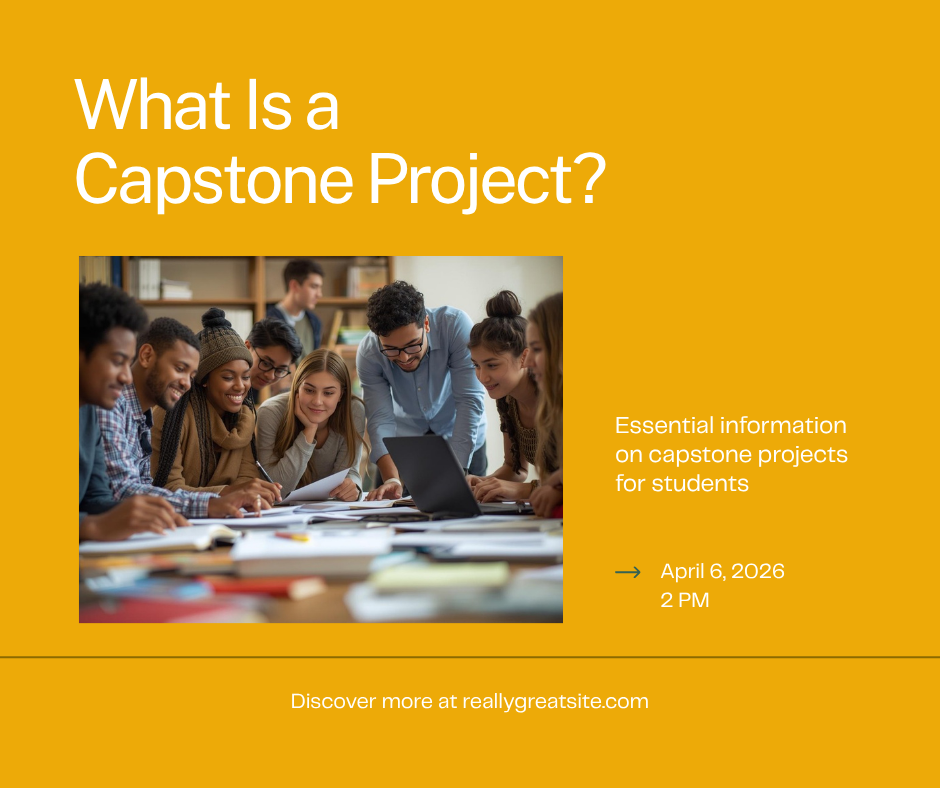

Capstone project? Complete guide for UK students — this is the definitive resource for understanding what a capstone project is, how it differs from a dissertation, and how to approach it successfully at UK universities. Whether you are studying business, engineering, computing, nursing, or social sciences, this capstone project? complete guide covers everything from project selection to final presentation, with expert advice tailored to UK higher education standards in 2026.
The capstone project is a culminating academic experience found in a growing number of UK university programmes, particularly in business, engineering, computing, design, and applied social science disciplines. Unlike a conventional dissertation — which is primarily a piece of independent research presented in written form — a capstone project typically combines research, design, problem-solving, and practical application in a single, substantial piece of work that demonstrates the student’s mastery of the skills and knowledge developed across their entire programme of study. This guide explains what a capstone project is, how it differs from a dissertation, and how to approach it effectively at UK universities.
What Is a Capstone Project?
The term “capstone” derives from the architectural metaphor of the final stone placed at the apex of an arch — the element that holds everything else in place and completes the structure. In academic terms, a capstone project serves a similar function: it is the culminating assessment that integrates and applies the knowledge, skills, and competencies developed across all previous stages of a degree programme, demonstrating that the student is ready to operate as a competent practitioner or researcher in their field.
In UK universities, capstone projects are most common in professionally oriented programmes where the integration of theory and practice is central to the educational aim. Business and management programmes may use a capstone consulting project in which students work with a real organisation to analyse a strategic problem and present evidence-based recommendations. Engineering programmes may use a capstone design project in which students design, build, and test an engineering system or component. Computing programmes may use a capstone software development project. Nursing and health science programmes may use a capstone clinical quality improvement project. The specific format, requirements, and assessment criteria of a capstone project vary significantly by discipline and institution.
How Does a Capstone Project Differ From a Dissertation?
While both capstone projects and dissertations are substantial, culminating assessments, they differ in several important ways. A dissertation is primarily an academic exercise in independent research — it involves identifying a research question, reviewing the literature, designing and conducting an empirical study (or conducting a systematic review), analysing data, and writing up findings in a formal academic document. The primary audience is academic, and the primary criterion for success is the quality and originality of the research and its contribution to academic knowledge.
A capstone project is more explicitly practice-oriented. It typically involves working on a real-world problem, often in partnership with an external organisation or community, and producing outputs that are designed to be practically useful rather than primarily academically significant. The deliverables of a capstone project may include a business report with strategic recommendations, a working prototype or technical system, a community needs assessment and intervention plan, or a clinical audit and quality improvement proposal. Assessment in a capstone project often includes both written report components and oral presentation or practical demonstration elements.
The distinction is not always clear-cut: many UK dissertations have applied dimensions, and many capstone projects incorporate substantial research components. If you are unsure which type of project your programme requires, your programme handbook and module leader are your definitive guides.
Choosing and Scoping Your Capstone Project
The scope and focus of your capstone project — and often the specific organisational or community context in which it is conducted — are among the most important decisions you will make. A well-scoped capstone project addresses a genuine and significant problem that can be meaningfully addressed within the time and resources available to you, produces outputs that are practically useful to the partner organisation or community, and allows you to demonstrate the full range of skills and competencies your programme has developed.
Common approaches to identifying a capstone project focus include: working with a partner organisation (a company, NHS trust, local authority, or charity) that has identified a specific problem or challenge they want help addressing; building on your work experience or placement insights to identify a problem you have encountered in professional practice; developing an idea that emerged from your dissertation or earlier coursework research; or responding to a challenge set by your programme’s industry partners. In programmes where students identify their own projects, your personal professional interests and career goals should be a primary consideration — a capstone project in an area directly relevant to your intended career will be both more motivating and more professionally valuable than one selected arbitrarily.
Key Phases of a Capstone Project
While the specific structure of a capstone project varies by discipline, most follow a broadly similar process. The initiation phase involves defining the problem, negotiating the scope and outputs with any partner organisation, securing ethical approval where needed, and developing a project plan with clear milestones. The research and analysis phase involves gathering and analysing relevant data — which may include primary data collection (interviews, surveys, observations), secondary data analysis (market data, organisational records, published research), and literature review. The design and development phase involves creating the proposed solution, recommendation, or artefact, drawing on the insights from the research phase. The evaluation and refinement phase involves testing, reviewing, and refining the proposed solution based on feedback from stakeholders, supervisors, or pilot testing. The presentation and reporting phase involves producing the final written report and, where required, presenting findings to assessors and/or partner organisations.
Working With an Industry or Community Partner
Many capstone projects involve collaboration with an external partner organisation — a company, NHS trust, charity, local authority, or community group — and managing this relationship effectively is an important part of the project that many students find challenging. Key considerations include: establishing clear expectations about the scope, deliverables, and timeline of the project from the outset, ideally documented in a project brief or memorandum of understanding; maintaining regular, professional communication with your partner contact throughout the project; managing the tension between the partner’s practical requirements and your academic requirements (which may include confidentiality, ethical constraints, and academic referencing); and ensuring that sensitive commercial or personal information is handled appropriately in accordance with data protection requirements and any confidentiality agreements.
How Projectsdeal Helps With Capstone Projects
Our team of specialist academic writers and research consultants includes professionals with backgrounds in business strategy, engineering, computing, health services research, and social policy who have extensive experience supporting UK students through capstone and applied research projects. We can assist with project scoping, literature review, research design, data analysis, report writing, and presentation preparation, ensuring that your capstone project meets the highest academic and professional standards.
Frequently Asked Questions
How long is a capstone project?
Capstone project scope varies enormously by programme. A business capstone project may involve a 6,000–10,000-word report plus a presentation and oral examination. An engineering capstone project may involve a technical design, a laboratory demonstration, and a written report. A computing capstone project may involve a working software system and documentation. Always refer to your programme handbook for the specific deliverables, word counts, and assessment criteria applicable to your capstone project.
Is a capstone project the same as an independent study project?
The terms overlap but are not identical. An independent study project typically refers to a student-initiated piece of work on a topic of the student’s own choosing, which may or may not have a practical partner organisation involvement. A capstone project has a more specific pedagogical purpose — it is the integrating, culminating experience that brings together learning from across the programme — and often involves an applied, practice-oriented focus. In some programmes, the terms are used interchangeably; in others, they refer to distinct types of assessment. Your programme documentation is the definitive guide.
Can I do my capstone project with my employer?
Yes — working on a capstone project with your current or former employer is common and can be very effective, because you have existing knowledge of the organisational context, established relationships with key stakeholders, and direct access to relevant data. However, you must manage the additional complexities of the insider researcher role carefully: be transparent about your dual position in your methodology, manage potential conflicts of interest explicitly, and ensure that your employer understands and accepts the academic requirements and constraints of the project, including any confidentiality limitations on what can be disclosed in your written report.
Related Study Guides
You may also find these guides helpful: How to Choose a Dissertation Topic, How to Write a Dissertation Proposal, How to Write Research Aims and Objectives, and How to Write an Executive Summary.
⚠️ Common Mistakes in Your Capstone Project? Complete Guide to Avoiding Them
The most critical question students ask when starting a capstone project is: “Capstone project? Complete guide or just self-directed research?” Many students underestimate the complexity of capstone project management and treat it as a standalone assignment rather than the culminating integration of their entire degree programme. UK universities including the University of Bath, University of Surrey, and Coventry University explicitly design capstone projects as capstones of learning — meaning they should demonstrate mastery across multiple modules, integrate diverse skill sets, and produce work of professional-standard quality that an employer or industry partner can directly evaluate.
Failing to define the project scope early is the most common structural error. Many students select an overly ambitious topic and spend the first two months expanding their scope, only to find that they have insufficient time for the research and production phases. The Quality Assurance Agency UK standards for capstone and work-based learning assessments specify that students must demonstrate the ability to independently scope, manage, and deliver a substantial project — scope management, therefore, is itself an assessed competency, not merely a planning detail.
Poor stakeholder management is another significant issue, particularly for capstone projects conducted in partnership with external organisations. Students who fail to maintain regular communication with their industry supervisor, or who change the project direction without consulting stakeholders, routinely submit work that does not meet the original brief. The Office for Students guidance on professional and work-based learning emphasises that students in partnership projects must demonstrate professional communication standards alongside academic competencies.
Finally, inadequate documentation of the research and development process is a persistent problem. Many capstone projects are assessed not only on the final product (a report, prototype, policy recommendation, or business plan) but also on the process documentation — including project logs, meeting notes, risk registers, and reflective journals. Students who focus exclusively on the final product without maintaining process documentation typically lose significant marks in the process and reflection components, which often account for 30-40% of the total grade in UK capstone assessment frameworks.
💡 Expert Tips for Your Capstone Project? Complete Guide for UK Students (2026)
If you are asking “capstone project? complete guide to getting started?” the first step is to conduct a thorough review of your institution’s capstone project handbook before selecting your topic. UK universities such as the University of Exeter, Loughborough University, and the University of Bristol publish detailed handbooks that specify the assessment criteria, word counts, presentation requirements, and ethical approval processes for capstone projects. Reading the handbook before topic selection prevents the common mistake of choosing a topic that requires data collection methods not approved by your institution’s ethics committee.
Project management methodology is essential for capstone success. The most widely used frameworks in UK higher education capstone projects are Agile (particularly for computing, design, and engineering projects) and PRINCE2 (for business and management projects). Even if your programme does not require a specific methodology, adopting a structured project management approach — with a Gantt chart, milestone schedule, risk register, and weekly progress review — significantly improves outcomes and provides the process documentation that examiners consistently reward. Many UK universities provide free student licences for project management software including Trello, Asana, and Microsoft Project.
For the literature review component of your capstone project, focus on synthesising current research rather than summarising individual sources. A strong capstone literature review identifies key themes, debates, and gaps in the existing research, and explicitly positions the capstone project as addressing one of those gaps. Use databases such as the British Library EThoS (Electronic Theses Online Service), Scopus, and Web of Science to identify the most cited and most recent research in your field. JSTOR and Google Scholar are useful supplementary tools but should not be your primary academic sources for a capstone project.
The presentation and viva component of UK capstone projects is often overlooked in preparation. Many UK programmes require a formal presentation to an assessment panel that may include external examiners, industry partners, or professional practitioners. Practise your presentation with your supervisor or peers well in advance, prepare clear answers to anticipated questions about your methodology and findings, and ensure your visual materials (slides, poster, prototype) are professional-standard. The University of Warwick and the University of Bristol both publish online guidance on effective academic presentations that is freely accessible to all students.
🏫 Capstone Project? Complete Guide Support Trusted by UK Students Since 2001
ProjectsDeal has been providing expert capstone project support to UK students since 2001, helping over 20,000 students across disciplines including Business, Engineering, Computing, Nursing, and Social Sciences deliver outstanding capstone projects. Our team of 200+ PhD-qualified specialists offers personalised consultations, complete project writing services, literature review support, data analysis, and Turnitin-verified editing for capstone projects at undergraduate and postgraduate levels. With over 45,000 verified Trustpilot reviews, we are the UK’s most trusted academic support service for capstone and final-year projects.
Whether your capstone project involves a business case analysis, an engineering design report, a computing system prototype, or a healthcare quality improvement project, ProjectsDeal provides expert, deadline-driven support tailored to your institution’s specific requirements and marking criteria. All our work complies with QAA standards and UK university academic integrity policies. Explore our complete dissertation writing guide for broader final-year project support. Contact ProjectsDeal today for a free capstone project consultation.
Need Expert Academic Help?
ProjectsDeal provides trusted dissertation, thesis, and essay writing support for UK university students. Get matched with a specialist in your subject area.
Capstone Project? Complete Guide: Key Insights for UK Students
A thorough understanding of capstone project? complete guide is invaluable for UK university students. Exploring capstone project? complete guide in depth strengthens academic writing and demonstrates the critical thinking skills UK lecturers value highly.
Applying knowledge of capstone project? complete guide consistently throughout your studies builds confidence and improves the quality of academic work at UK universities.
For further guidance on capstone project? complete guide, visit the Prospects UK higher education guidance — a trusted resource for UK students.