Mastering dissertation published is essential for UK students. 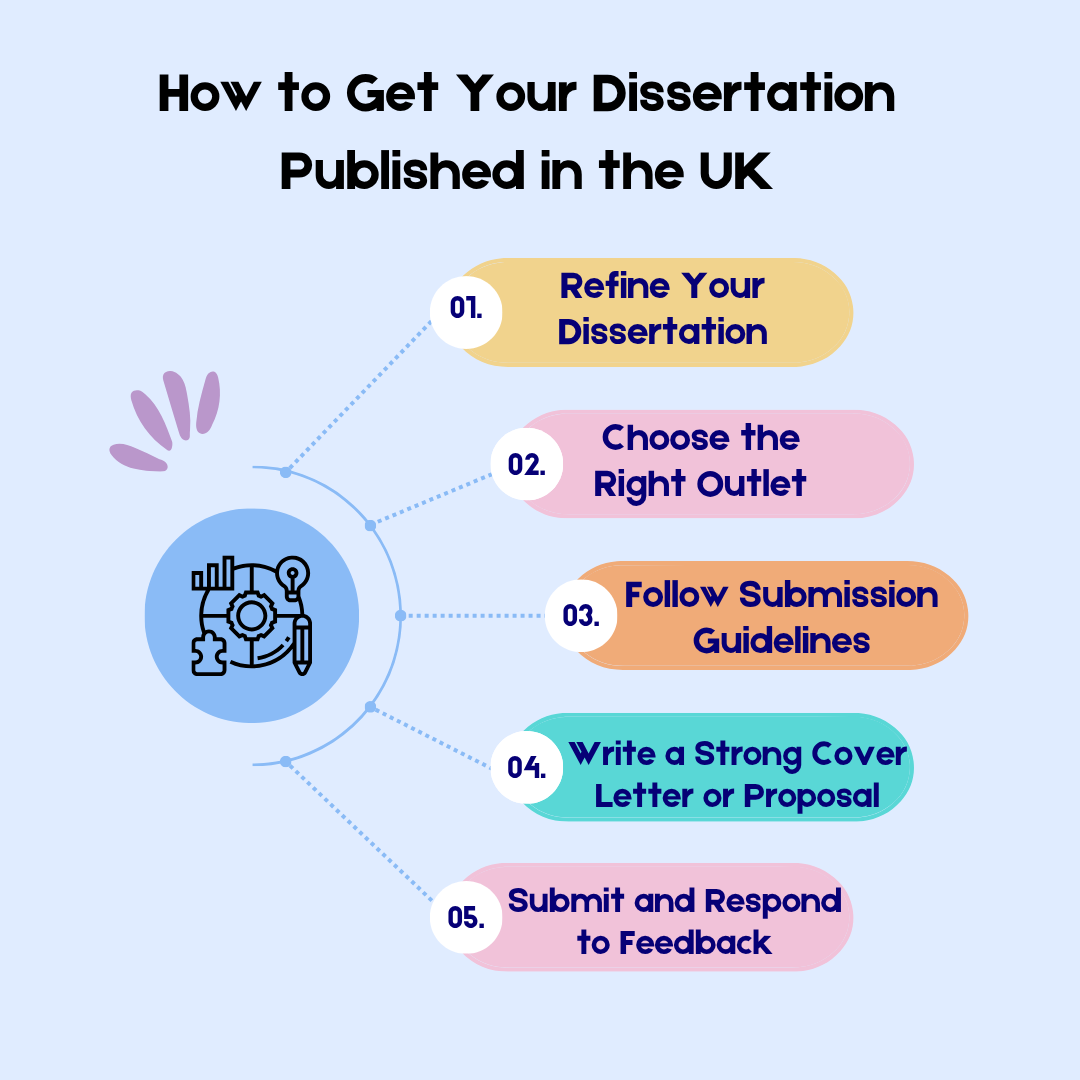
📚 What You’ll Learn in This Guide
A Complete Guide (2025 Edition)
How to Get Your Dissertation Published in the UK : Publishing your dissertation is a major milestone in your academic journey. It not only validates your research but also contributes to your field and boosts your professional reputation. Whether you’re looking to publish in a journal, as a book, or online, this guide will walk you through every step of the process and help increase your chances of success.
Publishing your dissertation can significantly boost your academic career, as UK Government Education discusses in its coverage of academic publishing trends. UCAS University Admissions highlights how UK universities encourage research dissemination. Publishing industry insights from Prospects UK Careers and early-career academic advice from HESA Higher Education Data provide practical steps for turning your dissertation into a published work.
Why Publish Your Dissertation?
Increase visibility in your field
Build your academic portfolio for postdoctoral or faculty positions
Contribute to ongoing research and debates
Reach a wider audience through open-access platforms
Top Ways to Publish a Dissertation in 2025
1. Academic Journals
Turning your dissertation into one or more journal articles is the most common route.
How to Do It:
Identify peer-reviewed journals in your discipline.
Read recent publications to understand tone, structure, and focus.
Adapt your dissertation into a concise manuscript (most journals prefer 6,000–10,000 words).
Submit and engage with the peer-review process.
2. Book Publishing
If your dissertation has broad appeal or offers new insights, consider publishing it as a book.
Your Options:
University presses: Best for academic, well-researched content.
Commercial academic publishers like Routledge or Springer.
Prepare a book proposal and query letter highlighting your research’s relevance and contribution.
3. Open Access Repositories
Make your dissertation freely accessible through platforms like:
ProQuest
Open Access Theses and Dissertations (OATD)
University digital repositories
Digital Commons Network
4. Self-Publishing
Publish your dissertation as an eBook or print edition on:
Amazon Kindle Direct Publishing
Lulu
IngramSpark
Ideal if you want full control over rights and formatting.
5. Academic Platforms
Upload your dissertation or sections of it on:
Academia.edu
ResearchGate
Your personal academic website or blog
These platforms help increase reach and citation potential.
Steps to Get Your Dissertation Published
Step 1: Refine Your Dissertation
Revise thoroughly: focus on clarity, structure, and academic tone.
Remove redundant sections (e.g., overly detailed literature reviews).
Consider hiring a professional editor.
Step 2: Choose the Right Outlet
Match your work to a journal’s scope, publisher’s focus, or audience interest.
Consider impact factor, review timelines, and acceptance rates.
Step 3: Follow Submission Guidelines
Every journal or publisher has its own requirements. Double-check:
Formatting style (APA, MLA, Chicago)
Need Help With Your Dissertation?
Our expert writers have helped thousands of students achieve top grades. Dissertations from £499 with free revisions.
â First-class quality guaranteed â On-time delivery â 100% plagiarism-free
Word count
Abstract and keywords
Citation format
Step 4: Write a Strong Cover Letter or Proposal
Summarize your research topic and significance.
Explain how your work fits the journal or publisher’s mission.
Be professional, concise, and enthusiastic.
Step 5: Submit and Respond to Feedback
Accept that peer review often involves major revisions.
Be open to criticism and use feedback constructively.
Stay patient—publication can take several months.
Copyright & Permissions
Understand the publication’s copyright policy:
Some require copyright transfer.
Others let you retain rights under Creative Commons licenses.
Always read the fine print before signing any agreement.
Boost Your Dissertation’s Impact
Attend Conferences
Presenting your research helps:
Get feedback from experts
Attract attention from editors or publishers
Network with potential collaborators
Leverage Your Academic Network
Talk to your advisor, committee, or colleagues who’ve published before. They can:
Recommend suitable journals or presses
Review your manuscript
Offer insight on what to expect
Promote Your Work Post-Publication
Share on LinkedIn, Twitter (X), or academic forums
Link in your email signature or online CV
Add your publication to Google Scholar
Interesting Tip: Try “Publishing by Chapter”
Instead of submitting the entire dissertation, break it down into individual journal articles, especially if your dissertation includes multiple case studies or themes. This can maximize your exposure and output.
Need Help? Get Professional Support
If the process feels overwhelming, consider getting expert help. Projectsdeal UK offers personalised, step-by-step guidance for publishing your dissertation in UK or international journals. Their academic publishing experts can assist you with:
Manuscript editing and formatting
Selecting the most suitable journals
Navigating the peer-review and revision process
Complying with UK-specific academic standards
📞 Contact via WhatsApp for a quick consultation: +44-7447-882377
They provide confidential, professional support tailored for UK PhD students and early-career researchers.
Final Thoughts: Persistence Pays Off
Publishing your dissertation won’t happen overnight. You may face rejections or revision requests, but that’s part of the journey. Stay committed, open to feedback, and proud of your research.
Quick Checklist for Dissertation Publishing
✅ Revise and edit your dissertation
✅ Choose the right publication outlet
✅ Follow submission guidelines
✅ Write a professional cover letter or proposal
✅ Respond to peer-review feedback
✅ Understand copyright
✅ Promote your published work
FAQs
Q: Can I publish my dissertation as is?
A: Rarely. You’ll need to revise it for clarity, length, and format to suit the outlet.
Q: How long does the publication process take?
A: It can take 3–12 months, depending on the journal and review process.
Q: Does publishing affect my copyright?
A: Yes. Some publishers require copyright transfer; others offer more flexible options.
You may also find these guides helpful: Psychology Dissertation, Mistakes to Avoid When Writing Your PhD Dissertation (2026 Guide), and How to Write a PhD Thesis 2026-Step by Step. Each article is written by UK academic experts to support your university studies.
Expert Academic Writing Services
From research proposals to full dissertations â trusted by 15,000+ UK students. Starting from £499.
â PhD-qualified writers â Money-back guarantee â Confidential service
Ready to Get Started? Talk to an Expert Today
Thousands of UK students trust ProjectsDeal to deliver high-quality academic work on time. Get a free consultation and see how we can help you succeed.
No obligation. Free consultation. Trusted by students at Russell Group universities across the UK.
Preparing a Dissertation for Journal Publication: Adapting Your Thesis
Converting a dissertation or thesis into a journal article is a common challenge for UK postgraduate students and early-career researchers. The two forms are structurally and stylistically very different, and a dissertation cannot simply be submitted to a journal as-is — it requires significant adaptation. Understanding the key differences will help you approach this task more efficiently and increase your chances of acceptance.
The most fundamental difference is length. UK dissertations are typically 10,000 to 80,000 words depending on level; journal articles in most fields range from 5,000 to 10,000 words. Condensing a dissertation into a journal article requires ruthless prioritisation: identify the single most important and original contribution of your dissertation — the finding or argument that most clearly advances knowledge in your field — and build the article around that contribution alone. The literature review, methodology, and discussion sections must all be substantially shortened, with only the material directly relevant to the central argument retained. Much of the contextual scaffolding that supports a dissertation is unnecessary in a journal article, where readers are assumed to have specialist knowledge of the field.
Journal selection is as important as the quality of the manuscript itself. Identify journals that publish research similar to yours in terms of topic, methodology, and disciplinary tradition — reading the aims and scope statements carefully will help you assess fit. Check the journal’s impact factor and ranking, the length of its review process, its open-access policy (important for UK Research Council-funded research, which must be published open access), and whether it charges publication fees. Submitting to an inappropriate journal is the most common reason manuscripts are rejected without review, and it can delay publication by months.
Alternative Pathways to Sharing Dissertation Research: Conference Presentations and Open Access
Journal publication is not the only route to sharing your dissertation research with the academic community. Conference presentations, both oral and poster, allow you to share your findings with specialists in your field and receive feedback that can strengthen your work before journal submission. Most UK academic disciplines have annual conferences at which PhD students and early-career researchers are actively encouraged to present — searching for the relevant professional association in your field (the British Sociological Association, the British Psychological Society, the Royal Geographical Society, and so on) will identify appropriate conference opportunities.
EThOS (Electronic Theses Online Service), maintained by the British Library, provides open-access hosting for UK doctoral theses. Submitting your thesis to EThOS (which your institution may do automatically) makes your research freely accessible to scholars globally and can generate citations before your journal article is published. Many UK universities also maintain their own institutional repositories where student dissertations and theses can be deposited. Depositing your work in these repositories is a straightforward and cost-free way of making your research publicly available.
For Master’s dissertations that produce genuinely novel findings, dissertation publication through academic book publishers — while less common than journal publication — is also possible, particularly in the humanities and qualitative social sciences where book-length arguments are the primary vehicle of scholarly communication. Some UK academic publishers, including Palgrave Macmillan, Routledge, and academic imprints of university presses, actively consider revised and expanded Master’s dissertations for publication as monographs or edited collection chapters, particularly if the topic is timely and the argument is sufficiently developed.
Need Expert Academic Help?
ProjectsDeal provides trusted dissertation, thesis, and essay writing support for UK university students. Get matched with a specialist in your subject area.
Get Your Dissertation Published: Key Insights for UK Students
UK students who master get your dissertation published gain a significant advantage. Understanding get your dissertation published thoroughly improves academic performance and helps achieve better grades at UK universities.
When developing skills in get your dissertation published, consistency is key. Practise regularly, seek tutor feedback, and use academic resources to strengthen your knowledge of get your dissertation published.
For further guidance on get your dissertation published, visit the Prospects UK dissertation guide — a trusted resource for UK students.