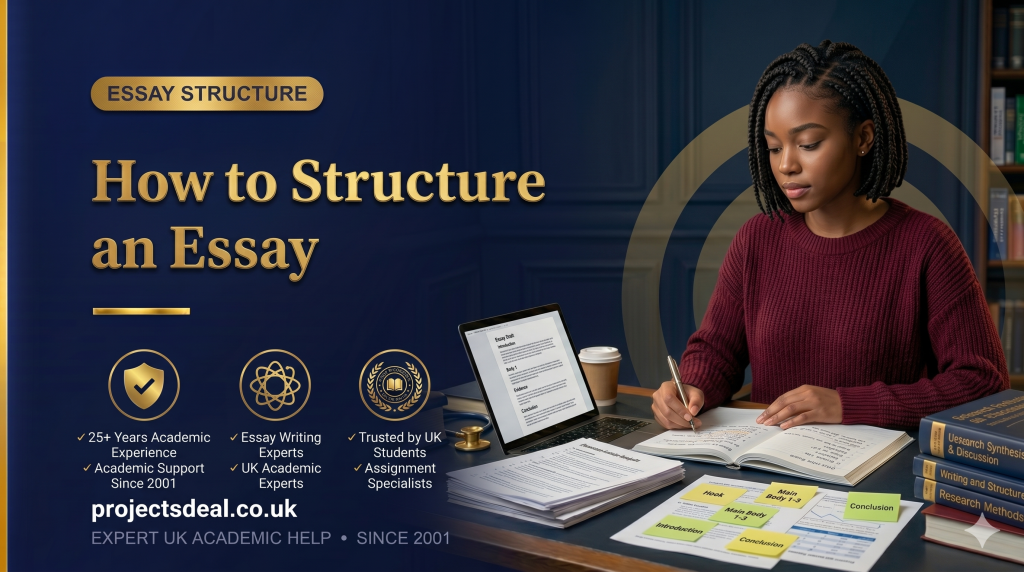
Learning how to structure an essay is an essential skill for UK university students. Even a well-researched essay loses marks if the reader cannot follow its argument — and that almost always comes down to structure. A clear structure shows the marker that you can organise ideas logically and build a case step by step. This complete UK guide explains the standard essay structure, how to use the PEEL paragraph model, how long each section should be, how to link paragraphs with signposting, and how to adapt the structure for argumentative essays.
How to structure an essay: Step-by-Step Guide
The Basic Essay Structure
Every essay has three parts: an introduction that sets up the topic and states your thesis, a main body of linked paragraphs that develop your argument with evidence, and a conclusion that draws everything together. The skill lies in how clearly each part connects to the others.
For further guidance on how to structure an essay uk, visit the academic writing skills guidance — a trusted resource for UK students and graduates.
How Long Each Part Should Be
As a rough guide, aim for about 10 percent introduction, 80 percent body and 10 percent conclusion. So a 1,500-word essay has an introduction and conclusion of roughly 150 words each, with the remaining 1,200 words building the argument across several body paragraphs.
The PEEL Paragraph Model
The most reliable way to structure a body paragraph is PEEL:
✓ Point — state the paragraph's main idea in the first sentence.
✓ Evidence — support it with a citation, data or example.
✓ Explanation — analyse what the evidence shows and why it matters.
✓ Link — connect back to the question and lead into the next point.
One clear idea per paragraph, developed through PEEL, keeps your argument easy to follow and easy to mark.
Ordering Your Paragraphs
Arrange your points in a deliberate order rather than the order you thought of them. Common approaches are strongest-point-first, a logical build-up from foundational to complex ideas, or a thematic grouping. Whatever you choose, each paragraph should follow naturally from the last so the argument feels like a journey, not a list.
Linking Paragraphs with Signposting
Signposting is the set of words and phrases that guide your reader — showing when you are adding to a point, contrasting, or moving to a new stage. Transitions such as “however”, “in contrast”, “building on this” and “a further factor” make the relationship between your paragraphs explicit and your structure visible.
Structuring an Argumentative Essay
For an argumentative essay, state your position in the introduction, devote body paragraphs to your supporting points, then address counter-arguments fairly before refuting them, and finish by reaffirming your case in the conclusion. Engaging with the other side strengthens rather than weakens your argument.
Common Mistakes to Avoid
✓ Paragraphs with more than one main idea.
✓ No clear thesis to organise around.
✓ Evidence with no explanation.
✓ Abrupt jumps between paragraphs with no signposting.
✓ An introduction or conclusion that is out of proportion.
Tips for a Clear Structure
Plan your paragraph order before you write, give each paragraph one job, use PEEL to develop it, signpost the transitions, and keep every paragraph tied to your thesis. A reader who never gets lost is a reader who awards marks.
Frequently Asked Questions
What is the basic structure of an essay?
Introduction, main body of linked paragraphs, and conclusion.
What is the PEEL paragraph structure?
Point, Evidence, Explanation, Link — a reliable model for body paragraphs.
How many paragraphs should an essay have?
As many as the argument needs; a common 1,500-word essay has roughly five to seven.
How long should each part of an essay be?
Roughly 10 percent introduction, 80 percent body and 10 percent conclusion.
What should each body paragraph contain?
One main point supported by evidence, explained and linked back to the question.
How do I link paragraphs together?
Use signposting and transitions that show how each point follows from or contrasts with the last.
Where does the thesis statement go?
At the end of the introduction.
What is signposting in an essay?
Words and phrases that guide the reader through your argument and show how sections connect.
Should each paragraph have one idea?
Yes — one clear main idea per paragraph keeps the argument easy to follow.
How do I structure an argumentative essay?
State your position, devote paragraphs to your supporting points, address counter-arguments, then conclude.
Related Study Guides
How to Write an Essay • How to Write an Introduction • How to Write a Thesis Statement • How to Write a Conclusion
UK students who master how to structure an essay uk gain a significant advantage in their academic career. Whether you are in your first year or final year, understanding how to structure an essay uk thoroughly will improve your overall academic performance and help you achieve better grades.
In summary, how to structure an essay uk is a fundamental aspect of UK higher education. By dedicating time to understanding and practising how to structure an essay uk, students can significantly improve their academic performance and develop skills that will serve them throughout their careers.
Want feedback on your essay structure before you hand in? Explore our essay writing service — trusted by UK students since 2001.
How to Structure Different Types of Essay
While the introduction, body, and conclusion structure applies broadly across UK academic essays, the internal organisation of the body varies depending on the type of essay and the discipline.
Argumentative or analytical essays are structured around the development of a central claim. The body is organised thematically: each section advances the argument by adding a new line of evidence or analysis. The classic “agree and disagree” structure—where one section presents the case for and another the case against—is weaker than a more analytically sophisticated structure that integrates multiple perspectives into a developed argument. Aim to have your own analytical position visible throughout the essay rather than simply reporting what others have said.
Comparative essays examine two or more texts, theories, cases, or historical periods. There are two main structural approaches: the block method (discuss one subject fully, then the other) and the point-by-point method (address each comparative dimension for both subjects before moving to the next). The point-by-point method is generally more analytically rigorous, as it forces direct comparison rather than sequential description, though the block method can work well for shorter comparisons or where detailed contextualisation of each subject is necessary before comparison is meaningful.
Discursive essays explore a question from multiple angles without necessarily arriving at a single definitive conclusion. They are common in law, ethics, and philosophy modules. Structure a discursive essay by presenting and analysing the strongest arguments on each side before arriving at a considered, balanced conclusion that reflects the genuine complexity of the question.
Reflective essays follow a different structure from purely analytical ones. Frameworks such as Gibbs’ Reflective Cycle or Johns’ Model provide a ready-made structure: description, feelings, evaluation, analysis, conclusion, and action plan. Reflective essays are common in nursing, social work, education, and counselling programmes, and must balance personal narrative with theoretical engagement.
Editing and Improving Your Essay Structure
Structural weaknesses are often more easily identified after a first draft is complete than during the planning and writing process. Building time for structural editing into your assignment schedule—reading your draft with specific attention to how the argument progresses from one paragraph to the next—is one of the highest-return activities available in the final stages of essay preparation.
A useful technique for structural editing is to write a one-sentence summary of each paragraph in your essay, in order. Then read these summaries as a sequence: do they tell a coherent story that develops your argument progressively from introduction to conclusion? If a paragraph’s one-sentence summary is vague, repeats a previous paragraph, or does not contribute clearly to the central argument, this signals a structural problem that needs to be addressed.
Check the transitional logic between paragraphs. Each paragraph should follow logically from the last and connect explicitly to the next. Abrupt transitions—where the reader cannot immediately see why you have moved from one point to the next—signal a structural gap. Add transition sentences that make the logical connection explicit: “While Smith’s argument is persuasive in this respect, it fails to account for the evidence presented by Jones…”
If you need professional support structuring an essay effectively or editing the structure of a draft you have already written, expert academic writing assistance can provide detailed feedback on argument organisation, paragraph flow, and overall essay structure that helps you present your ideas as clearly and persuasively as possible.
Need Expert Academic Help?
ProjectsDeal provides trusted dissertation, thesis, and essay writing support for UK university students. Get matched with a specialist in your subject area.