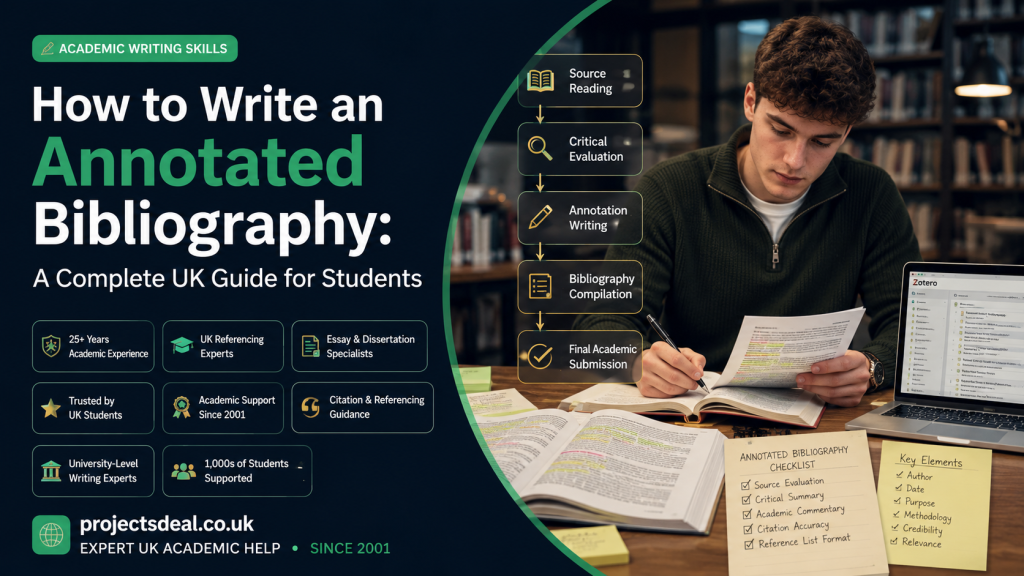
Learning how to write an annotated bibliography is an essential skill for UK university students. An annotated bibliography is a list of sources where each reference is followed by a short paragraph that summarises and evaluates it. UK tutors set it to make sure you have engaged critically with your reading before writing a literature review or dissertation. This complete guide explains what an annotated bibliography is, what each annotation should contain, the difference between descriptive and critical annotations, and how to format it correctly.
How to write an annotated bibliography: Step-by-Step Guide
What Is an Annotated Bibliography?
It is a reference list with annotations. Each entry gives the full citation in your required style, followed by a concise paragraph — usually 100 to 200 words — that summarises the source, assesses its quality, and explains its relevance to your topic.
For further guidance on how to write an annotated bibliography, visit the Harvard referencing guide — a trusted resource for UK students and graduates.
What Each Annotation Should Contain
✓ Summary — the source's main argument and scope.
✓ Evaluation — its credibility, methodology, strengths and limitations.
✓ Relevance — how it fits and informs your own research.
Descriptive vs Critical Annotations
A descriptive annotation simply summarises the source. A critical (or evaluative) annotation also judges its quality and usefulness. Most UK assignments want critical annotations — check your brief, but assume evaluation is expected.
How to Format It
List sources alphabetically by author, give each full citation in your required style (Harvard, APA, and so on), and place the annotation as an indented paragraph beneath. Keep formatting and citation style consistent throughout. See our Harvard referencing guide.
Choosing and Reading Sources
Select credible, relevant and reasonably current sources — peer-reviewed articles, scholarly books and reputable reports. Read each closely enough to summarise its argument and judge its rigour; an annotation is only as good as your engagement with the source.
Common Mistakes to Avoid
✓ Only summarising, with no evaluation.
✓ Inconsistent citation style.
✓ Annotations that are too long or too vague.
✓ Using weak or irrelevant sources.
✓ Forgetting to link the source to your topic.
Tips for a Higher Grade
Evaluate as well as summarise, keep each annotation concise and focused, use credible sources, stay consistent in style, and always explain relevance to your own work.
The Academic Context of Annotated Bibliographies in UK Universities
Annotated bibliographies occupy a distinct place in UK higher education assessment. Unlike a standard reference list, which simply catalogues sources, an annotated bibliography demonstrates your capacity to engage critically with the literature — a skill that is central to academic work at every level from undergraduate to doctoral study. UK universities, including Russell Group institutions such as Oxford, Cambridge, UCL, and Edinburgh, frequently set annotated bibliographies as standalone assignments or as preparatory components of larger projects such as dissertations, systematic reviews, and research proposals.
The ability to write a high-quality annotated bibliography signals to your assessor that you can identify authoritative sources, assess their methodological rigour, and situate individual works within the broader scholarly conversation of your field. For students undertaking research degrees, this skill is not merely assessed — it is essential to the research process itself. A well-constructed annotated bibliography becomes a living research tool that anchors your literature review and supports your theoretical framework.
Understanding Different Annotation Styles and When to Use Them
Not all annotated bibliographies look the same, and choosing the appropriate annotation style for your task is important. In UK academic contexts, you will most commonly encounter three distinct annotation types, each serving a different purpose and requiring a different approach from the writer.
Descriptive (or informative) annotations summarise the source’s content without evaluation. They tell the reader what the source covers, what argument the author advances, and what evidence or methodology is employed. These are most appropriate when your lecturer wants a factual overview of each source’s contribution to your topic.
Evaluative (or critical) annotations go further by assessing the source’s strengths and limitations. A critical annotation might note that a study uses a large and representative sample but employs an outdated theoretical model, or that a book chapter offers an insightful conceptual framework but lacks empirical support. Most UK university assignments at Level 6 (final year undergraduate) and above require this evaluative dimension.
Combination annotations blend description and evaluation, first summarising the source and then offering a critical assessment of its relevance and quality. This is the most comprehensive style and is typically expected in postgraduate assignments and research degree work.
Before you begin writing, always check your assignment brief carefully. If your module handbook specifies a particular annotation style or word count per entry (often 100–250 words per annotation), adhere to this exactly. Where no guidance is given, a combination annotation is generally the safest choice at Level 6 and above.
Referencing Systems and Citation Conventions in UK Annotated Bibliographies
The bibliographic entry that heads each annotation must conform to your institution’s prescribed referencing style. UK universities use a variety of systems, and the choice of style will affect how you present author names, publication dates, titles, and source details. The most common systems include Harvard referencing (most widely used in UK universities, particularly in social sciences, business, and humanities), APA 7th edition (standard in psychology, education, and many health disciplines), OSCOLA (used in UK law schools, relying on footnotes rather than in-text citations), and Vancouver (common in medicine and the health sciences, using numbered sequential citations).
Regardless of the referencing system you use, consistency is essential. Every entry must follow the same formatting conventions, and you should use a reliable institutional guide — such as your university library’s referencing pages — rather than relying solely on citation generators, which frequently introduce errors.
Want your referencing and citations checked by an academic specialist? Explore our academic writing & proofreading support — trusted by UK students since 2001.
Evaluating Source Quality: Academic Rigour in the UK Context
A critical component of writing effective annotations is the ability to evaluate source quality accurately. In UK academic culture, there is a strong emphasis on using peer-reviewed sources, and your ability to distinguish between high-quality, rigorous scholarship and less reliable material is part of what your assessor is looking to reward.
When evaluating a source, consider four key dimensions: Credibility — the author’s expertise and institutional affiliation, with peer-reviewed journal articles carrying more weight than websites or opinion pieces; Methodology — how the research was conducted, with randomised controlled trials and systematic reviews carrying greater evidential weight than small convenience samples; Currency — how recent the source is, which matters especially in rapidly developing fields such as AI, digital health, and climate science; and Relevance — how directly the source speaks to your specific research question.
UK universities generally expect students to draw primarily on peer-reviewed journal articles and academic books published by reputable university presses. Sources such as Wikipedia, news websites, and general-interest blogs are typically not considered acceptable as primary scholarly evidence, although they may help identify key debates and vocabulary in the early stages of research.
Writing Annotations That Demonstrate Critical Thinking
The quality of your annotations will be judged primarily on the depth and sophistication of your critical engagement rather than on description alone. High-quality annotations at Level 6 and postgraduate level demonstrate the ability to read actively, question assumptions, identify methodological strengths and limitations, and locate each source within the broader scholarly debate.
A strong annotation typically moves through several logical stages: a concise statement of the source’s central argument, a description of the methodology or approach, an evaluation of strengths and limitations, and a statement of relevance explaining how this source will contribute to your own research. Avoid the common error of simply restating what the source says in different words — this produces a descriptive annotation when a critical one is required.
Frequently Asked Questions
What is an annotated bibliography?
A list of sources where each citation is followed by a short paragraph summarising and evaluating it.
How long is each annotation?
Usually 100 to 200 words, though your brief may specify otherwise.
What should an annotation include?
A summary of the source, an evaluation of its quality, and its relevance to your research.
What is the difference between descriptive and critical annotations?
Descriptive annotations summarise; critical annotations also evaluate the source's quality and usefulness.
How do I format an annotated bibliography?
List sources alphabetically with full citations in your required style, each followed by an indented annotation.
Do annotations need citations?
Each entry begins with a full citation; the annotation itself does not usually need further references.
How many sources should it include?
As many as the brief requires; quality and relevance matter more than quantity.
What citation style should I use?
Whatever your department specifies — Harvard, APA, MLA or another — used consistently.
Is an annotated bibliography the same as a literature review?
No — a bibliography evaluates sources individually; a literature review synthesises them into a connected discussion.
How do I choose sources?
Pick credible, relevant and reasonably current scholarly sources that inform your topic.
How long should each annotation be in a UK university assignment?
Most UK university assignments specify a word count per annotation, typically between 100 and 250 words. Where no guidance is given, aim for approximately 150–200 words per annotation — enough to summarise the source, evaluate its quality and relevance, and explain its contribution to your work. At postgraduate level, annotations may be expected to be longer and more analytically sophisticated.
Can I use websites as sources in an annotated bibliography?
This depends on the type of website and your discipline. Peer-reviewed online journals, government publications, NHS guidelines, official institutional reports, and reputable NGO publications are generally acceptable. Wikipedia, general news sites, personal blogs, and commercial websites are usually not considered appropriate as primary scholarly sources in UK academic work. Always check your module handbook or ask your tutor if you are unsure about a particular source.
Do I need to include all sources I have read, or only those I will cite?
An annotated bibliography typically includes all sources you have consulted and found relevant, not just those you will cite in your main text. However, some assignments specify that you should include only sources you intend to reference. Read your assignment brief carefully: if it asks for a “critical annotated bibliography of sources used in your essay,” include only your cited sources; if it asks for a “review of the literature,” a broader selection is usually appropriate.
How do I organise the entries in an annotated bibliography?
Entries are most commonly organised alphabetically by the first author’s surname, which is standard in Harvard and APA referencing systems. Some assignments may request thematic or chronological organisation instead. Unless your brief specifies otherwise, alphabetical order is the default convention.
Is an annotated bibliography the same as a literature review?
No — though both involve engaging critically with sources. An annotated bibliography presents individual sources as discrete entries, each with its own standalone annotation. A literature review synthesises multiple sources together, identifying themes, debates, agreements, and contradictions across the literature as a whole. Some assignments use an annotated bibliography as a preparation exercise before writing a full literature review.
Related Study Guides
How to Write a Literature Review • Harvard Referencing Guide • How to Reference in APA 7 • How to Write a Research Paper
UK students who master how to write an annotated bibliography gain a significant advantage in their academic career. Whether you are in your first year or final year, understanding how to write an annotated bibliography thoroughly will improve your overall academic performance and help you achieve better grades.
Need Expert Academic Help?
ProjectsDeal provides trusted dissertation, thesis, and essay writing support for UK university students. Get matched with a specialist in your subject area.