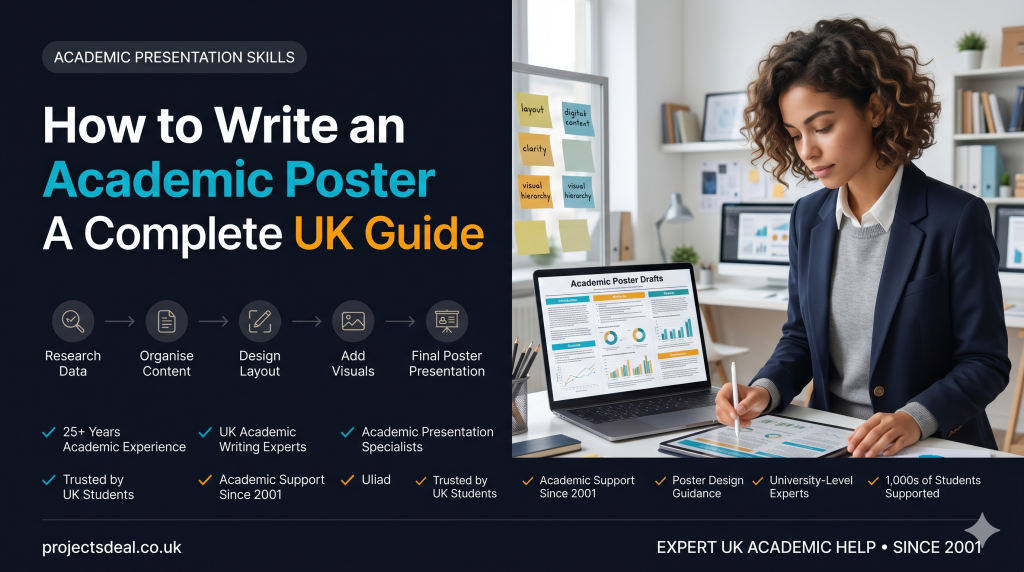
Learning how to write an academic poster is an essential skill for UK university students. An academic poster presents your research visually at a conference or assessment, distilling a whole project into a single, scannable page. It is judged on clarity and design as much as content. This complete UK guide explains what an academic poster is, what sections to include, how to design it for readability, and how to present it confidently.
How to write an academic poster: Step-by-Step Guide
What Is an Academic Poster?
An academic poster is a visual summary of a research project designed to be read in a few minutes. It must convey your question, method, findings and significance clearly, using a balance of concise text and visuals.
For further guidance on how to write an academic poster, visit the Prospects guide to studying in the UK — a trusted resource for UK students and graduates.
What to Include
✓ Title and authors.
✓ Introduction / aim.
✓ Method — briefly.
✓ Results — with charts or images.
✓ Conclusion and key references.
Design for Readability
Use a clear visual hierarchy: a large readable title, logical columns, generous white space, and legible fonts. Posters fail when they are walls of small text — let visuals carry the findings and keep text concise.
Less Text, More Visual
Resist cramming your whole report on. Use bullet-style points, charts, diagrams and images to communicate quickly. A viewer should grasp your main message in under a minute, then read detail if interested.
Presenting Your Poster
At a poster session you will often talk people through it. Prepare a short summary of your work, anticipate questions, and use the poster as a visual aid rather than reading from it. Confident, concise delivery makes a strong impression.
Common Mistakes and Tips
✓ Too much text.
✓ Tiny or inconsistent fonts.
✓ No clear visual flow.
✓ Cluttered layout. Tip: prioritise clarity, use visuals, and make the main message obvious at a glance.
When and Why Academic Posters Are Assessed at UK Universities
Academic poster presentations are a common assessment format across a range of UK university disciplines, from science and health sciences to social sciences, business and education. They test a specific and highly valued skill: the ability to distil complex research or academic work into a clear, visually compelling, self-explanatory format that communicates key findings to a non-specialist audience.
In the sciences — particularly biology, medicine, pharmacology, psychology and related fields — poster presentations are modelled on the academic conferences where researchers present and discuss new findings. UK undergraduate and postgraduate students in these disciplines regularly complete poster assessments as part of research methods, laboratory or project modules.
In business and management, posters are often used to present project analyses, market research findings or strategic recommendations. In education and social science, poster presentations test students’ ability to communicate research findings to a practitioner audience (teachers, social workers, healthcare professionals) who may not be specialists in academic methodology.
The key difference between a poster assessment and a written essay is that the poster must work without the presenter there to explain it. A well-designed academic poster tells its story independently, using visual hierarchy, clear headings and concise text to guide the reader through the content in logical sequence.
Structuring an Academic Poster: The Standard Sections
Most academic poster assessments in UK universities follow a standard structure derived from the conventions of scientific conference posters. The following sections are expected in most contexts, though the precise names and order may vary.
Title — The title should be informative rather than clever. It should communicate the topic and ideally the key finding or question. It must be legible from approximately 2 metres. Recommended font size: 72–96pt.
Author(s) and affiliation — Your name, student number (if required), module and institution. Typically presented in a smaller font below the title.
Introduction / Background — Contextualises the topic and establishes why the research is important. Should be brief — 3–5 sentences in most poster formats. Includes a clear statement of the research question or aim.
Methods — A brief description of how the research was conducted. For empirical research, this includes study design, participants, data collection method and analysis approach. Methods sections on posters are typically summarised in bullet points or a concise paragraph.
Results / Findings — The central section of the poster. Key findings should be presented visually (graphs, tables, images) with brief explanatory text. Visuals should be clearly labelled and captioned.
Discussion / Conclusions — What do the findings mean? How do they relate to existing literature? What are the implications? What are the limitations? These are typically presented in brief paragraphs or bullet points.
References — A condensed reference list. Include only the most important sources cited on the poster, formatted in the appropriate referencing style. Font can be smaller (8–10pt) in the references section.
Want one-to-one support with your dissertation? Explore our dissertation writing service — trusted by UK students since 2001.
Academic Poster Design Principles
The design of an academic poster is as important as its content. A poster with excellent content but poor design will be harder to read and less effective at communicating findings. The following design principles are widely applicable across academic disciplines.
Visual hierarchy — Use size, colour and position to guide the reader’s eye through the poster in the intended sequence. The title should be the most visually prominent element. Section headings should be clearly distinguishable from body text. Key figures or findings should be visually highlighted.
Readable fonts at appropriate sizes — Use a clean, sans-serif font (Arial, Calibri, Helvetica) for body text at a minimum of 24pt. Section headings at 36–48pt. Title at 72–96pt. Avoid decorative fonts that compromise legibility.
Colour palette — Use two to three colours consistently throughout the poster. Ensure sufficient contrast between background and text colours. Avoid colour combinations that are inaccessible to colour-blind readers (red-green combinations are particularly problematic). If your institution has a brand colour palette, use it.
White space — Overcrowded posters are harder to read and look less professional. Leave adequate white space between sections, around figures and in the margins. White space is not wasted space — it makes content more legible and the overall design more professional.
High-resolution images and figures — All images, graphs and figures should be high resolution (at least 300dpi for print). Low-resolution images appear pixelated when printed at poster size and significantly reduce the professional quality of the presentation.
Consistent alignment and grid — Use a consistent column grid (typically two or three columns for A0 posters) and align all elements to it. Misaligned text boxes and figures create a disordered appearance.
Presenting Your Academic Poster
In most UK university poster assessment contexts, the poster is both a static display and the focus of a live presentation or discussion with markers. Preparing for the live presentation element is as important as producing the poster itself.
Prepare a two-minute “elevator pitch” summary of your poster that covers: the research question, the key findings, and their implications. This pitch should be deliverable without referring to notes, since fluency and confidence are part of what is being assessed.
Anticipate questions markers or audience members are likely to ask about your methodology, your findings and their limitations. Practise articulating clear, confident answers. Markers at poster presentations often probe methodology and limitations specifically, so ensure you can discuss these elements in detail beyond what is visible on the poster itself.
Bring any supporting materials that enhance understanding — handouts with a QR code linking to a full report, business cards with your contact details, or supplementary data tables that were too detailed for inclusion on the poster. These demonstrate thorough preparation and professionalism.
Frequently Asked Questions
What is an academic poster?
A visual summary of a research project designed to be read quickly at a conference or assessment.
What sections does an academic poster include?
Title and authors, introduction or aim, method, results, conclusion and key references.
How do I design a readable poster?
Use a clear visual hierarchy, legible fonts, columns and generous white space.
How much text should a poster have?
As little as possible — let charts, images and concise points carry the message.
What font size should I use?
Large enough to read from a distance; the title biggest, body text clearly legible.
How do I present a poster?
Prepare a short verbal summary and use the poster as a visual aid, not a script.
What is the most common poster mistake?
Cramming in too much small text.
How long should viewers take to read it?
They should grasp the main message in under a minute.
What size should an academic poster be?
The standard academic conference poster size is A0 (841mm x 1189mm), and most UK university poster assessments use this format. Some assessments use A1 (594mm x 841mm). Check your module brief for the exact size requirement — designing at the wrong size requires significant reworking.
What software should I use to make an academic poster?
The most widely used tools for academic posters at UK universities are Microsoft PowerPoint (most common, as it is widely available) and Canva (free online tool with many poster templates). Adobe InDesign and Illustrator are used for professional quality but require expertise and licencing. For scientific posters with many figures, PowerPoint or Canva are entirely appropriate.
How much text should be on an academic poster?
Academic posters should contain significantly less text than a written essay. A good rule of thumb: if someone standing 1 metre away needs more than 3–5 minutes to read your poster, it contains too much text. Aim for approximately 300–500 words of body text across the entire poster, using visuals, bullet points and concise sentences rather than prose paragraphs.
Do academic posters need to be referenced?
Yes — any claims based on specific studies, statistics or published data should be cited on the poster, using the appropriate referencing style. A condensed references section at the bottom of the poster lists the key sources cited. Full bibliography format is typically not required — the most important sources cited in the poster content are sufficient.
How long should the poster presentation speech be?
Most UK university poster presentations allow 2–5 minutes for the student to present their poster, followed by questions from markers. Prepare a focused, confident two-minute summary that covers the research question, key findings and main implications — and practise delivering it without reading from notes.
Related Study Guides
How to Write a Research Paper • How to Write a Presentation • How to Write an Abstract • How to Write a Dissertation
UK students who master how to write an academic poster gain a significant advantage in their academic career. Whether you are in your first year or final year, understanding how to write an academic poster thoroughly will improve your overall academic performance and help you achieve better grades.
Need Expert Academic Help?
ProjectsDeal provides trusted dissertation, thesis, and essay writing support for UK university students. Get matched with a specialist in your subject area.