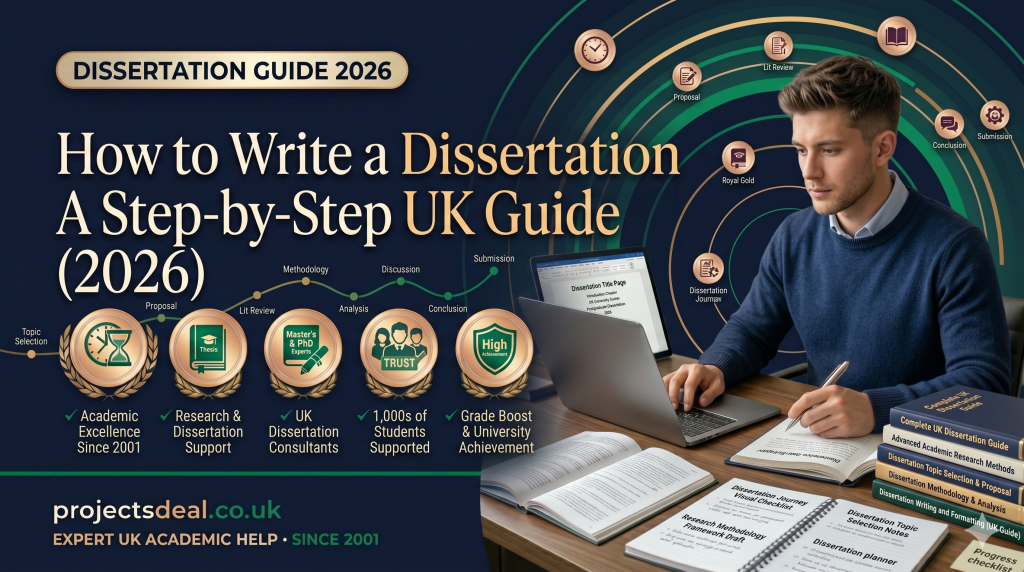
A dissertation is the largest and most independent piece of work in a UK degree, and for many students the most daunting. It is your chance to investigate a question that genuinely interests you, demonstrate that you can plan and conduct rigorous research, and make a small but real contribution to your field. This complete UK guide walks you through every stage — from choosing a topic and writing a proposal, through each chapter of the dissertation, to planning, referencing, editing and avoiding the most common mistakes.
What Is a Dissertation?
A dissertation is an extended piece of independent, original research that answers a focused question. Unlike an essay, which argues a position using existing sources, a dissertation requires you to design a study, gather or critically analyse evidence, and present your own findings and conclusions. In the UK, undergraduate dissertations are usually 8,000–12,000 words, Master's dissertations 12,000–20,000 words, and a PhD thesis can reach around 80,000 words. Whatever the level, the marker is looking for a clear research question, a critical command of the literature, a justified method, and analysis that goes beyond description.
Choosing Your Dissertation Topic
The topic is the foundation of everything that follows, so it is worth real thought. A strong topic is focused, researchable, current and genuinely interesting to you — you will live with it for months. Avoid topics that are too broad (“social media and society”) or impossible to research within your time and resources. Read recent journal articles in your area, look at the “future research” sections of existing studies for gaps, and discuss ideas with your supervisor early. See our guide to choosing a dissertation topic for a step-by-step approach.
Writing the Research Proposal
Most UK universities require an approved proposal before you begin. The proposal is a plan: it sets out your working title, the background and rationale, your aim, objectives and research questions, a brief review of the literature showing the gap, your proposed methodology, a timeline, and any ethical considerations. A good proposal proves your project is focused, feasible and worthwhile. See our dissertation proposal guide and guide to aims and objectives.
The Structure of a Dissertation
Although conventions vary by discipline, most UK dissertations follow a recognisable structure. Understanding the job of each chapter is half the battle.
Title Page, Abstract and Contents
The abstract is a concise summary — aim, method, key findings and conclusion — written last but placed first. It is often the only part read before your work is shortlisted, so make it count. See our abstract guide.
Introduction
The introduction establishes the topic, context, problem and aim, states your research questions, defines the scope, and outlines the structure. By the end, the reader should know exactly what you are investigating and why. See our dissertation introduction guide.
Literature Review
The literature review is not a summary of everything written on your topic; it is a critical synthesis that organises sources by theme, shows where they agree and disagree, and identifies the gap your study addresses. This is where many students lose marks by describing rather than analysing. See our literature review guide.
Methodology
The methodology explains how you answered your questions and, crucially, justifies every choice: your research design, whether the study is qualitative, quantitative or mixed, your sampling, data collection and analysis, and your ethical safeguards. A reader should be able to judge — and in principle repeat — your study. See our methodology guide.
Results / Findings
The results chapter presents what you found objectively, using clear tables, figures and (for qualitative work) representative quotes — without interpretation. See our results chapter guide.
Discussion
The discussion interprets your findings: what they mean, how they relate to the literature, their implications, and their limitations. This is where the highest marks are earned, because it demonstrates critical thinking. See our discussion chapter guide.
Conclusion, References and Appendices
The conclusion answers your research questions, states your contribution, acknowledges limitations and suggests future research — without introducing new evidence. The reference list and appendices follow. See our conclusion guide and appendix guide.
Planning and Time Management
A dissertation fails or succeeds on planning long before it is written. Break the project into stages — proposal, reading, ethics approval, data collection, analysis, drafting each chapter, editing — and work backwards from your deadline, setting milestones with buffer time. A simple Gantt chart or a calendar of weekly targets keeps you on track and prevents the all-too-common last-minute crisis. Write steadily; even 500 words a day adds up far faster than occasional binges.
Researching and Referencing Efficiently
Gather credible, relevant and reasonably current sources — peer-reviewed journals, scholarly books and reputable reports — and take organised notes that record the citation as you go. Use a reference manager (such as Zotero, Mendeley or EndNote) to store sources and format citations automatically. Reference in your required style consistently, and add every citation the moment you use a source rather than reconstructing them at the end. See our Harvard referencing guide and guide to avoiding plagiarism.
Want one-to-one support with your dissertation? Explore our dissertation writing service — trusted by UK students since 2001.
Writing Tips for a Higher Grade
✓ Keep every chapter tied to your research question.
✓ Be critical and analytical, not descriptive.
✓ Use clear signposting so the reader always knows where they are.
✓ Support every claim with evidence.
✓ Write in a formal, objective academic voice.
✓ Keep results and discussion distinct.
✓ Revise your introduction once the dissertation is complete so it matches the finished work.
Common Mistakes to Avoid
✓ A topic or question that is too broad.
✓ A literature review that lists rather than synthesises.
✓ A methodology that describes methods without justifying them.
✓ Mixing results with interpretation.
✓ Leaving referencing and proofreading to the last minute.
✓ Ignoring your marking criteria.
✓ Starting data collection before ethical approval.
Editing and Proofreading
Reserve your final weeks to edit and proofread the whole document: check consistency across chapters, the logical flow of your argument, referencing accuracy, formatting against your guidelines, and a final read for sense and surface errors. Errors across tens of thousands of words are easy to miss when rushing, so build in time — or use a professional proofreader. See our proofreading guide.
Frequently Asked Questions
How long is a UK dissertation?
Undergraduate dissertations are typically 8,000–12,000 words and Master's 12,000–20,000 words; a PhD thesis can reach 80,000 words. Always follow your own brief.
How long does it take to write a dissertation?
Most students work on a dissertation over a full term or longer; a realistic plan allows weeks for research, drafting and editing rather than a last-minute rush.
What are the main chapters of a dissertation?
Introduction, literature review, methodology, results/findings, discussion, and conclusion, plus references and appendices.
Should I write the introduction first or last?
Draft it early to set direction, but revise it last so it matches the finished study.
What referencing style should I use?
Whatever your department specifies — commonly Harvard, APA, Vancouver or OSCOLA — applied consistently.
Do I need ethical approval?
Any study involving participants or personal data usually requires ethical approval before data collection begins.
What is the hardest part of a dissertation?
Many students find the literature review and discussion hardest, because both require synthesis and critical analysis rather than description.
How do I avoid plagiarism in a dissertation?
Cite every source, paraphrase properly, quote accurately, and run a similarity check before submission.
How is a dissertation marked?
On its research question, literature review, methodology, analysis, critical discussion, structure, and referencing — check your marking rubric.
Can I get help with my dissertation?
Yes — a specialist can provide an original model dissertation or support a single chapter, as a reference for your own work within your university's policy.
Further Reading: Authoritative UK Sources
For trusted, independent guidance, see these UK sources:
✓ 7 steps to writing a dissertation – Prospects
✓ Academic integrity – QAA
Related Study Guides
Dissertation Proposal • Literature Review • Methodology • Discussion Chapter • Choosing a Topic
Need Expert Academic Help?
ProjectsDeal provides trusted dissertation, thesis, and essay writing support for UK university students. Get matched with a specialist in your subject area.