
Complete Guide with Chapter Breakdown (2026)
PhD Thesis Structure UK: A UK PhD thesis typically spans 70,000 to 100,000 words, structured into six to eight chapters comprising an introduction, literature review, methodology, results, discussion, and conclusion. It must demonstrate an original contribution to knowledge, often organized as a standalone document or via a publication-based (paper-based) format
Understanding the correct PhD thesis structure in the UK is one of the most critical steps for any doctoral student. Your thesis is not just a long academic document — it is a formal presentation of years of research, analysis, and original contribution to your field. Even strong research can lose impact if it is poorly structured or difficult to follow.
In UK universities, examiners expect a clear, logical, and well-organised thesis that demonstrates not only subject knowledge but also your ability to present complex ideas in a structured academic format. A properly structured thesis helps:
- Improve clarity and readability
- Strengthen your arguments and research flow
- Meet strict UK university guidelines
- Increase your chances of successful viva and approval
However, many PhD students find themselves confused and overwhelmed when it comes to structuring their thesis. This is completely normal, especially when dealing with detailed chapters, formatting rules, and academic expectations.
Some of the most common challenges students face include:
- Uncertainty about what chapters to include and how they differ
- Difficulty organising content logically across multiple sections
- Lack of clarity on UK university requirements and expectations
- Confusion about formatting, referencing styles, and word count limits
- Balancing depth of research with proper academic structure
Without a clear structure, even well-researched work can appear disorganised, which may affect how examiners evaluate your thesis.
If you’re currently struggling with how to organise your PhD thesis, you’re not alone. Thousands of students across the UK face the same challenge every year.
This comprehensive guide by projectsdeal.co.uk is designed to simplify the entire process for you. In the following sections, you’ll learn:
- The standard PhD thesis structure used in UK universities
- A detailed breakdown of each chapter and what to include
- Formatting guidelines and word count expectations
- Common mistakes to avoid
- Practical tips to improve your thesis quality
By the end of this guide, you’ll have a clear roadmap to structure your PhD thesis effectively and meet UK academic standards with confidence.
Typical UK PhD Thesis Structure
A standard PhD thesis structure in the UK follows a clear and logical format designed to present your research in a coherent and academically rigorous way. While exact requirements may vary between universities, most theses include the following core sections:
Title Page & Abstract:
A concise overview of your research, including the aim, methodology, and key findings. This section provides examiners with a quick understanding of your study.
Acknowledgements & Declarations:
A brief section where you acknowledge support from supervisors, institutions, or individuals, along with a declaration confirming the originality of your work.
Introduction (approx. 10% of total word count):
Sets the foundation of your thesis by outlining the research background, aims, objectives, and the significance of your study. It also highlights your contribution to the field.
Literature Review:
A critical evaluation of existing research related to your topic. This chapter identifies gaps in current knowledge and positions your research within the academic conversation.
Methodology:
Explains how your research was conducted, including research design, data collection methods, sampling techniques, and justification for your chosen approach.
Results / Findings:
Presents the data collected during your research. This section may be divided into multiple chapters based on themes, case studies, or experiments.
Discussion:
Interprets your findings and links them back to your research questions and existing literature. This is where your analytical and critical thinking skills are demonstrated.
Conclusion & Further Research:
Summarises the key findings of your study, highlights its contribution to knowledge, and suggests areas for future research.
Bibliography / References:
A complete and properly formatted list of all sources cited in your thesis, following a recognised referencing style such as Harvard or APA.
Appendices:
Includes supplementary materials such as raw data, questionnaires, interview transcripts, or additional documents that support your research.
Key Features of UK PhD Thesis Submissions
Original Contribution to Knowledge:
The most important requirement of a UK PhD thesis is to demonstrate originality. Your research must add new insights or perspectives to your academic field.
Paper-Based (Thesis by Publication) Option:
Some UK universities allow a thesis format based on published or publishable research papers, combined with an overarching introduction and conclusion.
Strict Formatting Guidelines:
Most universities require standard formatting, such as:
- 12-point font (Times New Roman or similar)
- 1.5 or double line spacing
- Consistent margins and referencing style
The “Sandwich” Structure:
A commonly used approach where:
- The introduction provides context and direction
- The main body delivers critical and analytical content
- The conclusion focuses on implications and future research
What is the Ideal PhD Thesis Structure in the UK?
If you explore your university library or browse academic resources online, you’ll find countless books and guides explaining the “ideal” PhD thesis structure. Many of these are useful and worth reading. However, for most students, the real challenge is not the lack of information — it’s understanding how to apply that structure to their own research in a practical way.
In this guide, projectsdeal.co.uk brings you a simplified “PhD thesis structure 101” approach, designed specifically for UK students. This is based on practical experience, common university expectations, and the real challenges students face when writing their thesis.
A Practical Introduction to Structuring Your PhD Thesis
Rather than overwhelming you with theory, this section focuses on giving you a clear and realistic overview of how a PhD thesis is typically structured in the UK.
In the following sections, you’ll:
- Understand the standard PhD thesis format used in UK universities
- Learn what each chapter is meant to achieve
- Get practical insights into how to plan and organise your content effectively
- See how different sections of your thesis connect to form a complete research document
This will give you a strong foundation before diving deeper into writing each chapter.
Important: There is No One “Perfect” Structure
Before going further, it’s important to understand one thing:
👉 There is no single “perfect” PhD thesis structure.
While most UK theses follow a common format, your final structure may vary depending on:
- Your subject area
- Your research methodology
- Your university or department guidelines
- Whether you choose a traditional thesis or a thesis by publication
If your thesis doesn’t perfectly match a standard structure, that’s completely normal. What matters most is that your work is:
- Logically organised
- Clearly presented
- Academically rigorous
Why Understanding Structure is So Important
A clear thesis structure is not just about presentation — it directly affects how your research is understood and evaluated.
A well-structured thesis helps you:
- Present complex ideas in a clear and logical way
- Build strong academic arguments
- Guide the reader (and examiner) through your research journey
- Avoid confusion and repetition
On the other hand, a poorly structured thesis can make even strong research difficult to follow.
Need Help Structuring Your PhD Thesis?
If you’re finding it difficult to organise your thesis or unsure whether you’re meeting UK academic standards, getting the right guidance can save you time and stress.
At projectsdeal.co.uk, students get structured support tailored to UK universities, including:
- Clear guidance on thesis structure
- Help with chapter organisation
- Support with literature review and methodology
- Expert academic assistance
📞 Contact: +44-7447-882377
👉 Now, let’s move on to the complete PhD thesis structure in the UK and break down each chapter in detail.
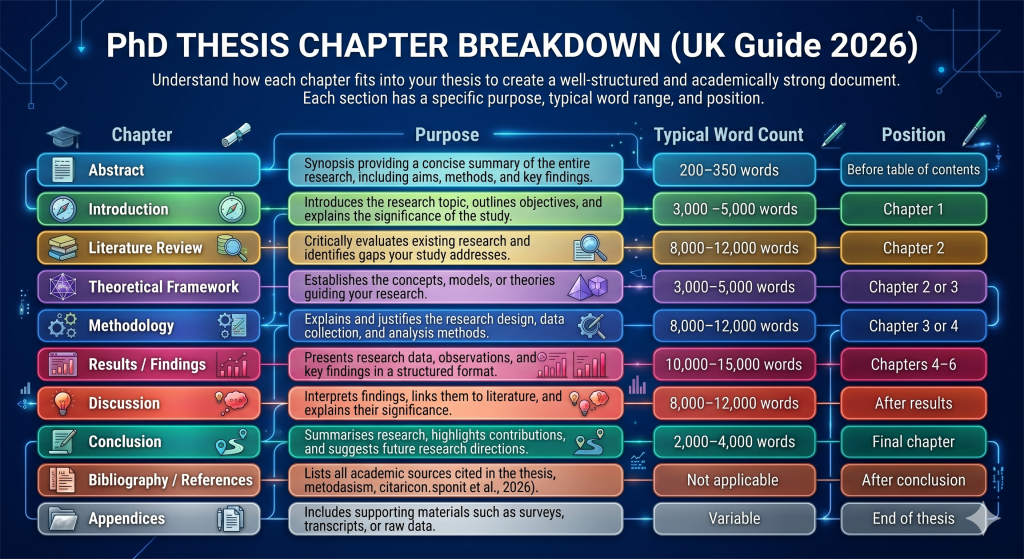
PhD Thesis Chapter Breakdown (UK Guide 2026)
Understanding how each chapter fits into your PhD thesis is essential for creating a well-structured and academically strong document. Each section has a specific purpose, typical word range, and position within the thesis.
Below is a simplified breakdown to help you see the big picture of your PhD structure:
PhD Thesis Structure (UK)
| Chapter | Purpose | Typical Word Count | Position |
|---|---|---|---|
| Abstract | Provides a concise summary of the entire research, including aims, methods, and key findings | 200–350 words | Before table of contents |
| Introduction | Introduces the research topic, outlines objectives, and explains the significance of the study | 3,000–5,000 words | Chapter 1 |
| Literature Review | Critically evaluates existing research and identifies gaps your study addresses | 8,000–12,000 words | Chapter 2 |
| Theoretical Framework | Establishes the concepts, models, or theories guiding your research | 3,000–5,000 words | Chapter 2 or 3 |
| Methodology | Explains and justifies the research design, data collection, and analysis methods | 8,000–12,000 words | Chapter 3 or 4 |
| Results / Findings | Presents research data, observations, and key findings in a structured format | 10,000–15,000 words | Chapters 4–6 |
| Discussion | Interprets findings, links them to literature, and explains their significance | 8,000–12,000 words | After results |
| Conclusion | Summarises research, highlights contributions, and suggests future research directions | 2,000–4,000 words | Final chapter |
| Bibliography / References | Lists all academic sources cited in the thesis | Not applicable | After conclusion |
| Appendices | Includes supporting materials such as surveys, transcripts, or raw data | Variable | End of thesis |
How to Use This Structure Effectively
This breakdown is a general guideline followed by most UK universities, but your exact structure may vary depending on your subject area, research type, and institutional requirements.
👉 Always:
- Check your university guidelines
- Follow your supervisor’s advice
- Adjust word count distribution if needed
How to Structure a PhD Abstract (UK Guide)

Your abstract is a short but powerful summary placed at the beginning of your PhD thesis. Although it appears first, it is usually the last section you write, once your research is fully completed.
A well-written abstract should clearly summarise your entire study — including your research purpose, methodology, findings, and contribution. Most importantly, your abstract must answer one key question:
👉 “So what?” — Why does your research matter?
In other words, what is the value and contribution of your thesis to your academic field?
What Should a PhD Abstract Include?
A strong PhD abstract in the UK typically addresses the following six key questions:
- What is the purpose of your research?
(Why did you conduct this study?) - What does existing research say?
(Briefly highlight current approaches and gaps in the literature) - What are your research aims or questions?
(What are you trying to investigate or prove?) - What methodology did you use?
(How did you conduct your research?) - What are your main findings?
(What did your research discover?) - What are your conclusions and implications?
(What do your findings mean for your field?)
👉 These elements ensure your abstract gives a complete snapshot of your thesis.
When Should You Write Your Abstract?
One common mistake students make is trying to write the abstract too early.
👉 In reality, your abstract should be written after completing your thesis, because:
- You need a full understanding of your findings
- Your conclusions may evolve during writing
- Your contribution becomes clearer at the end
Most students write their abstract alongside the acknowledgements and final edits.
Challenges of Writing a PhD Abstract
Writing a strong abstract can be difficult because:
- You have a strict word limit (usually 250–300 words)
- You need to summarise an entire thesis in a very small space
- Every sentence must add value
👉 This means your writing must be clear, precise, and highly focused.
Tips to Write an Effective PhD Abstract
To make your abstract strong and impactful, follow these practical guidelines:
- Use clear and concise sentences
Avoid overly complex language — clarity is more important than sophistication - Focus on key points only
Highlight 4–5 essential ideas instead of trying to include everything - Avoid repeating your thesis title
The abstract should add new information, not duplicate - Do not include references or citations
Keep it self-contained - Use relevant keywords naturally
This helps with searchability and clarity - Stick to the word limit
Exceeding it may lead to revision requests - Avoid vague or ambiguous language
Be specific about your research and findings - Do not include unnecessary background details
Keep the focus on your research - Ensure everything mentioned appears in your thesis
Do not introduce new information - Edit carefully
Every word should serve a purpose — remove anything unnecessary
What to Avoid in Your Abstract
To maintain academic quality, avoid the following:
❌ Over-explaining theoretical frameworks
❌ Making exaggerated claims about your research
❌ Using unclear or technical jargon without explanation
❌ Adding information not included in the thesis
❌ Writing long or complex sentences
👉 Your abstract should be accurate, balanced, and honest — not promotional.
How ProjectsDeal.co.uk Can Help You with Your PhD Abstract
Writing a PhD abstract may seem like a small task, but it plays a critical role in how your research is understood and evaluated. Many students struggle to summarise their entire thesis clearly while staying within strict word limits and academic expectations.
At projectsdeal.co.uk, we provide structured academic support tailored to UK university standards. Whether you’re unsure how to begin your abstract or need help refining it, our experts can guide you through the process.
With projectsdeal.co.uk, you can get:
- Clear structuring of your abstract based on UK guidelines
- Assistance in summarising complex research effectively
- Help with clarity, coherence, and academic tone
- Plagiarism-free and properly formatted content
- Expert review and editing support
📞 Contact: +44-7447-882377
Our goal is to help you present your research in the best possible way while reducing stress and saving time.
How to Structure a PhD Introduction (UK Guide)

The introduction is one of the most important chapters of your PhD thesis. It sets the tone for your entire research and creates the first impression for your examiner. A strong introduction not only explains what your thesis is about but also convinces the reader that your research is valuable and worth reading.
In simple terms, your PhD introduction has three main purposes:
- Establish your research area (your territory)
- Identify and justify your research gap (your niche)
- Explain the importance and contribution of your study
What Should Your PhD Introduction Do?
A well-written introduction should give the reader a clear understanding of your entire thesis without needing to read every chapter in detail.
By the end of your introduction, the reader should know:
- What your research is about
- Why your topic is important in your field
- What problem or gap your study addresses
- How your research was conducted (briefly)
- How your thesis is structured (chapter overview)
👉 Think of your introduction as a roadmap — it guides the reader through your research journey.
Key Elements of a Strong PhD Introduction
1. Background and Context
Introduce your research area and provide relevant background information to set the stage.
2. Research Problem
Clearly define the problem your study addresses and highlight the gap in existing research.
3. Research Aim and Objectives
Explain what your study aims to achieve and outline your research questions.
4. Significance of the Study
Show why your research matters and what value it adds to your field.
5. Methodology Overview
Briefly explain how your research was conducted (detailed discussion comes later).
6. Thesis Structure
Provide a short overview of how your thesis is organised chapter by chapter.
Focus on Your Contribution (Most Important Part)
Your introduction must clearly highlight your original contribution to knowledge.
👉 This is what examiners care about the most.
Make it clear:
- What is new in your research?
- What gap are you filling?
- Why does your work matter?
Your contribution should be easy to identify — not hidden or unclear.
Tips for Writing an Effective Introduction
- Start broad, then narrow down to your specific topic
- Keep your writing clear and structured
- Avoid unnecessary detail
- Maintain logical flow between sections
- Align your introduction with the rest of your thesis
Common Mistakes to Avoid
❌ Being vague about your research problem
❌ Not clearly stating your aims
❌ Overloading with background information
❌ Weak or unclear contribution
❌ Poor structure and flow
How ProjectsDeal.co.uk Can Help You with Your PhD Introduction
Writing a strong PhD introduction can be challenging, especially when you need to clearly define your research problem, justify your study, and highlight your contribution — all while meeting UK academic standards.
At projectsdeal.co.uk, we provide structured academic support designed specifically for PhD students in the UK. Whether you’re starting your introduction or struggling to refine it, our experts can guide you at every step.
With projectsdeal.co.uk, you can get:
- Clear structuring of your introduction based on UK guidelines
- Help in defining your research problem and objectives
- Support in presenting your contribution effectively
- Assistance with academic tone, clarity, and flow
- Editing and proofreading to meet university standards
📞 Contact: +44-7447-882377
Our goal is to help you create a strong, well-structured introduction that makes a powerful first impression on your examiners.
How to Structure a PhD Literature Review (UK Guide)

Imagine you’re developing a new product — before creating something original, you would first study what already exists. You’d analyse previous designs, understand their strengths, identify their weaknesses, and figure out how your version can improve on them.
👉 The same idea applies to your PhD literature review.
You cannot produce meaningful, original research unless you fully understand what has already been done in your field. Your literature review is where you explore existing studies, evaluate them critically, and position your research within the wider academic conversation.
Think of it as mapping your research “family tree” — showing where your work comes from and where it fits.
What is the Purpose of a Literature Review?
A PhD literature review is not just a summary of previous studies — it is a critical and analytical discussion of existing research.
In UK universities, a strong literature review serves three main objectives:
- Demonstrate your understanding of the field
Show that you are familiar with key studies, theories, and debates - Identify research gaps or limitations
Highlight what is missing, unclear, or underexplored in existing work - Justify your research contribution
Explain how your study addresses these gaps and adds new knowledge
👉 This is where you build the foundation for your entire thesis.
How to Approach Your Literature Review
To structure your literature review effectively, you need to move beyond simple description and focus on critical analysis.
Instead of just answering:
👉 “What did other researchers do?”
You should focus on:
👉 “What does this research mean, and what is missing?”
Key Steps in Writing a PhD Literature Review
While the exact process may vary, most students follow a structured approach like this:
1. Choose a Broad Research Area
Start with a general topic related to your field of study.
2. Identify Key Sources
Find relevant academic papers, journals, books, and credible sources.
3. Understand the Conversation
Analyse who is saying what, when, and why. Look for patterns, debates, and trends.
4. Take Structured Notes
Organise your notes based on themes, theories, or methodologies.
5. Narrow Down Your Focus
Refine your topic to focus on specific areas relevant to your research.
6. Evaluate Sources Critically
Compare studies, identify strengths and weaknesses, and assess reliability.
7. Use the “Snowball” Method
Follow references from key papers to discover additional relevant sources.
8. Identify Research Gaps
Look for unanswered questions, inconsistencies, or areas needing further study.
9. Start Writing Early
Don’t wait until the end — begin drafting as you review literature to save time and improve clarity.
How to Structure Your Literature Review Chapter
A well-organised literature review typically includes:
- Introduction
Overview of the chapter and research focus - Thematic or Conceptual Sections
Group studies based on themes, theories, or approaches - Critical Analysis
Compare and evaluate existing research - Research Gap Identification
Highlight what is missing - Summary
Link the literature to your research objectives
Common Mistakes to Avoid
❌ Simply summarising studies without analysis
❌ Listing research without clear structure
❌ Ignoring conflicting viewpoints
❌ Not linking literature to your research question
❌ Using outdated or irrelevant sources
👉 Your literature review should be analytical, structured, and purposeful.
How ProjectsDeal.co.uk Can Help You with Your Literature Review
Writing a PhD literature review can be overwhelming, especially when you need to analyse large volumes of research and present it in a structured, critical format.
At projectsdeal.co.uk, we provide expert academic support tailored to UK university standards. Whether you’re struggling to organise your sources or develop critical analysis, our team can guide you through the process.
With projectsdeal.co.uk, you can get:
- Help in structuring your literature review effectively
- Assistance in identifying research gaps
- Support with critical analysis and academic writing
- Guidance on selecting relevant and high-quality sources
- Editing and proofreading for clarity and consistency
📞 Contact: +44-7447-882377
Our goal is to help you create a strong literature review that clearly supports your research and meets academic expectations.
How to Structure a Theoretical Framework Chapter (UK Guide)
The theoretical framework is the foundation that supports your entire PhD thesis. It provides the concepts, theories, and assumptions that guide your research and shape how you interpret your findings.
Think of it as the blueprint of your study. Just as a building needs a strong framework to stand, your research needs a clear theoretical base to remain focused and academically sound.
By the time a reader finishes your theoretical framework chapter, they should clearly understand the intellectual foundation of your research.
What Should Your Theoretical Framework Explain?
A well-structured theoretical framework should answer the following key questions:
- What theories or concepts are you using?
(Are there specific models, hypotheses, or frameworks guiding your study?) - Why have you chosen these theories?
(What makes them suitable for your research problem?) - What are the implications of using these theories?
(How do they influence your analysis and interpretation?) - How do these theories connect to existing literature and your research problem?
(How have other researchers applied them, and how does your work differ?) - How will you apply these theories in your study?
(How do they help you measure or analyse your data?) - What is the relationship between key concepts?
(Can you present this through a model or diagram?)
👉 These elements ensure your framework is not just descriptive, but analytical and purposeful.
What is the Role of a Theoretical Framework?
Your theoretical framework can take different forms depending on your research approach, but generally it serves to:
- Define the theoretical assumptions behind your study
- Link your research to existing academic knowledge
- Guide the development of hypotheses, concepts, or propositions
- Help explain “how” and “why” your research problem exists
Think of It as a Toolbox
A helpful way to understand your theoretical framework is to think of it as a toolbox.
In your literature review, you identified a problem or gap.
👉 The theoretical framework gives you the tools (theories, models, concepts) to analyse and address that problem.
These tools help you:
- Focus your research
- Structure your data collection
- Interpret your findings logically
How to Structure Your Theoretical Framework Chapter
A typical structure may include:
1. Introduction to the Framework
Briefly introduce the purpose of the chapter and the theories you will discuss.
2. Overview of Relevant Theories
Discuss key theories, models, or concepts relevant to your study.
3. Critical Evaluation of Theories
Analyse strengths, limitations, and relevance of each theory.
4. Application to Your Research
Explain how these theories will be used in your study.
5. Conceptual Model (if applicable)
Present relationships between variables using a diagram or framework.
6. Summary
Summarise how your chosen framework supports your research objectives.
Be Critical, Not Just Descriptive
When discussing theory, your goal is not just to explain what others have said — but to critically evaluate it.
You should:
- Compare different theoretical perspectives
- Question their relevance to your study
- Highlight limitations in existing approaches
- Explain why your chosen framework is appropriate
👉 This shows examiners that you understand the current state of knowledge in your field.
Why This Chapter Matters
Your discipline may already have established theories and approaches. These can:
- Provide a strong starting point for your research
- Help shape your methodology
- Offer tested ways to analyse your data
However, in some cases:
- Existing theories may not fully explain your research problem
👉 In such situations, you must justify:
- Why existing theories are insufficient
- How your approach improves or adapts them
Linking Your Theory to Your Research
Once you select your theoretical perspective, you must clearly show how it connects to:
- Your research problem
- Your literature review
- Your methodology
- Your data analysis
Even if the connection is subtle, it must be explained.
👉 This ensures your thesis remains coherent and logically structured.
Common Mistakes to Avoid
❌ Simply describing theories without analysis
❌ Including irrelevant or outdated theories
❌ Failing to justify theory selection
❌ Not linking theory to your research problem
❌ Ignoring alternative perspectives
👉 Your framework should be focused, critical, and directly relevant to your study.
How ProjectsDeal.co.uk Can Help You with Your Theoretical Framework
Developing a strong theoretical framework can be one of the most challenging parts of a PhD thesis, especially when you need to connect complex theories with your research problem.
At projectsdeal.co.uk, we provide expert academic support tailored to UK university standards. Whether you’re unsure which theories to use or struggling to structure your framework, our team can guide you effectively.
With projectsdeal.co.uk, you can get:
- Help in selecting relevant theories and models
- Guidance on structuring your theoretical framework chapter
- Support in linking theory with your research objectives
- Assistance with conceptual models and relationships
- Editing and proofreading for clarity and academic quality
📞 Contact: +44-7447-882377
Our goal is to help you build a clear, strong theoretical foundation that supports your entire thesis.
How to Structure a Methods Chapter (UK Guide)
The methods chapter is often one of the most detailed and descriptive sections of your PhD thesis. It explains exactly how your research was conducted, allowing readers and examiners to understand — and potentially replicate — your study.
Not all theses have a separate methods chapter (especially in some qualitative or integrated designs), but in most UK PhD theses, this section plays a crucial role in demonstrating the rigour and credibility of your research.
What is the Purpose of a Methods Chapter?
The methods chapter is not just about describing what you did — it’s about justifying your choices and showing how your approach aligns with your research objectives.
In general, this chapter aims to:
- Explain how you answered your research questions
Describe the overall approach used in your study - Detail the data collection methods
Explain the techniques and tools used to gather data - Justify your methodological choices
Show why your chosen methods are appropriate - Link your methods to existing research
Compare your approach with similar studies in your field
👉 This section proves that your research is systematic, logical, and academically sound.
What Should Your Methods Chapter Answer?
By the end of your methods chapter, your reader should clearly understand:
- What did you do to achieve your research aims?
- Why did you choose this approach instead of others?
- How does your methodology relate to your research philosophy?
(e.g., epistemology and ontology) - What data collection methods did you use, and why?
- When and where was the data collected, and from whom?
- What tools or techniques were used to analyse the data?
- What are the limitations or implications of your methods?
- Were there any ethical considerations involved?
👉 If these questions are clearly answered, your methods chapter is doing its job well.
How to Structure Your Methods Chapter
A typical PhD methods chapter in the UK may include the following sections:
1. Research Design
Explain your overall research approach (qualitative, quantitative, or mixed methods) and why it is suitable for your study.
2. Research Philosophy
Discuss your epistemological and ontological stance (e.g., positivism, interpretivism) and how it influences your research.
3. Data Collection Methods
Describe how you collected your data, such as:
- Surveys
- Interviews
- Experiments
- Case studies
👉 Justify why these methods were chosen.
4. Sampling Strategy
Explain:
- Who your participants were
- How they were selected
- Sample size and rationale
5. Data Analysis Techniques
Describe how you analysed your data:
- Statistical tools (e.g., SPSS)
- Thematic analysis
- Content analysis
6. Ethical Considerations
Explain how you ensured:
- Participant consent
- Confidentiality
- Data protection
7. Limitations of the Methodology
Acknowledge any weaknesses in your approach and explain their impact on your research.
Be Clear and Justified
The key to a strong methods chapter is not just description — it’s justification.
You should:
- Explain why each method was chosen
- Compare alternatives where relevant
- Show awareness of strengths and limitations
👉 This demonstrates critical thinking and strengthens your research credibility.
Common Mistakes to Avoid
❌ Simply listing methods without explanation
❌ Failing to justify your choices
❌ Ignoring research philosophy
❌ Not linking methods to research questions
❌ Overlooking ethical considerations
👉 Your methods chapter should be clear, logical, and well-justified.
How ProjectsDeal.co.uk Can Help You with Your Methods Chapter
Writing a methods chapter can be challenging, especially when you need to clearly explain and justify your research design while aligning it with UK academic standards.
At projectsdeal.co.uk, we provide expert support to help students structure and refine their methodology effectively.
With projectsdeal.co.uk, you can get:
- Guidance on selecting the right research methods
- Help in structuring your methods chapter clearly
- Support in linking methodology with research objectives
- Assistance with data analysis techniques and tools
- Editing and proofreading for clarity and academic quality
📞 Contact: +44-7447-882377
Our goal is to help you present your research methods with clarity, confidence, and academic accuracy.
How to Structure an Empirical Chapter (UK Guide)
The empirical chapter is where you present the results of your research. Compared to other sections of your thesis, this chapter is often more technical and data-focused, as its primary role is to show what you found — not what it means.
By the time you reach this stage, you will already be very familiar with your data, which makes writing this section more straightforward. However, clarity and organisation are essential, as this chapter forms the foundation for your later analysis and discussion.
What is the Purpose of an Empirical Chapter?
The empirical chapter is designed to present your research findings in a clear and structured way.
It focuses on:
- Reporting the outcomes of your data collection
- Organising results logically (themes, variables, or experiments)
- Providing evidence to support your research
👉 Importantly, this chapter is about presentation, not interpretation.
What Should Your Empirical Chapter Answer?
By the end of this section, your reader should be able to clearly understand:
- What are the key results of your research?
- What patterns, themes, or trends emerge from the data?
- How do the findings relate (at a basic level) to existing studies?
- Were there any unexpected results or challenges?
- Have the results been clearly explained and presented?
- Is the data organised in a logical and easy-to-follow way?
👉 If your reader can answer these questions, your empirical chapter is effective.
How to Structure Your Empirical Chapter
A typical empirical chapter in a UK PhD thesis may include:
1. Introduction to the Chapter
Briefly explain what the chapter will cover and how the results are organised.
2. Overview of Data Collection
Provide a short recap of:
- Data sources
- Sample or participants
- Context of data collection
(Keep this brief — full details belong in the methods chapter.)
3. Presentation of Findings
This is the core of the chapter.
Present your results using:
- Tables
- Graphs
- Charts
- Thematic groupings
👉 Organise findings by themes, research questions, or variables.
4. Key Patterns and Observations
Highlight important trends or patterns in the data without analysing them deeply.
5. Summary of Results
Provide a brief summary of the main findings before moving to the discussion chapter.
Keep Presentation Clear and Structured
Since this chapter is data-heavy, clarity is essential.
You should:
- Use headings and subheadings for organisation
- Present data in a logical sequence
- Avoid unnecessary repetition
- Ensure tables and figures are clearly labelled
👉 The goal is to make your findings easy to understand.
Important: Do Not Mix Results with Discussion
One of the most common mistakes students make is combining results with interpretation.
👉 In the empirical chapter:
- You present the findings
- You do not fully interpret or evaluate them
Detailed analysis and meaning belong in the discussion chapter.
Common Mistakes to Avoid
❌ Mixing results with discussion
❌ Presenting data without clear structure
❌ Overloading with unnecessary detail
❌ Not linking findings to research questions
❌ Poor use of tables or visuals
👉 Keep your presentation focused, organised, and relevant.
How ProjectsDeal.co.uk Can Help You with Your Empirical Chapter
Presenting research findings clearly can be challenging, especially when dealing with complex data and multiple variables.
At projectsdeal.co.uk, we provide expert academic support tailored to UK university standards, helping students present their empirical data effectively.
With projectsdeal.co.uk, you can get:
- Help in organising and structuring your findings
- Support with tables, charts, and data presentation
- Guidance on aligning results with research objectives
- Assistance in maintaining clarity and logical flow
- Editing and proofreading for academic quality
📞 Contact: +44-7447-882377
Our goal is to help you present your research results clearly and professionally, ensuring your work meets academic expectations.
How to Structure a Discussion Chapter (UK Guide)

The discussion chapter is where your research truly comes to life. This is the stage where you move beyond simply presenting results and begin to interpret, analyse, and explain what your findings actually mean.
Many PhD students find this chapter the most challenging — and that’s completely normal. Unlike earlier stages of your academic journey, where you mainly reviewed existing research, here you are expected to think independently, form arguments, and contribute new insights to your field.
👉 This is where you begin to demonstrate your expertise as a researcher.
What is the Purpose of a Discussion Chapter?
The discussion chapter is where you make sense of your findings and connect them back to your research questions, literature review, and theoretical framework.
Its main purpose is to:
- Interpret your results
- Explain their significance
- Compare them with existing studies
- Highlight your contribution to knowledge
👉 In simple terms:
Results = What you found
Discussion = What it means
Why is the Discussion Chapter Difficult?
This chapter can feel difficult because:
- You are expected to go beyond description and into critical analysis
- You must connect multiple parts of your thesis (results, literature, theory)
- You are presenting ideas that may be new or not previously explored
👉 This is often the first time you are not just learning from others — but adding to academic knowledge yourself.
What Should Your Discussion Chapter Answer?
By the end of this chapter, your reader should be able to understand:
- What do your findings actually mean?
- How do they relate to your research questions?
- Do they support or contradict existing studies?
- Why did you get these results?
- What is your contribution to the field?
- What are the implications of your findings?
👉 If these questions are clearly answered, your discussion chapter is strong.
How to Structure Your Discussion Chapter
A typical PhD discussion chapter in the UK may include:
1. Introduction to the Chapter
Briefly explain what the discussion will cover and how it is organised.
2. Summary of Key Findings
Provide a short recap of your main results (without repeating everything).
3. Interpretation of Results
Explain what your findings mean and why they matter.
4. Link to Literature
Compare your results with previous studies:
- Do they agree?
- Do they differ?
- Why?
5. Theoretical Implications
Discuss how your findings relate to your theoretical framework.
6. Practical Implications
Explain how your research can be applied in real-world contexts (if relevant).
7. Limitations
Acknowledge any limitations in your study and their impact.
8. Recommendations for Future Research
Suggest areas where further research is needed.
Key Difference: Discussion vs Empirical Chapter
This is where many students get confused.
👉 Empirical Chapter:
- Presents data
- Shows results
- No deep interpretation
👉 Discussion Chapter:
- Interprets findings
- Explains meaning
- Connects to theory and literature
👉 Keep these sections clearly separate for better clarity.
Tips for Writing an Effective Discussion
- Focus on analysis, not repetition
- Clearly link findings to research questions
- Use evidence from your results to support arguments
- Be confident in presenting your insights
- Maintain logical flow between sections
Common Mistakes to Avoid
❌ Repeating results instead of analysing them
❌ Not linking findings to literature
❌ Ignoring unexpected results
❌ Making unsupported claims
❌ Weak or unclear contribution
👉 Your discussion should be critical, structured, and insightful.
How ProjectsDeal.co.uk Can Help You with Your Discussion Chapter
Writing a discussion chapter can be challenging, especially when you need to interpret results, connect them with theory, and clearly present your contribution.
At projectsdeal.co.uk, we provide expert academic support tailored to UK university standards, helping students develop strong and well-structured discussion chapters.
With projectsdeal.co.uk, you can get:
- Guidance on interpreting and analysing your findings
- Help in linking results with literature and theory
- Support in presenting your contribution clearly
- Assistance with structure, clarity, and academic tone
- Editing and proofreading for quality and consistency
📞 Contact: +44-7447-882377
Our goal is to help you turn your findings into meaningful academic insights and strengthen your overall thesis.
How to Structure a PhD Conclusion (UK Guide)

The conclusion is the final chapter of your PhD thesis — and it plays a crucial role in shaping the last impression your examiner will have of your work. It is your opportunity to bring everything together and clearly demonstrate the value of your research.
At this stage, your job is not to introduce new ideas, but to reflect on your research journey, connect your findings back to your objectives, and highlight your overall contribution to knowledge.
What is the Purpose of a Conclusion?
A strong PhD conclusion should:
- Clearly answer your research questions
- Link your findings back to your aims and objectives
- Explain the significance of your research
- Acknowledge any limitations or shortcomings
- Suggest directions for future research
👉 In simple terms, the conclusion tells the reader:
What did you do, what did you find, and why does it matter?
What a Conclusion Should NOT Do
It’s important to remember that your conclusion is not the place for new information.
Avoid:
❌ Introducing new data or findings
❌ Adding new arguments
❌ Expanding on ideas not discussed earlier
👉 Everything in your conclusion should already be supported by your thesis.
How to Approach Your Conclusion
Writing a strong conclusion requires a shift in perspective. Instead of focusing on individual chapters, you need to step back and look at your thesis as a whole.
Think of your thesis as a complete story:
- Each chapter contributes a part
- The conclusion brings everything together
Key Elements of a Strong Conclusion
A well-structured conclusion typically includes:
1. Restating Research Questions and Objectives
Briefly remind the reader what your study aimed to achieve.
2. Summary of Key Findings
Provide a concise overview of your main results without repeating details.
3. Overall Contribution to Knowledge
Clearly highlight what your research has added to your field.
👉 This is one of the most important parts — make it clear and confident.
4. Significance and Implications
Explain why your findings matter:
- Academic significance
- Practical applications (if relevant)
5. Limitations of the Study
Acknowledge any weaknesses or constraints in your research.
6. Recommendations for Future Research
Suggest areas where further investigation is needed.
Three Key Tips for Writing a Strong Conclusion
- Speak with confidence
By this stage, you are an expert in your topic — your writing should reflect that - Focus on the bigger picture
Don’t get lost in details — highlight the overall value of your thesis - Emphasise your contribution clearly
Make it obvious what your research has achieved
What Should Your Conclusion Achieve?
By the time your reader finishes your conclusion, they should be able to answer:
- What were the research questions and objectives?
- What are the final answers to those questions?
- What is the significance of the findings?
- What contribution has the research made?
- Are the conclusions supported by the results and discussion?
👉 If these points are clear, your conclusion is effective.
Why the Conclusion Matters So Much
Your conclusion is the last section your examiner will read before evaluating your thesis.
👉 This means:
- It reinforces your overall argument
- It highlights your contribution
- It leaves a lasting impression
A strong conclusion can significantly influence how your entire thesis is perceived.
How ProjectsDeal.co.uk Can Help You with Your Conclusion
Writing a clear and impactful conclusion can be challenging, especially when you need to summarise your entire thesis and present your contribution confidently.
At projectsdeal.co.uk, we provide expert academic support tailored to UK university standards, helping students craft strong and effective conclusions.
With projectsdeal.co.uk, you can get:
- Guidance on structuring your conclusion effectively
- Help in clearly presenting your research contribution
- Support in linking findings with research objectives
- Assistance with clarity, coherence, and academic tone
- Editing and proofreading for final submission
📞 Contact: +44-7447-882377
Our goal is to help you finish your thesis with a strong, professional conclusion that leaves a lasting impression.
PhD Thesis Guidelines by UK Universities (Word Count & Structure)
While the general PhD thesis structure in the UK is similar across institutions, each university has its own specific guidelines for word count, formatting, and submission requirements.
Below is a simplified comparison of some well-known UK universities to help you understand typical expectations:
UK University PhD Thesis Guidelines Overview
| University | Typical Word Count | Key Guidelines | Notes |
|---|---|---|---|
| University of Oxford | Up to 100,000 words | Must demonstrate original contribution to knowledge, strict formatting rules | Varies by department |
| University of Cambridge | ~80,000 words | Clear structure required, includes thesis summary and viva | Some subjects differ |
| University College London (UCL) | 80,000–100,000 words | Includes abstract, chapters, references, appendices | Word count excludes bibliography |
| University of Manchester | Up to 80,000 words | Strong emphasis on research contribution and methodology clarity | Faculty-specific rules apply |
| University of Edinburgh | ~100,000 words | Requires detailed literature review and clear thesis structure | Formatting guidelines strict |
| King’s College London | 80,000–100,000 words | Must include originality and critical analysis | Department variations |
| University of Birmingham | ~80,000 words | Focus on clarity, structure, and research impact | Some flexibility |
| University of Leeds | Up to 100,000 words | Includes full thesis with references and appendices | Check school guidelines |
| University of Bristol | 80,000–100,000 words | Requires clear methodology and contribution | Structure may vary |
| University of Glasgow | ~80,000 words | Emphasis on research quality and originality | Includes thesis + viva |
Important Notes for PhD Students
👉 These word counts are general guidelines, not strict rules. Always:
- Check your department-specific handbook
- Confirm with your supervisor
- Review submission regulations carefully
👉 Word count may exclude:
- Bibliography / references
- Appendices
- Tables and figures (in some cases)
What Do UK Universities Expect Overall?
Across most UK universities, your PhD thesis must:
- Demonstrate original research contribution
- Follow a clear and logical structure
- Show critical analysis and academic depth
- Meet formatting and submission standards
How ProjectsDeal.co.uk Can Help You Meet University Guidelines
Understanding different university requirements can be confusing, especially when guidelines vary by institution and department.
At projectsdeal.co.uk, we help PhD students align their thesis with specific UK university standards, ensuring accuracy and compliance.
With projectsdeal.co.uk, you can get:
- Guidance based on your target university requirements
- Help in managing word count and structure
- Support in formatting according to UK guidelines
- Editing and proofreading before submission
- Expert assistance to improve clarity and academic quality
📞 Contact: +44-7447-882377
Our goal is to help you meet your university’s expectations and submit a well-structured, high-quality PhD thesis.
Frequently Asked Questions (FAQs) – PhD Thesis Structure UK
1. What is the typical structure of a PhD thesis in the UK?
A typical UK PhD thesis includes the following sections: abstract, introduction, literature review, theoretical framework, methodology, results, discussion, conclusion, references, and appendices. The exact structure may vary depending on the university and subject area.
2. How many chapters are in a PhD thesis UK?
Most UK PhD theses contain 6 to 8 main chapters, including introduction, literature review, methodology, results, discussion, and conclusion. Some theses may combine or split chapters depending on the research design.
3. What is the word count for a PhD thesis in the UK?
The typical word count for a PhD thesis in the UK ranges between 80,000 and 100,000 words, depending on the university and discipline. This usually excludes references and appendices.
4. How long does it take to write a PhD thesis in the UK?
Writing a PhD thesis can take anywhere from 6 months to 2 years, depending on your research progress, writing speed, and revisions required.
5. What is the hardest chapter in a PhD thesis?
Many students find the discussion chapter the most challenging because it requires critical thinking, interpretation of results, and linking findings with existing literature.
6. Can I change my thesis structure during my PhD?
Yes, it is common to refine or adjust your thesis structure as your research develops. However, major changes should always be discussed with your supervisor.
7. What is the difference between a PhD thesis and a dissertation in the UK?
In the UK, a PhD thesis refers to doctoral-level research, while a dissertation is typically used for undergraduate or master’s level projects.
8. Do all UK universities follow the same PhD structure?
No, while the overall structure is similar, each university and department may have specific guidelines for formatting, word count, and chapter organisation.
9. What is included in a PhD abstract?
A PhD abstract summarises your research, including aims, methodology, key findings, and conclusions. It is usually 250–300 words and written after completing the thesis.
10. Can I get help with writing my PhD thesis in the UK?
Yes, many students seek academic guidance for structuring, editing, and improving their thesis to meet university standards.
At projectsdeal.co.uk, we provide expert support for PhD students, including:
- Thesis structuring guidance
- Chapter-by-chapter writing support
- Editing and proofreading
- Assistance aligned with UK academic standards
Final Conclusion: PhD Thesis Structure UK
Writing a PhD thesis in the UK can feel overwhelming, especially when you’re managing multiple chapters, strict university guidelines, and high academic expectations. However, once you understand the structure — from introduction to conclusion — the entire process becomes much more clear and manageable.
Each chapter plays a critical role:
- The introduction sets the direction
- The literature review and theoretical framework build your foundation
- The methodology explains your research approach
- The empirical and discussion chapters present and interpret findings
- The conclusion highlights your overall contribution
👉 When all these sections are well-structured and connected, your thesis becomes a powerful and coherent piece of research.
Remember, success in a PhD is not just about writing more — it’s about writing clearly, structuring effectively, and demonstrating original contribution.
🚀 Need Expert Help with Your PhD Thesis?
If you’re struggling with structuring your thesis, writing chapters, or meeting UK university standards, expert support can save you time, reduce stress, and improve your final submission.
At ProjectsDeal.co.uk, we help PhD students with:
- Complete PhD thesis writing support
- Chapter-by-chapter assistance
- UK university guideline compliance
- Plagiarism-free, high-quality work
- Editing and proofreading services
📌 Get Started Today
👉 PhD Thesis Writing Services:
https://projectsdeal.co.uk/phd-thesis-writing-services.aspx
👉 See why ProjectsDeal is trusted by students:
https://finance.yahoo.com/news/projectsdeal-co-uk-voted-best-090900913.html
WhatsApp: +44-7447-882377
Need Expert Academic Help?
ProjectsDeal provides trusted dissertation, thesis, and essay writing support for UK university students. Get matched with a specialist in your subject area.