Learning how to write a phd literature review is an essential skill for UK university students. 
How to Write a PhD Literature Review :Writing a PhD literature review is an iterative and evolving process of identifying, evaluating, and synthesising existing research to justify the need for your own study. Unlike a master’s-level review, a PhD literature review demands greater depth, critical analysis, and academic rigour, often involving 100–300 high-quality sources and spanning approximately 6,000 to 12,000 words, depending on your discipline and university requirements.
At projectsdeal.co.uk, we support PhD students in developing well-structured, comprehensive literature reviews that not only demonstrate subject expertise but also clearly establish a strong foundation for original research.
How to write a phd literature review: Complete Guide for UK Students
What is a PhD Literature Review?
A PhD literature review is usually one of the first and most important steps you take after beginning your doctoral journey. Once you’ve had initial discussions with your supervisor and refined your research topic, the next stage is to explore, analyse, and evaluate the existing research in your field.
This process is not just about reading — it is about understanding the academic landscape in which your research sits.
What Does a Literature Review Involve?

A PhD literature review requires you to examine a wide range of academic sources, including:
- Peer-reviewed journal articles (most important and up-to-date research)
- Books and academic publications (foundational theories and concepts)
- Research papers and conference proceedings
- Government reports, policy documents, and datasets
- Theses and dissertations (in some cases)
👉 Together, these sources form what is known as the “scholarly literature” related to your research topic.
What Makes a PhD Literature Review Different?
At PhD level, a literature review goes far beyond simply summarising what others have written.
At projectsdeal.co.uk, we often see students make the mistake of treating it like a descriptive task — but in reality, it is a high-level academic analysis.
👉 A strong literature review should:
- Critically evaluate existing studies
- Compare different viewpoints and findings
- Identify patterns, trends, and debates
- Highlight contradictions or limitations in research
- Show where gaps exist in current knowledge
👉 Most importantly, it should answer this key question:
“Where does my research fit, and why is it needed?”
Think of It Like This
Imagine your research field as a conversation between scholars.
- Some researchers agree with each other
- Some challenge existing ideas
- Some introduce new perspectives
👉 Your job in the literature review is to:
- Understand this conversation
- Analyse it critically
- Position your research within it
Why Do You Need a Literature Review in a PhD?
Your literature review serves several important purposes:
✅ Builds Your Academic Foundation
It helps you understand the key theories, concepts, and research in your field.
✅ Prevents Duplication
Ensures you are not repeating work that has already been done.
✅ Identifies Research Gaps
Shows what is missing — and where your research can contribute.
✅ Strengthens Your Research Direction
Helps refine your research questions and objectives.
✅ Demonstrates Critical Thinking
Shows examiners that you can analyse and evaluate complex information.
Literature Review vs Summary: The Key Difference
One of the biggest misconceptions is confusing a literature review with a summary.
👉 Summary = describing what others have done
👉 Literature Review = analysing, comparing, and evaluating research
Example:
❌ Weak approach:
“Smith (2020) studied X. Jones (2021) studied Y.”
✅ Strong approach:
“While Smith (2020) supports X, Jones (2021) presents contrasting evidence, highlighting a gap in…”
👉 This is what examiners expect at PhD level.
How It Connects to Your Thesis
Your literature review is not a standalone chapter — it connects directly to the rest of your thesis:
- It leads to your research questions
- It supports your theoretical framework
- It justifies your methodology
- It sets the stage for your analysis and discussion
👉 A weak literature review often leads to a weak thesis overall.
A Continuous Process (Not One-Time Work)
Another important thing to understand is that your literature review is not something you write once and finish.
Throughout your PhD:
- You will discover new studies
- Your understanding will evolve
- Your research direction may change
👉 This means your literature review is a living document that you refine over time.
What is the Purpose of a PhD Literature Review?
The purpose of a PhD literature review goes far beyond simply describing what other researchers have done. At doctoral level, it is a critical, analytical, and strategic piece of writing that forms the foundation of your entire thesis.
Rather than listing studies, your goal is to engage deeply with existing research, question it, and use it to build a strong justification for your own work.
At projectsdeal.co.uk, we often see students misunderstand this stage by treating it as a summary task — but in reality, it is one of the most important parts of your PhD.
Core Purpose of a Literature Review
A high-quality PhD literature review is designed to:
1. Analyse and Evaluate Existing Research
You must go beyond summarising and start critically engaging with the literature.
This includes:
- Assessing strengths and weaknesses of studies
- Evaluating research methods and findings
- Questioning assumptions and conclusions
👉 At projectsdeal.co.uk, we guide students to move from basic description to advanced critical evaluation, which is essential for PhD-level writing.
2. Identify Patterns, Trends, and Debates
When you review multiple studies, you will start to notice:
- Common research themes
- Ongoing academic debates
- Areas of agreement and disagreement
👉 Your role is to connect these ideas and present a clear, structured understanding of your field.
3. Highlight Contradictions and Limitations
Not all research aligns — and identifying this is crucial.
A strong literature review:
- Points out conflicting findings
- Explains possible reasons for differences
- Identifies limitations in previous research
👉 This demonstrates depth of knowledge and strong analytical skills — something we emphasise at projectsdeal.co.uk when supporting PhD students.
4. Identify Gaps in Knowledge
This is one of the most important objectives of your literature review.
You need to clearly show:
- What has not been studied
- What is under-researched
- What problems still remain
👉 These gaps are where your research becomes valuable and relevant.
5. Position Your Research Within the Field
Your literature review should clearly explain:
- How your research connects to existing studies
- Whether it supports, challenges, or extends current knowledge
- Where it fits within academic discussions
👉 This positioning is essential to demonstrate the importance and relevance of your work.
The Most Important Goal: Your Contribution
👉 The ultimate purpose of your literature review is to answer one key question:
“Why does your research matter?”
You must clearly show:
- What your study adds to existing knowledge
- How it fills identified gaps
- Why it is important for your academic field
👉 At projectsdeal.co.uk, we help students clearly define and present this contribution — which is critical for PhD success.
Think of It Like Building an Argument
A helpful way to understand the literature review is to see it as a structured argument:
- First, you explain what is already known
- Then, you identify what is missing
- Finally, you show how your research will fill that gap
👉 In simple terms:
You are proving that your research is necessary, valuable, and worth doing.
From Description to Critical Thinking
One of the biggest shifts at PhD level is moving from:
❌ Description → listing studies
✅ Analysis → evaluating and connecting ideas
👉 At projectsdeal.co.uk, we focus on helping students develop this critical thinking approach, which is essential for high-quality academic writing.
How It Strengthens Your Thesis
A strong literature review improves your entire thesis by:
- Providing a clear research direction
- Supporting your research questions
- Justifying your methodology
- Strengthening your discussion and conclusions
👉 A weak literature review often leads to a weak thesis — which is why it’s important to get it right.
Planning Your PhD Literature Review
Starting your PhD literature review can feel overwhelming, especially when you’re faced with hundreds of papers, books, and sources. Many students don’t struggle with reading — they struggle with where to begin and how to stay focused.
The key is planning. A well-planned literature review saves time, improves quality, and prevents confusion later in your PhD journey.
At projectsdeal.co.uk, we’ve seen that students who spend time planning their literature review early tend to write faster, stay organised, and produce stronger research.
Start with Supervisor Guidance
Your supervisor is one of your most valuable resources at this stage. They can help you avoid wasting time and guide you in the right direction.
Typically, your supervisor will:
- Recommend key authors and landmark studies in your field
- Direct you toward important theories, models, and frameworks
- Highlight major debates and research trends
- Help you refine and narrow down your research focus
👉 Don’t ignore this guidance — it gives you a starting point and academic direction.
Smart Strategies to Find Relevant Literature
Once you have an initial direction, your next step is to expand your research using smart techniques.
1. Use Bibliographies (Reference Lists)
Every strong academic paper includes a list of references.
👉 This is a goldmine.
- Look at the sources cited in key papers
- Identify frequently mentioned authors
- Trace foundational studies
2. Follow Citation Trails
Instead of searching randomly:
- See who has cited a particular paper
- Explore newer research built on older studies
👉 This helps you stay relevant and up-to-date.
3. Use Academic Databases Effectively
Focus on high-quality sources such as:
- Google Scholar
- Scopus
- Web of Science
- JSTOR
- University library databases
👉 Use filters like:
- Publication date (last 5–10 years)
- Keywords
- Subject area
Avoid the “Academic Rabbit Hole”
One of the biggest mistakes PhD students make is trying to read everything.
👉 This leads to:
- Information overload
- Confusion
- Wasted time
You might start with one paper and end up reading 20 unrelated studies.
👉 At projectsdeal.co.uk, we always advise:
Focus only on research that directly supports your topic, research questions, or methodology.
Ask yourself:
- Is this relevant to my study?
- Does it support my argument?
- Does it help identify a gap?
👉 If not, skip it.
How Much Literature Should You Include?
There is no fixed number of sources, but your literature review should clearly demonstrate both:
Depth
- Detailed understanding of key studies
- Strong analysis of important research
Breadth
- Coverage of different perspectives
- Inclusion of various theories and approaches
What Should You Include?
A strong PhD literature review typically includes:
✅ Foundational (Classic) Studies
- Key theories and original research
- Important for building your academic base
✅ Recent Research (Last 5–10 Years)
- Shows awareness of current developments
- Keeps your research relevant
✅ Key Theories and Debates
- Major discussions in your field
- Conflicting viewpoints and arguments
👉 This balance shows examiners that you understand both the history and current direction of your research area.
Importance of Note-Taking in Literature Review
Note-taking is one of the most critical yet underestimated parts of the literature review process.
Many students read extensively but fail to take structured notes — which leads to confusion when writing.
At projectsdeal.co.uk, we recommend treating note-taking as a core research activity, not an optional step.
What Should You Record While Reading?
As you go through each source, make sure to document:
1. Key Arguments and Findings
- What is the main idea of the study?
- What conclusions does it reach?
2. Methodologies Used
- Qualitative or quantitative?
- Data collection methods?
- Sample size and context?
3. Strengths and Limitations
- What does the study do well?
- Where does it fall short?
👉 This is essential for critical analysis.
4. Relevance to Your Research
- How does this study support your topic?
- Does it relate to your research question?
Add Your Own Critical Thoughts
👉 This is where most students go wrong.
Don’t just copy notes — add your own insights:
- Do you agree with the findings?
- Are there weaknesses in the method?
- Does it contradict other studies?
👉 These insights will become your analysis when you start writing.
Use a Structured Note System
To stay organised, you can:
- Use spreadsheets (Excel/Google Sheets)
- Use reference tools (Zotero, Mendeley)
- Create thematic folders
👉 This helps you:
- Quickly find sources
- Avoid repetition
- Save time during writing
Why Good Note-Taking Saves Time
Many students skip proper note-taking and struggle later.
👉 Good notes help you:
- Write faster
- Stay organised
- Avoid re-reading sources
- Maintain consistency
👉 In simple terms:
The better your notes, the easier your writing process will be.
How Long Should a PhD Literature Review Be? (UK)
The length of a PhD literature review in the UK can vary significantly depending on your subject area, research scope, and university guidelines. While there is no fixed word count, most universities provide general expectations based on discipline.
👉 It’s important to understand that quality matters more than quantity — your literature review should be comprehensive, critical, and relevant.
Typical PhD Literature Review Word Count (UK)
| Subject Area | Typical Word Count | Key Focus | Notes |
|---|---|---|---|
| Arts & Humanities | 5,000 – 10,000 words | Theoretical analysis, critical interpretation | Often more conceptual and argument-driven |
| Social Sciences | 6,000 – 10,000 words | Theories, frameworks, debates | Balanced focus on theory and application |
| Business & Management | 6,000 – 12,000 words | Models, case studies, frameworks | Includes practical and theoretical insights |
| STEM (Science, Technology, Engineering, Mathematics) | 8,000 – 12,000 words | Recent studies, data-driven research | More focus on recent and technical literature |
| Medical & Health Sciences | 8,000 – 15,000 words | Clinical studies, evidence-based research | Requires extensive and up-to-date sources |
What Affects the Length of Your Literature Review?
Several factors influence how long your literature review should be:
- Your research topic complexity
- Availability of existing literature
- Your research methodology
- University or department guidelines
- Supervisor expectations
👉 At projectsdeal.co.uk, we always advise students to focus on depth of analysis rather than just increasing word count.
Important Tip
👉 These word counts are only general benchmarks.
Always confirm with:
- Your supervisor
- Your university guidelines
Because requirements can vary between institutions and departments.
How to Structure a PhD Literature Review (UK Guide)
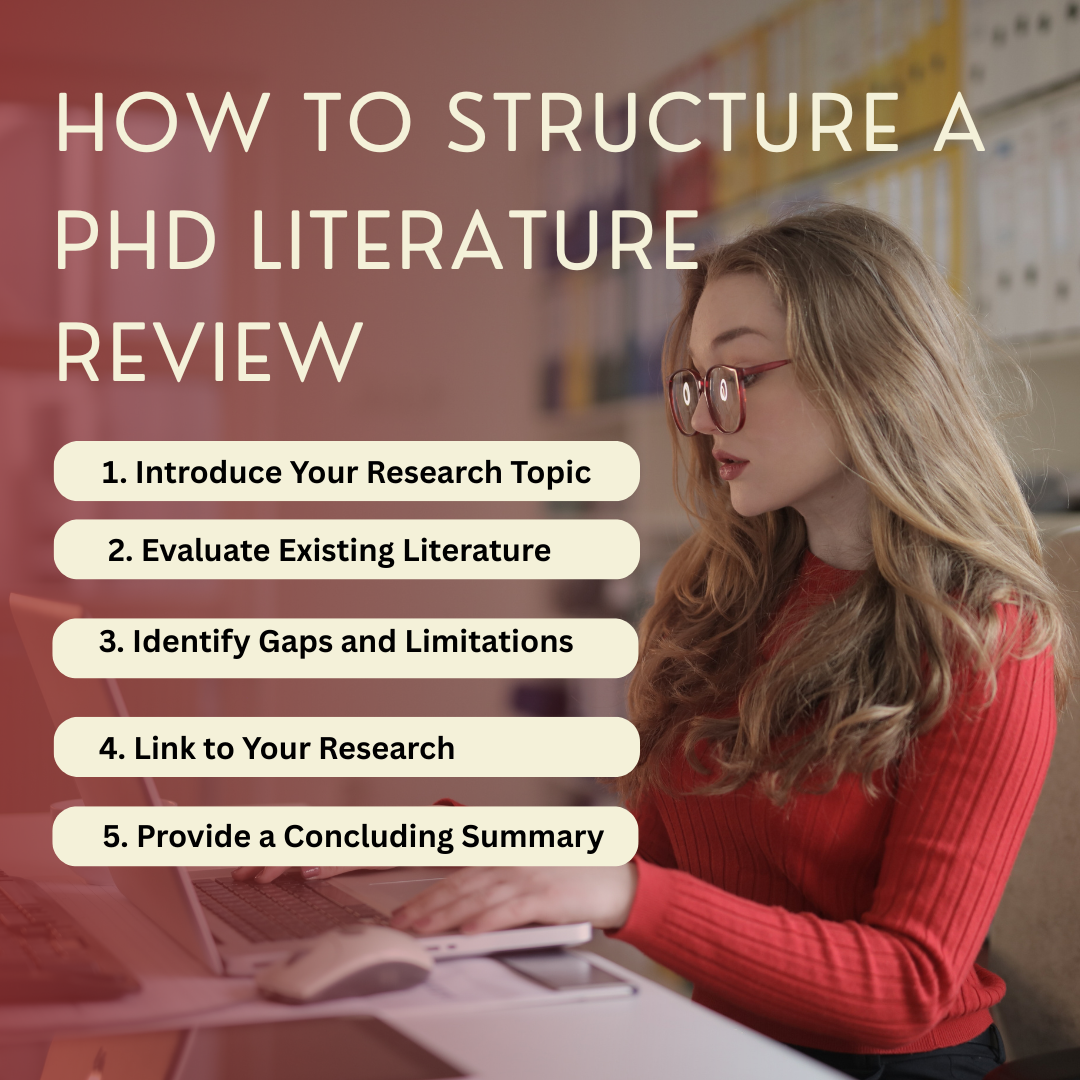
Before you start writing your PhD literature review, it’s essential to have a clear and logical structure. Without structure, your review can quickly become a collection of disconnected summaries rather than a strong academic argument.
At PhD level, structure is not just about organisation — it is about guiding your reader through a clear narrative of your research field.
At projectsdeal.co.uk, we often see that students who plan their structure in advance produce more coherent, focused, and higher-quality literature reviews.
What Should a Literature Review Include?
A well-structured PhD literature review should achieve the following:
1. Introduce Your Research Topic
Start by setting the context of your review.
Include:
- Background of the topic
- Scope and focus of the review
- Key themes or areas you will cover
👉 This helps the reader understand what to expect.
2. Evaluate Existing Literature
This is the core of your literature review.
You need to:
- Discuss key studies and authors
- Compare different perspectives
- Analyse theories, models, and findings
👉 Remember: this is not about listing studies — it’s about engaging with them critically.
3. Identify Gaps and Limitations
A strong literature review must clearly show:
- What has not been studied
- What is under-researched
- Limitations in existing work
👉 These gaps justify your research.
4. Link to Your Research
You must clearly connect the literature to your own study.
Explain:
- How your research builds on existing work
- How it addresses identified gaps
- Why your approach is different or necessary
5. Provide a Concluding Summary
End your literature review by:
- Summarising key insights
- Reinforcing research gaps
- Leading into your research questions or methodology
👉 This creates a smooth transition to the next chapter.
Different Ways to Structure Your Literature Review

There is no single “correct” structure — the best approach depends on your topic, research questions, and discipline.
1. Chronological Structure
In this approach, you organise literature based on time or historical development.
👉 Best for:
- Topics that have evolved over time
- Research areas with clear historical progression
✅ Example:
- Early theories (1990–2005)
- Modern developments (2005–2020)
- Recent advancements (2020–present)
Want an expert to review your literature review before you submit? Explore our academic writing support — trusted by UK students since 2001.
⚠️ Important Tip:
Don’t just list studies in order.
👉 Instead, focus on:
- How ideas have changed
- What improvements have been made
- What problems still remain
👉 At projectsdeal.co.uk, we recommend combining chronological structure with critical analysis for better impact.
2. Thematic Structure (Most Recommended)
This is the most commonly used structure in UK PhDs.
Instead of time, you organise literature based on themes or topics.
👉 Best for:
- Complex research areas
- Studies with multiple dimensions or subtopics
✅ Example:
If your topic is “online education”, your themes might be:
- Student engagement
- Learning outcomes
- Technology adoption
- Assessment methods
👉 Why This Works:
- Improves clarity
- Groups similar ideas together
- Makes comparison easier
👉 At projectsdeal.co.uk, we strongly recommend thematic structure because it allows for better analysis, comparison, and flow.
3. Methodological Structure
In this approach, you organise literature based on research methods used by other scholars.
👉 Best for:
- Scientific and technical research
- Data-driven studies
- Mixed-method research
✅ Example:
- Qualitative studies (interviews, case studies)
- Quantitative studies (surveys, experiments)
- Mixed-method approaches
👉 What to Analyse:
- Which methods are most effective
- Strengths and limitations of each approach
- How methods influence results
👉 This structure is especially useful when your research focuses on method comparison or validation.
Can You Combine Structures?
👉 Yes — and in many PhDs, you should.
For example:
- Use themes as your main structure
- Within each theme, discuss studies chronologically or methodologically
👉 This creates a more advanced and flexible literature review.
Golden Rule: Don’t Just Describe — Analyse
No matter which structure you choose, one rule always applies:
👉 Always compare, analyse, and connect studies — don’t just list them.
Weak vs Strong Approach
❌ Weak:
- Listing studies one after another
- No connection between ideas
✅ Strong:
- Comparing findings
- Highlighting agreements and contradictions
- Linking studies to your research
How to Maintain Flow and Coherence
To ensure your literature review reads smoothly:
- Use linking phrases (e.g., “However”, “In contrast”, “Similarly”)
- Group related studies in one paragraph
- Maintain a clear argument throughout
👉 Your literature review should feel like a connected discussion, not separate summaries.
Writing a PhD Literature Review (UK Guide)
Writing a PhD literature review is very different from writing other chapters of your thesis. Unlike the methodology or results sections, this chapter is not about presenting your own data — it is about demonstrating your understanding of existing research and positioning your study within it.
At this stage, your role shifts from being a reader to becoming a critical academic voice.
At projectsdeal.co.uk, we often notice that students struggle not because they lack knowledge, but because they are unsure how to translate their reading into structured, critical writing.
What Should You Focus on While Writing?
When writing your literature review, your primary focus should be on:
1. Demonstrating Knowledge of Your Field
You need to show that you:
- Understand key theories and concepts
- Are familiar with important studies and authors
- Know the major debates in your field
👉 This builds your credibility as a researcher.
2. Showing Critical Thinking
PhD-level writing requires you to go beyond description.
You should:
- Question assumptions
- Compare different viewpoints
- Analyse strengths and weaknesses
👉 At projectsdeal.co.uk, we guide students to develop this critical approach, which is essential for high marks.
3. Evaluating Other Researchers’ Work
You are expected to:
- Assess the quality of research
- Evaluate methodologies used
- Identify limitations and biases
👉 This shows that you can engage with research at an advanced academic level.
Important Reminder
👉 At this stage, you are NOT presenting your full original research.
Instead, you are:
- Building a strong foundation
- Identifying gaps
- Preparing the reader for your study
👉 Think of it as setting the stage for your research contribution.
Key Tips for Writing a High-Quality Literature Review
1. Avoid Simple Paraphrasing
Don’t just rewrite what other authors have said.
❌ Weak:
“Smith (2020) states that…”
✅ Strong:
“Smith (2020) argues that…, however this approach is limited because…”
👉 Always add your own analysis.
2. Use Your Own Voice and Academic Tone
Even though you are discussing other research, your writing should reflect your perspective.
- Be confident in your analysis
- Use formal academic language
- Maintain clarity and precision
3. Maintain a Logical Flow
Your literature review should read like a connected argument, not separate paragraphs.
To improve flow:
- Use linking words (However, Similarly, In contrast)
- Group related studies together
- Follow a clear structure (themes, methods, etc.)
👉 At projectsdeal.co.uk, we emphasise that flow is key to readability and examiner understanding.
4. Clearly Explain Connections Between Studies
Don’t just mention multiple studies — explain how they relate.
👉 Ask:
- Do they agree or disagree?
- Do they build on each other?
- Do they address the same issue differently?
👉 This creates a deeper level of analysis.
5. Critically Evaluate Arguments and Evidence
This is the most important skill at PhD level.
You should:
- Assess the validity of findings
- Question research design
- Highlight limitations
👉 This transforms your writing from descriptive to analytical.
Common Mistakes to Avoid
Many PhD students make similar mistakes when writing their literature review.
❌ 1. Simply Summarising Studies
Listing what each author says without analysis.
👉 This is one of the biggest reasons for low marks.
❌ 2. Poor Organisation and Structure
- No clear themes
- Random order of studies
👉 This makes your review confusing and hard to follow.
❌ 3. Lack of Critical Analysis
- Accepting studies without questioning
- Not identifying weaknesses
👉 This weakens your academic argument.
❌ 4. Including Irrelevant Sources
Trying to include everything you’ve read.
👉 This reduces focus and clarity.
❌ 5. Trying to Cover Too Much
Being too broad instead of focused.
👉 Depth is always more important than quantity.
Strong vs Weak Writing Example
❌ Weak:
“Many researchers have studied online learning.”
✅ Strong:
“While previous studies on online learning have focused primarily on accessibility, there remains limited research on student engagement, highlighting a key gap…”
👉 This shows analysis, direction, and purpose.
How to Improve Your Writing Process
To make writing easier:
- Start writing early — don’t wait until you finish reading
- Write in sections based on themes
- Revise and refine continuously
- Get feedback from your supervisor
👉 At projectsdeal.co.uk, we also support students with editing, structuring, and improving academic writing quality.
Is Your Literature Review Final?
Not at all.
One of the most important things to understand about a PhD literature review is that it is never truly “finished” in the early stages. Instead, it is a work in progress that evolves alongside your research.
At projectsdeal.co.uk, we often see students treat the literature review as a one-time task — but in reality, it develops continuously throughout your PhD journey.
Why is the Literature Review a Work in Progress?
As your research progresses, several things naturally change:
1. You Will Discover New Sources
Even after writing your first draft, you will continue to:
- Find new journal articles
- Discover updated studies
- Come across relevant theories
👉 Academic research is constantly evolving, and your literature review should reflect the most current knowledge.
2. Your Perspective Will Evolve
In the beginning, your understanding of the topic may be limited.
Over time:
- You gain deeper insight
- You develop stronger opinions
- You become more critical
👉 This means your earlier interpretations may need to be refined or rewritten.
3. Your Research Direction May Change
It’s very common for PhD research to shift slightly as you progress.
- Your research questions may be refined
- Your focus may narrow or expand
- Your methodology may evolve
👉 As a result, your literature review must be updated to stay aligned with your final research direction.
Key Takeaway
👉 Your literature review is not static — it is a living document.
You should:
- Revisit it regularly
- Update it with new research
- Refine your analysis
👉 At projectsdeal.co.uk, we always advise students to treat their literature review as something that grows alongside their thesis.
Finalising Your Literature Review
As you approach submission, your focus shifts from writing to refining and aligning your literature review.
What Should You Check Before Final Submission?
Before submitting your thesis, ensure your literature review:
✅ Aligns with Your Final Research Findings
- Does it support your conclusions?
- Are your arguments consistent throughout?
✅ Reflects Changes in Your Research Direction
- Have you updated it based on new insights?
- Does it match your final research questions?
✅ Supports Your Overall Argument
- Does it clearly justify your study?
- Does it lead logically into your findings and discussion?
How to Write the Final Literature Review Conclusion
The conclusion of your literature review is crucial. It should clearly summarise:
- What the existing literature shows
- What gaps or limitations exist
- How your research addresses those gaps
👉 This section acts as a bridge between your literature review and the rest of your thesis.
Literature Review and PhD Upgrade (UK)
In many UK universities, your literature review plays a key role in the PhD upgrade (or transfer) process.
What is the PhD Upgrade?
The upgrade usually takes place at the end of your first year and is designed to assess whether your research is suitable for a full PhD.
What Does It Involve?
Typically, you will need to:
- Submit a written document (including your literature review)
- Present your research to academic reviewers
- Answer questions about your work
- Receive feedback and recommendations
Why is the Literature Review Important Here?
Your literature review is often one of the main sections evaluated during this stage.
It demonstrates:
- Your understanding of the field
- Your ability to identify research gaps
- The relevance of your research
👉 This stage is critical because it confirms:
Your project is strong enough to continue as a PhD.
At projectsdeal.co.uk, we support students in preparing for this stage by ensuring their literature review is clear, structured, and academically strong.
How ProjectsDeal.co.uk Can Help You with Your Literature Review
| Service Area | What You Get with projectsdeal.co.uk |
|---|---|
| Planning & Structure | ✔️ Help in planning and organising your literature review with a clear academic structure |
| Source Selection | ✔️ Guidance on choosing relevant, high-quality academic sources |
| Critical Analysis | ✔️ Support in analysing, comparing, and evaluating research effectively |
| Research Gap Identification | ✔️ Assistance in identifying strong and meaningful research gaps |
| Academic Writing Support | ✔️ Help in improving clarity, coherence, and academic tone |
| Editing & Proofreading | ✔️ Thorough review to ensure error-free, plagiarism-free, and high-quality content |
Frequently Asked Questions (FAQs) – PhD Literature Review (UK)
1. How to structure a PhD literature review?
A PhD literature review should follow a clear academic structure:
- Introduction (topic, scope, and purpose)
- Main body (thematic, chronological, or methodological analysis)
- Critical evaluation of studies
- Identification of research gaps
- Conclusion linking to your research
👉 A well-structured review improves clarity and strengthens your overall thesis.
2. What are the 5 C’s of a literature review?
The 5 C’s help you write a strong literature review:
- Cite – Reference relevant studies
- Compare – Identify similarities between research
- Contrast – Highlight differences and contradictions
- Critique – Evaluate strengths and weaknesses
- Connect – Link studies to your research
3. Can ChatGPT write a literature review?
ChatGPT can help with:
- Structuring your literature review
- Generating ideas and summaries
- Improving writing clarity
👉 However, you must:
- Add your own critical analysis
- Use real academic sources
- Follow university guidelines
4. What are the 7 steps in writing a literature review?
- Define your research topic
- Search for relevant literature
- Read and take structured notes
- Organise sources into themes
- Analyse and evaluate studies
- Identify research gaps
- Write and refine your review
5. How long is a typical PhD literature review?
In the UK, a literature review is usually:
- 5,000–10,000 words (Arts & Humanities)
- 8,000–12,000 words (STEM subjects)
👉 Always confirm with your university or supervisor.
6. What are the 4 types of literature review?
- Narrative Review – General overview of research
- Systematic Review – Structured and method-based review
- Scoping Review – Explores research scope and gaps
- Meta-analysis – Statistical analysis of multiple studies
7. What are the 7 qualities of good literature?
A strong literature review should be:
- Clear
- Structured
- Critical
- Relevant
- Up-to-date
- Well-referenced
- Analytical
8. What are the three main parts of a literature review?
- Introduction – Defines topic and scope
- Main Body – Critical analysis of literature
- Conclusion – Summary and research gap
9. Is a literature review written in first person?
Generally, no.
👉 Academic writing usually avoids first person and uses a formal, objective tone.
However, some universities may allow limited use — always check guidelines.
10. What to avoid in a literature review?
❌ Simply summarising studies
❌ Lack of structure
❌ No critical analysis
❌ Using outdated sources
❌ Including irrelevant information
11. Can I do a literature review in 3 hours?
No — a PhD literature review cannot be completed in 3 hours.
👉 It requires:
- Extensive research
- Critical analysis
- Structured writing
However, you can draft a small section in a few hours.
12. How do I start writing a literature review?
Start by:
- Defining your research topic
- Collecting relevant sources
- Grouping studies into themes
- Creating an outline
👉 Then begin writing with a clear structure and critical approach.
Conclusion: Mastering Your PhD Literature Review
Writing a PhD literature review is not just an academic requirement — it is the foundation of your entire research project. A well-written literature review demonstrates your understanding of the field, highlights important research gaps, and clearly justifies why your study matters.
Throughout this guide, we’ve seen that a strong literature review requires:
- Careful planning and structured organisation
- Critical analysis rather than simple description
- Clear connection between existing research and your own study
👉 Most importantly, your literature review should build a strong argument that supports your research and positions it within the wider academic conversation.
It’s also important to remember that your literature review is not a one-time task. It evolves as your research progresses, requiring continuous updates, refinement, and alignment with your final findings.
Many PhD students struggle with:
- Finding and selecting relevant sources
- Maintaining a clear structure
- Writing critically at an advanced academic level
👉 This is completely normal — but getting it right can make a huge difference to your overall thesis quality.
Final Thought
👉 A powerful literature review doesn’t just summarise what exists — it clearly shows why your research needs to exist.
Need Expert Help with Your PhD Literature Review?
If you’re feeling stuck, short on time, or unsure how to write a high-quality literature review, expert guidance can make the process much easier.
At projectsdeal.co.uk, we provide professional academic support tailored to UK PhD standards. From structuring your literature review to refining your critical analysis, our experts help you create a clear, well-organised, and impactful review.
✔️ Personalised academic support
✔️ UK university standard writing
✔️ Plagiarism-free, high-quality content
✔️ Editing, proofreading, and expert guidance
📞 Contact: +44-7447-882377
👉 Get expert help here:
https://projectsdeal.co.uk/phd-thesis-writing-services.aspx
👉 Trusted by students:
https://finance.yahoo.com/news/projectsdeal-co-uk-voted-best-090900913.html
🚀 Take the next step today
Don’t let your literature review slow down your PhD progress. Get professional support and complete your research with confidence.
Need Expert Academic Help?
ProjectsDeal provides trusted dissertation, thesis, and essay writing support for UK university students. Get matched with a specialist in your subject area.