
Critical essay writing: how to master this essential academic skill is one of the most important questions for UK university students at every level. Critical essay writing: how you analyse, evaluate, and argue — rather than simply describe and summarise — is what separates First-class essays from average ones, and is the primary competency assessed in arts, humanities, social sciences, and law programmes across the UK.
Critical essay writing is one of the most highly valued and most challenging forms of academic writing in UK universities. Unlike descriptive writing — which reports, summarises, or explains — critical writing evaluates, analyses, and argues. It moves beyond “what” to address “how” and “why,” and it requires you to engage actively with ideas, evidence, and arguments rather than passively reproducing them. This comprehensive guide explains what critical essay writing involves, how to approach it systematically, and how to develop the analytical skills that distinguish a first-class essay from a second-class one.
What Does “Critical” Mean in Academic Writing?
In everyday usage, “critical” often implies a negative evaluation — finding fault with something. In academic writing, the term has a different and more precise meaning. Academic critical thinking involves the systematic, evidence-based evaluation of claims, arguments, and evidence — assessing their strengths and weaknesses, their assumptions and limitations, their relationship to other relevant ideas, and their implications for the broader question at hand. A critical essay does not simply find fault with existing scholarship — it engages analytically with it, acknowledging what is strong and convincing alongside what is limited, ambiguous, or contested.
The distinction between descriptive and critical writing is perhaps the most important one in UK academic writing pedagogy. Descriptive writing tells the reader what something is or what an author said; critical writing goes further to analyse what it means, evaluate whether it is convincing, and assess what implications it has. The difference is not merely stylistic — it reflects a fundamentally different intellectual stance towards knowledge, one that treats ideas as objects of analysis rather than as received facts to be reported.
Core Components of Critical Thinking in Essays
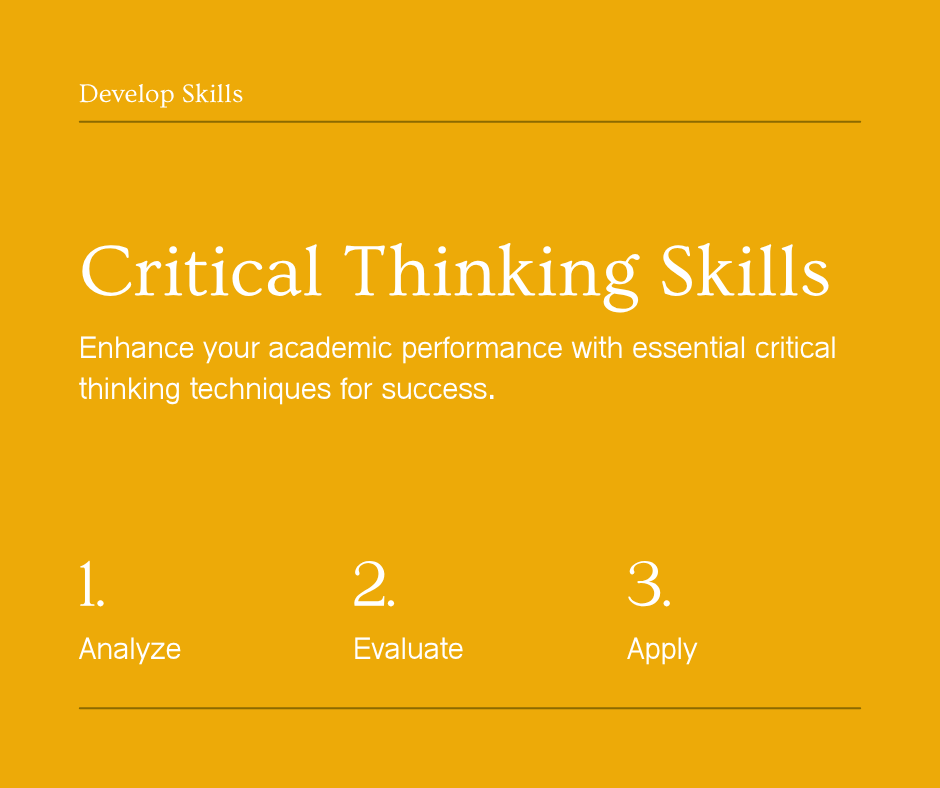
Developing strong critical thinking in your academic essays requires several distinct intellectual skills that can be cultivated through deliberate practice. Analysis involves breaking down a complex idea, argument, or piece of evidence into its component parts to understand how it works — what assumptions it rests on, what evidence it draws on, what logical moves it makes, and what conclusions it reaches. Evaluation involves assessing the quality, validity, and significance of those components — asking whether the evidence is reliable and sufficient, whether the reasoning is sound, and whether the conclusions are justified. Synthesis involves bringing together insights from multiple sources or perspectives to build a more comprehensive understanding of a complex topic — identifying patterns, connections, and tensions across different bodies of evidence and argument. Argumentation involves constructing and defending your own position on a question, using evidence and reasoning to support your claims and engaging with counterarguments fairly and rigorously.
Reading Critically: The Foundation of Critical Writing
Strong critical writing is built on a foundation of critical reading — the ability to engage actively and analytically with academic texts rather than accepting them passively. Critical reading in academic contexts involves more than understanding what a source says — it involves actively questioning its claims, evaluating its evidence, identifying its assumptions and limitations, and considering how it relates to other relevant scholarship.
Several questions can guide critical reading of any academic source: What is the author’s main claim or argument? What evidence do they use to support it? How was that evidence produced — what were the methodological choices, and what limitations do they introduce? What theoretical framework or set of assumptions underpins the argument? Are there alternative interpretations of the evidence that the author does not adequately address? How does this source relate to other sources you have encountered on the topic — does it agree, disagree, or add nuance to other scholars’ findings? What are the most significant strengths and limitations of this piece of scholarship?
Making notes in response to these questions as you read — rather than simply summarising what the source says — is the most effective way to develop the analytical raw material you need to write a strong critical essay.
Structuring a Critical Essay
A critical essay requires the same structural discipline as any academic essay — a clear introduction with a thesis, well-organised body paragraphs, and a synthesising conclusion — but the specific demands of critical writing impose additional structural considerations. Your thesis should be a specific, arguable analytical claim about the topic you are examining — not a neutral description of what you will discuss but a clear statement of the position your essay will defend. Your body paragraphs should each make a single analytical point that supports your thesis, grounded in evidence from your critical reading. Your conclusion should synthesise your analytical findings — reflecting on what your analysis has collectively demonstrated — rather than merely restating what each paragraph has said.
In a critical essay, the argument is paramount. Every paragraph should be serving the overall argument, and you should be constantly asking whether each sentence is advancing your analytical case or merely occupying space. Critical essays that are awarded high marks consistently demonstrate tight logical organisation, where each analytical move builds on the previous one in a coherent, cumulative argument. Critical essays that are awarded lower marks often have good ideas but present them in a fragmented, disconnected way that prevents the reader from seeing how they add up to a coherent analytical claim.
Using Evidence in Critical Writing
Evidence in a critical essay serves a different function from evidence in a descriptive essay. Rather than using evidence to illustrate or support a factual claim, a critical essay uses evidence analytically — to build, support, complicate, and qualify an argument. This requires you to introduce evidence thoughtfully (explaining its context and relevance before presenting it), present it precisely (quoting or paraphrasing accurately, with proper citation), and — most importantly — explain its analytical significance (how and why it supports or complicates your argument).
A common weakness in student critical essays is the “quote dump” — inserting a long quotation from a source without explanation or analysis. Even a well-chosen quotation requires interpretation: you need to explain, in your own words, what the quotation demonstrates and why it is relevant to your argument. The guiding principle is that evidence should never be left to speak for itself — it is your analytical interpretation of the evidence that makes the essay critical rather than descriptive.
Engaging With Counterarguments
A hallmark of sophisticated critical writing is the ability to engage fairly and rigorously with counterarguments — positions that challenge or complicate your own. Many students are reluctant to include counterarguments in their essays, worrying that acknowledging opposing views will weaken their argument. In fact, the opposite is true: engaging with the strongest counterarguments and explaining why they do not undermine your thesis demonstrates intellectual confidence, analytical depth, and familiarity with the full complexity of the scholarly debate.
Effective counterargument engagement typically follows a “concede and refute” or “qualify and explain” structure: briefly acknowledge the strongest version of the opposing view, then explain why it does not invalidate your thesis — either because the evidence it relies on is flawed, because it addresses a different aspect of the question, or because the weight of evidence favours your position overall. This kind of engagement with opposing views is a distinguishing feature of first-class analytical essays across UK universities.
How Projectsdeal Helps With Critical Essay Writing
Our specialist academic writing team includes subject experts with extensive experience producing critical essays across humanities, social sciences, law, business, healthcare, and STEM disciplines. We can help you develop your analytical argument, engage critically with the relevant scholarship, structure your essay for maximum clarity and impact, and ensure that your writing meets the highest standards of critical analysis expected at your level of study.
Frequently Asked Questions
How do I know if my writing is descriptive or critical?
A practical test is to ask yourself: am I telling the reader what exists, or am I explaining what it means and whether it is convincing? Phrases such as “According to Smith, X is true” or “Jones argues that Y” are often descriptive — they report what a source says without evaluating it. Phrases such as “Smith’s claim that X is convincing because… however, it is limited by…” or “While Jones argues Y, this position is complicated by Z” signal critical engagement. Another useful test is to count the proportion of your writing that introduces, reports, and summarises sources versus the proportion that evaluates, interprets, and argues — in a strong critical essay, the latter should substantially outweigh the former.
How do I develop my critical thinking skills?
Critical thinking develops through deliberate practice, reflective reading, and engagement with feedback. Reading academic sources actively and critically — using the questions outlined above — is the most important habit to develop. Engaging with seminar discussions in which ideas are debated and challenged, rather than merely presented, also develops critical thinking. Reading exemplary essays in your field — model essays provided by your department, published academic articles, and prize-winning student essays where available — provides concrete examples of what strong critical writing looks and feels like. Taking the feedback on previous assignments seriously — identifying patterns in what assessors have said is “too descriptive” and actively working to address these in subsequent pieces — is the most direct pathway to improvement.
Should I include my own opinion in a critical essay?
Yes — a critical essay requires you to take and defend an analytical position, which is a form of informed academic opinion. However, “your opinion” in this context means a reasoned, evidence-based judgement — not a personal preference or an unsupported assertion. The key phrase is “evidence-based”: your analytical position should emerge from and be supported by your engagement with the evidence and scholarship, not be asserted without justification. First-person phrases such as “I believe” or “I think” are generally avoided in UK academic critical essays; instead, allow your argument to emerge from your analytical presentation of the evidence.
Related Study Guides
You may also find these guides helpful: How to Write an Argumentative Essay, How to Write a PEEL Paragraph, How to Write an Essay Plan, and How to Proofread an Essay.
⚠️ Common Mistakes in Critical Essay Writing: How UK Students Get It Wrong
The most fundamental mistake in critical essay writing: how students approach analysis is replacing critical evaluation with description. Many UK students — particularly those transitioning from A-level to university — write essays that describe what theorists, researchers, and authors have said, without ever questioning whether their evidence is convincing, their reasoning is sound, or their conclusions are justified. UK university marking rubrics at institutions including the University of Bristol, University of Sussex, and King’s College London all specify that First-class essays must demonstrate “critical engagement” with sources — meaning students must evaluate the quality and limitations of the evidence, not merely report it.
Over-reliance on a small number of sources is a related critical essay writing error. Many students cite the same 3-5 sources repeatedly throughout their essay, creating the impression of limited reading and a narrow academic horizon. The Quality Assurance Agency UK Subject Benchmark Statements for most disciplines specify that undergraduate students should engage with a “substantial” body of scholarly literature — typically 15-25+ sources for a 2,500-word essay. Breadth of reading is itself evidence of critical engagement: it demonstrates that you have surveyed the field broadly enough to understand the range of perspectives, debates, and evidence available.
Failing to take a clear position is another widespread error. Many students present multiple perspectives without ever committing to a view — hedging every statement with “on the one hand… on the other hand” without ever reaching a conclusion. The Office for Students quality standards for UK higher education emphasise that students must demonstrate the ability to “construct and sustain logical arguments” — which requires taking and defending a clear intellectual position, not merely presenting multiple views side by side.
Poor paragraph structure undermines even well-researched critical essays. Many students write paragraphs that are either too short (1-2 sentences) and underdeveloped, or too long (10+ sentences) and unfocused. UK academic writing tutors at institutions including the University of Edinburgh and the University of Manchester consistently recommend the PEEL structure for critical essay paragraphs: Point (the analytical claim you are making), Evidence (the specific scholarly evidence you are citing), Explanation (how the evidence supports your point), and Link (connecting back to the essay argument or forward to the next point). Well-structured PEEL paragraphs produce essays that are both clearly argued and easy to mark.
💡 Expert Tips for Critical Essay Writing: How to Achieve First-Class Results UK (2026)
UK academics and writing tutors consistently advise students to approach critical essay writing: how to plan the argument before writing a single word. Produce an analytical plan that outlines your main argument, your 3-5 key sub-arguments (one per paragraph or section), and the specific evidence you will use to support each sub-argument. This plan ensures that every paragraph serves a clear argumentative function, eliminates padding and repetition, and maintains a logical thread from introduction to conclusion. The University of Oxford, University of Cambridge, and London School of Economics all provide freely accessible essay writing guides that emphasise argument planning as the foundation of critical essay success.
Develop your critical vocabulary. Critical essay writing requires precise, discipline-specific language that goes beyond general evaluative terms like “good” and “bad”. Use the evaluative vocabulary of your discipline: in sociology, “reductive”, “problematic”, “contested”; in economics, “empirically robust”, “causally ambiguous”, “internally consistent”; in literary studies, “subversive”, “hegemonic”, “intertextual”. Examiners at top UK universities assess not only the substance of your argument but also the precision and discipline-appropriateness of the language you use to express it. Building a vocabulary of critical analysis terms in your discipline is one of the highest-leverage skills you can develop as a university student.
Engage critically with your own argument. One of the most sophisticated things a critical essay writer can do is identify and address the strongest possible objection to their own argument. This technique — sometimes called “steelmanning” — involves anticipating a counter-argument, presenting it fairly, and then explaining why it does not fundamentally undermine your thesis. For example: “One might object that the evidence for this claim is too context-specific to support a general conclusion. However, the consistency of the finding across three independent datasets from different institutional contexts suggests that this is not merely an artefact of a particular sample.” This kind of self-critical engagement signals the highest level of academic sophistication.
Revision and editing are underestimated components of critical essay writing success. Many UK students submit their first draft without meaningful revision, losing marks to issues that a careful edit would have caught: unclear thesis statements, underdeveloped arguments, weak evidence integration, and inconsistent critical engagement across paragraphs. UK writing centres at institutions including UCL Writing Lab, the University of Manchester Writing Support Team, and Bristol’s Academic Skills Service all recommend a minimum of 3 revision passes: one for argument (is the logic clear and coherent?), one for evidence (is every claim supported by specific scholarly evidence?), and one for language and style (is the critical vocabulary precise and appropriately academic?).
🏫 Critical Essay Writing: How to Get Expert UK Support Since 2001
ProjectsDeal has been helping UK students master critical essay writing: how to achieve First-class results since 2001. Our team of 200+ PhD-qualified academic writers and writing tutors has supported over 20,000 students across disciplines including History, English Literature, Sociology, Law, Philosophy, Business, Psychology, and more. We provide personalised critical essay writing, structural review, argument planning support, and Turnitin-verified proofreading services, all backed by over 45,000 positive Trustpilot reviews from satisfied UK students.
Whether you need help developing a clear thesis, strengthening your critical analysis, improving your paragraph structure, or editing your essay for academic style and precision, ProjectsDeal provides expert, deadline-driven support tailored to your institution’s specific marking criteria. All our work complies with QAA UK standards and university academic integrity policies. Explore our complete dissertation writing guide for broader academic writing support. Contact ProjectsDeal today for a free critical essay writing consultation.
Need Expert Academic Help?
ProjectsDeal provides trusted dissertation, thesis, and essay writing support for UK university students. Get matched with a specialist in your subject area.
Critical Essay Writing: How: Key Insights for UK Students
UK students who understand critical essay writing: how will find it greatly benefits their academic studies. Critical Essay Writing: How is a fundamental area that UK universities expect students to engage with at degree level.
Mastering critical essay writing: how requires both theoretical knowledge and practical application. Regular engagement with critical essay writing: how significantly improves academic performance.
For further guidance on critical essay writing: how, visit the Prospects UK higher education guidance — a trusted resource for UK students.