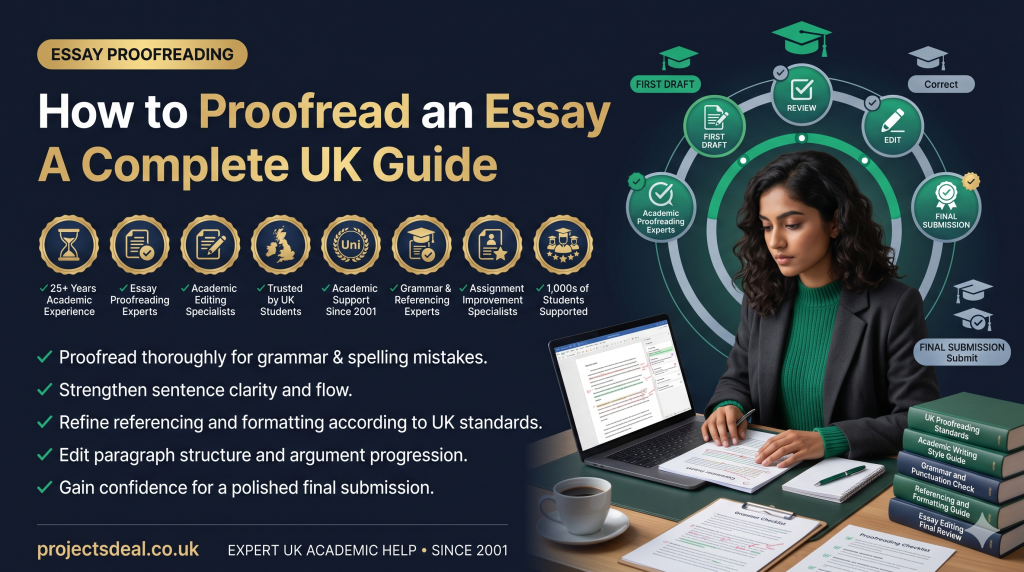
Learning how to proofread an essay is an essential skill for UK university students. Proofreading is the final step that turns a good essay into a polished one — and the step students most often rush or skip. Careless errors in spelling, grammar, referencing and formatting cost easy marks and undermine otherwise strong work. This complete UK guide explains the difference between editing and proofreading, a reliable step-by-step proofreading method, what to check, and the techniques that help you catch mistakes you would normally read straight past.
How to proofread an essay: Step-by-Step Guide
Editing vs Proofreading
They are not the same. Editing improves content, structure and clarity — the substance of your argument. Proofreading is the final surface check for spelling, grammar, punctuation, referencing and formatting errors. Edit first, proofread last.
For further guidance on how to proofread an essay, visit the academic writing skills guidance — a trusted resource for UK students and graduates.
A Step-by-Step Method
✓ Take a break before proofreading so you read with fresh eyes.
✓ Read slowly, ideally aloud, to catch awkward phrasing.
✓ Check one type of error at a time.
✓ Verify every citation and reference.
✓ Check formatting against the brief.
✓ Do a final read for sense.
What to Check
Spelling and typos, grammar and punctuation, consistent tense and tone, referencing accuracy and style, formatting (font, spacing, headings), word count, and that figures and tables are labelled. A checklist makes sure nothing is missed.
Techniques That Catch More Errors
Read your work aloud or use text-to-speech — your ear catches what your eye skips. Read the essay backwards sentence by sentence to focus on wording rather than meaning. Print it out, or change the font, to see it afresh.
Why You Miss Your Own Mistakes
Your brain fills in what it expects to see, so you read your intended text rather than what is on the page. Time away, a change of format, and reading aloud all break this familiarity — which is why proofreading immediately after writing is least effective.
Common Mistakes to Avoid
✓ Proofreading immediately after writing.
✓ Relying only on spellcheck.
✓ Checking everything at once.
✓ Skipping the reference list.
✓ Ignoring formatting requirements.
Tips for Error-Free Work
Leave time between writing and proofreading, read aloud, check one error type at a time, verify references carefully, and use a checklist. A fresh, methodical final pass protects the marks your writing has already earned.
Why Proofreading Matters for UK University Grades
Many UK students underestimate the extent to which surface errors — grammar, spelling, punctuation, referencing — affect their grades. While strong intellectual content is essential for high marks, presentation errors can cost marks even in strong work. More importantly, a proofreading error like a missing citation, a wrong reference or a misquoted statistic can constitute academic misconduct rather than just a stylistic weakness.
UK marking criteria at most universities explicitly include presentation as a grading criterion alongside analysis, argument and evidence. First-class essays are almost always technically clean; a 2:1 essay with excellent argument but poor proofreading will rarely reach a first. At postgraduate level, technical accuracy is expected as a baseline — significant proofreading errors signal inadequate care and attention that can drag a strong piece of work down to an average grade.
Professional-level proofreading takes approximately as long as the writing itself — plan to spend at least 10–20% of your total essay time on proofreading and editing. For a 3,000-word essay, that means at least 45–90 minutes of dedicated proofreading after the draft is complete.
The Three Stages: Structural Editing, Copy Editing and Proofreading
Effective error-checking proceeds in three distinct stages, each focused on different types of problem. Attempting to do all three simultaneously — checking grammar while worrying about structure — is less effective than addressing each in turn.
Stage 1: Structural editing (substantive editing) — Addressed before proofreading. Read the entire essay for big-picture issues: Does the essay answer the question? Is the argument coherent? Are the paragraphs in the right order? Are there sections that are underdeveloped or over-long? Are there points that do not follow from each other? Structural problems should be fixed at this stage, not during proofreading — changing large sections during proofreading creates new errors and wastes time.
Stage 2: Copy editing — Reads the essay for sentence-level clarity, grammar and consistency. Are sentences grammatically correct? Is the language clear and precise? Are tenses consistent? Is the register appropriate? Is terminology used consistently throughout? Copy editing improves the quality of individual sentences and paragraphs.
Stage 3: Proofreading — Reads the final text specifically for typographical errors, spelling, punctuation, referencing accuracy and formatting. This is the most granular stage and should be done on the final version after structural and copy editing are complete. Proofreading a draft that may still be substantially revised is wasted effort.
The Most Common Proofreading Errors in UK Student Essays
UK university markers consistently report the following categories of error in student essays. Focusing your proofreading on these common error types maximises the efficiency of the process.
Apostrophe errors — The misuse of apostrophes is one of the most common errors in student writing. The rules: apostrophes indicate possession (the student’s essay, the students’ essays) and contractions (it’s = it is). “Its” as a possessive pronoun never takes an apostrophe. “There/Their/They’re”, “Your/You’re” and “Its/It’s” are among the most commonly confused homophone pairs.
Comma splices — Joining two independent clauses with a comma rather than a full stop, semicolon or conjunction. “The results were significant, they confirmed the hypothesis” should be: “The results were significant; they confirmed the hypothesis” or “The results were significant. They confirmed the hypothesis.”
Subject-verb agreement — Particularly in complex sentences with long noun phrases, the verb may not agree with the subject: “The analysis of the three studies are…” should be “is” because the subject is “analysis” (singular), not “studies.”
Referencing errors — Missing citations, inconsistent author name formatting, incorrect year, missing volume/issue/page numbers, absent DOI, and misquoted or misattributed claims are all common referencing errors that proofreading should catch.
Inconsistent formatting — Different heading formats, inconsistent font size, varying margins, inconsistent spacing and non-standard title page format all create an impression of hasty, unpolished work.
Want a professional pair of eyes on your final draft? Explore our academic writing support — trusted by UK students since 2001.
Proofreading Techniques That Work
The following techniques are empirically supported as effective proofreading strategies.
Time delay — The most effective single proofreading technique is to leave at least 24 hours between finishing your draft and beginning proofreading. Distance from the text allows you to see what is actually on the page rather than what you intended to write.
Read aloud — Reading aloud engages a different cognitive pathway than silent reading and catches errors that silent reading misses — particularly run-on sentences, missing words, awkward phrasing and rhythm problems. Read slowly, word by word.
Change the format — Print the essay rather than reading on screen, or change the font and size before reading. The change in visual presentation makes familiar text look new and unfamiliar errors become visible.
Read backwards for spelling — Reading from the end backwards, word by word or sentence by sentence, removes contextual meaning and focuses attention on individual words, making spelling errors easier to spot.
Use spell check — but do not rely on it — Spell checkers catch spelling errors in isolation but miss correctly spelled wrong words (“their” for “there,” “affect” for “effect,” “principle” for “principal”), grammar errors in complex sentences and all referencing errors. Use spell check as a first pass, not a substitute for careful manual reading.
Proofread in focused blocks — Read in 20–30 minute concentrated blocks with breaks between them. Proofreading concentration declines rapidly — errors invisible when tired are visible when fresh.
Frequently Asked Questions
What is the difference between editing and proofreading?
Editing improves content, structure and clarity; proofreading is the final check for surface errors.
How do I proofread my own work?
Take a break, read slowly or aloud, check one error type at a time, and verify references and formatting.
Why can't I see my own mistakes?
Your brain reads what it expects, so familiarity hides errors; time away and reading aloud help.
Is spellcheck enough?
No — it misses wrong words used correctly, grammar issues and referencing errors.
What should I check when proofreading?
Spelling, grammar, punctuation, tense, referencing, formatting and word count.
Should I read aloud when proofreading?
Yes — it helps you catch awkward phrasing and missing words.
When should I proofread?
Last, after editing, and ideally after a break from the work.
How long does proofreading take?
It varies with length, but a careful pass is worth the time it takes.
Can someone else proofread my essay?
A professional proofreader can correct errors without changing your ideas; check it is permitted by your institution.
Does proofreading change my argument?
No — proofreading fixes surface errors; changing the argument is editing.
What is the difference between editing and proofreading?
Editing (or substantive editing/copy editing) addresses the content, structure, clarity and style of the writing. Proofreading specifically addresses technical errors — spelling, grammar, punctuation, formatting and referencing accuracy — in the final, near-complete version. Editing comes first; proofreading is the final quality check.
How long should I spend proofreading an essay?
A useful guideline is to spend at least 10–20% of your total writing time on editing and proofreading combined. For a 3,000-word essay that took 8 hours to write, plan at least 45–90 minutes for editing and proofreading. Complex or important pieces (dissertations, major coursework) deserve proportionally more proofreading time.
Can I use Grammarly for proofreading?
Grammarly and similar tools can be useful supplements to manual proofreading but should not be relied on as the sole proofreading method. They miss discipline-specific terminology, referencing errors, factual inaccuracies, structural problems and many context-dependent grammar issues. Always combine automated checking with manual reading.
Should I proofread my dissertation myself or hire a professional?
Both approaches are legitimate, and many students use professional proofreading for major assessed work. Professional proofreading services can catch errors that self-proofreading misses, particularly for students who find grammar and punctuation rules difficult. Always ensure that the proofreader only corrects surface errors rather than improving the academic content — substantive editing of your academic work by someone else may constitute academic misconduct.
What is the most effective time to proofread?
The most effective time to proofread is after a gap of at least 24 hours since writing the final draft, when you are well-rested and in a distraction-free environment. Morning proofreading after a full night’s sleep consistently catches more errors than proofreading immediately after writing, when the mental model of “what you meant to write” interferes with seeing “what you actually wrote.”
Related Study Guides
How to Write an Essay • How to Avoid Plagiarism • Harvard Referencing Guide • How to Structure an Essay
UK students who master how to proofread an essay gain a significant advantage in their academic career. Whether you are in your first year or final year, understanding how to proofread an essay thoroughly will improve your overall academic performance and help you achieve better grades.
Need Expert Academic Help?
ProjectsDeal provides trusted dissertation, thesis, and essay writing support for UK university students. Get matched with a specialist in your subject area.