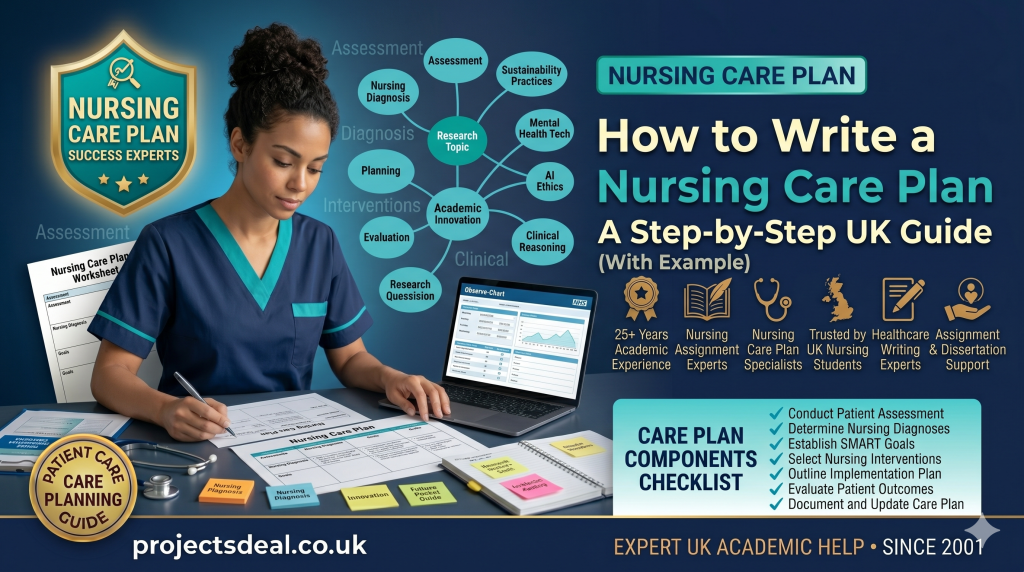
Learning how to write a nursing care plan uk guide is an essential skill for UK university students. The nursing care plan is one of the most common — and most heavily assessed — pieces of work you will produce as a UK nursing student, and it remains central to safe, person-centred practice long after you qualify. It is also where students most often lose marks, usually for vague goals, missing rationale, or a weak link between assessment and intervention. This complete UK guide explains exactly how to write a nursing care plan, step by step: the nursing process (ADPIE), the components of a care plan, NANDA nursing diagnoses, SMART goals, the different care plan formats, and several full worked examples you can adapt for assignments and placement.
How to write a nursing care plan uk guide: Step-by-Step Guide
What Is a Nursing Care Plan?
A nursing care plan is a structured, written document that identifies a patient's actual or potential health problems, sets measurable goals or expected outcomes, and details the evidence-based nursing interventions and evaluation used to achieve them. It is both a clinical tool — keeping care consistent, safe and person-centred across the whole multidisciplinary team — and an academic one, because it demonstrates your clinical reasoning and your ability to link theory to practice. In UK assignments, your marker uses the care plan to check that you can assess holistically, diagnose accurately, plan realistically, justify your decisions with current evidence, and evaluate honestly.
For further guidance on how to write a nursing care plan uk guide, visit the Open University learning and study skills resources — a trusted resource for UK students and graduates.
Why Nursing Care Plans Matter
Well-written care plans improve patient safety, support continuity of care between shifts and settings, and provide a legal record of the care delivered. They translate a complex clinical picture into clear, shared actions, which reduces error and ensures nothing is missed. Crucially, they align your practice with the four themes of the NMC Code: prioritise people, practise effectively, preserve safety and promote professionalism. Learning to write a strong care plan is therefore not just an assignment skill — it is a core professional competence the Nursing and Midwifery Council expects you to evidence throughout your career.
The Components of a Nursing Care Plan
Whatever template your university uses, every nursing care plan contains the same five core components:
✓ Assessment data — the subjective and objective information you have gathered about the patient.
✓ Nursing diagnosis — the actual or potential problem, usually written in NANDA format.
✓ Expected outcomes / goals — what you want to achieve, written as SMART goals.
✓ Nursing interventions and rationale — the actions you will take and, crucially, why.
✓ Evaluation — how and when you will judge whether the goal has been met.
Understanding these components is the foundation of the whole task: each flows logically from the one before, and your marker is checking that the links between them are clear and justified.
Types of Nursing Care Plan
There are three broad types of care plan you may encounter. A standardised care plan is a pre-written template for a common condition or procedure, used to ensure consistent baseline care. An individualised care plan is tailored to a specific patient's unique needs, preferences and circumstances. A computerised or electronic care plan is delivered through digital records systems now common across the NHS. In assignments, you are almost always expected to individualise — showing that care is shaped around the person, not just the diagnosis.
The Nursing Process: ADPIE
UK nursing care plans are built on the five stages of the nursing process, remembered as ADPIE. Each stage feeds the next, and a strong care plan shows the thread running clearly through all five.
1. Assessment
Assessment is the foundation of the whole plan. Gather subjective data (what the patient, family or carer reports — symptoms, concerns, preferences) and objective data (vital signs and NEWS2, laboratory results, physical examination findings). Use a recognised, structured framework so nothing is missed: the Roper-Logan-Tierney Activities of Living model is widely used in the UK, while the ABCDE approach (Airway, Breathing, Circulation, Disability, Exposure) is used for acutely unwell patients. Always record the patient's own perspective — person-centred care begins at assessment.
2. Diagnosis
From your assessment, identify the nursing problem (actual or potential) using the NANDA-I structure, known as the PES format: Problem related to cause (aetiology), as Evidenced by Signs and symptoms. For example: “Impaired skin integrity related to prolonged pressure on the sacral area, as evidenced by non-blanching erythema and a Grade 2 pressure ulcer.” Where a patient has several problems, prioritise them using the ABCs, immediate safety, and Maslow's hierarchy of needs — physiological and safety needs come before higher-level needs.
3. Planning
Set SMART goals — Specific, Measurable, Achievable, Relevant and Time-bound — for both the short and long term, and agree them with the patient wherever possible. “The patient will be comfortable” is not measurable; “The patient will report a pain score of 3/10 or less within one hour of analgesia” is. Good goals make evaluation straightforward.
4. Implementation
Deliver the interventions and give a clear, evidence-based rationale for each. Interventions fall into three types: independent (nurse-initiated, such as repositioning), dependent (carried out on a prescription or order, such as administering analgesia) and collaborative (with the multidisciplinary team, such as a dietitian or physiotherapy referral). The rationale is where most academic marks sit — always say why, with reference to current evidence.
5. Evaluation
Measure outcomes against your SMART goals: met, partially met or not met. State how and when you reassessed, and what you would change if a goal was not achieved. Evaluation closes the loop and demonstrates reflective, responsive practice rather than a one-off plan.
Nursing Care Plan Formats and Templates
Care plans are usually laid out in columns. The format your university requires affects how much detail you include, so always check your assignment brief.
| Format | Columns | Best for |
|---|---|---|
| Three-column | Diagnosis, Interventions, Evaluation | Quick, basic care plans |
| Four-column | Diagnosis, Goal/Outcome, Interventions, Evaluation | Most UK assignments |
| Five-column | Assessment, Diagnosis, Goal, Interventions+Rationale, Evaluation | Detailed, advanced plans |
Worked Example 1 — Acute Pain
| Nursing diagnosis | SMART goal | Interventions & rationale | Evaluation |
|---|---|---|---|
| Acute pain related to surgical incision, as evidenced by a pain score of 7/10 and guarding. | Patient reports pain of 3/10 or less within 1 hour and maintains it over the shift. | Administer prescribed analgesia and reassess (dependent); reposition and offer non-pharmacological measures (independent); refer to the acute pain team if uncontrolled (collaborative). Rationale: multimodal analgesia is the evidence-based standard for acute post-operative pain. | Reassessed at 30 and 60 minutes; pain 2/10 — goal met. Continue monitoring. |
Worked Example 2 — Impaired Skin Integrity (Pressure Ulcer)
| Nursing diagnosis | SMART goal | Interventions & rationale | Evaluation |
|---|---|---|---|
| Impaired skin integrity related to pressure, as evidenced by a Grade 2 sacral pressure ulcer. | No deterioration in the ulcer and no new pressure damage within 7 days. | Reposition per risk assessment, use a pressure-redistributing mattress, optimise nutrition and hydration, and document using the Waterlow score. Rationale: pressure redistribution and nutrition are central to NICE pressure-ulcer guidance. | Reviewed at day 7; ulcer stable, no new damage — goal met. |
Worked Example 3 — Risk of Infection
| Nursing diagnosis | SMART goal | Interventions & rationale | Evaluation |
|---|---|---|---|
| Risk of infection related to an invasive central venous catheter. | Patient remains free of signs of catheter-related infection throughout admission. | Use aseptic non-touch technique (ANTT) for line care, monitor the site and observations (NEWS2), and review the line's ongoing need daily. Rationale: ANTT and prompt line review reduce catheter-related bloodstream infections. | No signs of infection observed; line removed when no longer required — goal met. |
Care Plans for Common Conditions
The same ADPIE process applies whatever the condition; only the specific problems, goals and interventions change. For a patient with COPD, you might focus on ineffective breathing pattern and self-management; for type 2 diabetes, on knowledge deficit and blood-glucose control; for dementia, on person-centred care and managing distress; and for a post-operative patient, on pain, infection risk and early mobilisation. Always individualise to the specific patient in front of you rather than reusing a generic template.
Frameworks and Models to Apply
Strong care plans apply recognised models correctly rather than just naming them: the NMC Code; Roper-Logan-Tierney activities of living; NANDA-I diagnoses; Maslow's hierarchy for prioritisation; SMART goals; and reflective models such as Gibbs where a reflective element is required.
Referencing Your Nursing Care Plan
Support every clinical decision with current sources — ideally from the last three to five years — including NICE guidance, the NMC Code and peer-reviewed journals, referenced in your university's style (usually Harvard or APA). Accurate referencing is one of the easiest ways to protect your grade. See our Harvard referencing guide.
How to Write a Nursing Care Plan: Quick Summary
1. Assess the patient holistically using a recognised framework. 2. Identify and prioritise the nursing diagnosis in PES format. 3. Set SMART goals agreed with the patient. 4. Plan evidence-based interventions with a clear rationale. 5. Evaluate against the goals and revise as needed. Keep every stage linked, and reference your decisions throughout.
Common Mistakes to Avoid
✓ Vague, unmeasurable goals.
✓ Interventions listed with no rationale.
✓ Ignoring the patient's voice and preferences.
✓ Outdated references.
✓ A weak or missing evaluation.
✓ No clear link between assessment, diagnosis, goal and intervention.
Tips for Top Marks
Keep every section connected back to your assessment; justify each intervention with evidence; write in the third person and a professional tone; protect confidentiality (use a pseudonym and follow the NMC Code); and make your evaluation honest and specific. A focused, well-evidenced care plan for one patient always scores higher than a generic template.
Frequently Asked Questions
What are the 5 steps of a nursing care plan?
The five steps are Assessment, Diagnosis, Planning, Implementation and Evaluation, known by the acronym ADPIE. Together they form the nursing process that structures every care plan.
What is a nursing care plan?
A structured, written document that identifies a patient's actual or potential problems, sets measurable goals, and lists the evidence-based interventions and evaluation used to meet them.
What are the components of a nursing care plan?
The core components are assessment data, the nursing diagnosis, expected outcomes or goals, nursing interventions with rationale, and evaluation.
What is a NANDA nursing diagnosis?
A standardised diagnosis written in the PES format: problem related to cause (aetiology), as evidenced by signs and symptoms, for example impaired skin integrity related to pressure, as evidenced by erythema and tissue damage.
What is a SMART goal in a nursing care plan?
A goal that is Specific, Measurable, Achievable, Relevant and Time-bound, so the outcome can be evaluated objectively.
What are the three types of nursing intervention?
Independent (nurse-initiated), dependent (carried out on a prescription or order) and collaborative (with the wider multidisciplinary team).
What is the difference between a nursing diagnosis and a medical diagnosis?
A medical diagnosis names a disease; a nursing diagnosis describes the patient's response to a health problem and the issues nursing care can address.
Which assessment model is used for care plans in the UK?
Roper-Logan-Tierney Activities of Living is widely used in the UK; the ABCDE approach is used for acutely unwell patients.
How do you prioritise nursing diagnoses?
Use the ABCs (airway, breathing, circulation), patient safety, and Maslow's hierarchy of needs to decide which problems to address first.
How do I write a nursing care plan for an assignment?
Assess the patient, form a NANDA diagnosis, set SMART goals, plan evidence-based interventions with rationale, and explain how you would evaluate the outcomes, all referenced to current guidance.
Related Study Guides
How to Write a Reflective Essay (Gibbs) • How to Write a Literature Review • Harvard Referencing Guide • How to Write a Case Study
UK students who master how to write a nursing care plan uk guide gain a significant advantage in their academic career. Whether you are in your first year or final year, understanding how to write a nursing care plan uk guide thoroughly will improve your overall academic performance and help you achieve better grades.
Need support getting your assignment over the line? Explore our assignment help service — trusted by UK students since 2001.
Nursing Care Plan Templates: Complete UK Examples by Patient Condition
Understanding how care plans vary by patient condition is essential for UK nursing students. Here are the key components to include for the most common nursing care plan scenarios encountered in UK placements and coursework:
Care Plan for a Patient with Type 2 Diabetes
Assessment data: HbA1c levels, blood glucose readings, BMI, diet history, medication compliance, signs of peripheral neuropathy, foot care routine.
Nursing diagnoses (NANDA): Ineffective health management related to complex medication regime; Risk for unstable blood glucose level; Risk for impaired skin integrity related to peripheral neuropathy.
Expected outcomes (SMART goals): Patient will maintain blood glucose levels between 4–7 mmol/L before meals within 2 weeks; Patient will demonstrate correct insulin injection technique by end of first education session.
Nursing interventions: Monitor blood glucose 4× daily and document; educate patient on carbohydrate counting and glycaemic index; refer to diabetic specialist nurse; conduct daily foot inspection; arrange dietitian referral.
Evaluation: Review blood glucose diary at each visit; reassess HbA1c at 3 months; adjust plan if targets not met within 2 weeks.
Care Plan for a Post-Operative Patient (General Surgery)
Assessment data: Vital signs, pain score (NRS 0–10), wound status, urine output, IV site condition, mobility level, bowel sounds.
Nursing diagnoses: Acute pain related to surgical incision; Risk for infection related to surgical wound; Impaired physical mobility related to post-operative fatigue.
Expected outcomes: Patient will report pain NRS ≤3 within 30 minutes of analgesia administration; No signs of surgical site infection (SSI) within 30 days; Patient will ambulate 10 metres by end of Day 2 post-operatively.
Interventions: Administer prescribed analgesia as per medication chart; assess and document pain score every 2 hours; wound assessment and dressing change per protocol; hourly urine output monitoring first 24 hours; early mobilisation protocol with physiotherapy.
NANDA Nursing Diagnoses: Most Common for UK University Assignments
UK nursing programmes commonly require students to use NANDA-I (North American Nursing Diagnosis Association) taxonomy for academic care plans. The most frequently examined NANDA diagnoses include:
| NANDA Diagnosis | Common Related To | Common Evidenced By |
|---|---|---|
| Acute Pain | Surgical procedure, injury, disease process | Patient reports pain score ≥4, guarding behaviour, altered vital signs |
| Impaired Gas Exchange | COPD, pneumonia, pulmonary oedema | SpO2 <95%, dyspnoea, altered ABGs |
| Risk for Falls | Altered gait, medication effects, cognitive impairment | Risk assessment score (Morse/Waterlow) |
| Ineffective Tissue Perfusion | Peripheral arterial disease, post-operative | Pallor, reduced capillary refill, absent peripheral pulses |
| Anxiety | Diagnosis disclosure, treatment plan, hospitalisation | Patient-reported anxiety, tachycardia, restlessness |
| Knowledge Deficit | New diagnosis, complex medication, discharge planning | Questions about condition, incorrect health behaviours |
| Risk for Infection | Invasive lines, surgical wound, immunosuppression | No current signs — risk-based diagnosis |
NMC Standards in Nursing Care Plans: What UK Students Need to Know
The Nursing and Midwifery Council (NMC) Code of Conduct (2018) and the NMC Standards of Proficiency for Registered Nurses (2018) underpin all nursing care planning in the UK. Key NMC standards relevant to care plan development include:
- Standard 1.1: Treat people as individuals and uphold their dignity — care plans must reflect individualised, patient-centred goals, not generic templates.
- Standard 2.6: Maintain appropriate professional boundaries — care plans should document therapeutic, not personal, interventions.
- Standard 6.2: Recognise and respond appropriately to situations of risk — risk assessment frameworks (Waterlow scale for pressure ulcers, NEWS2 for deterioration) should be referenced in care plans where relevant.
- Standard 7.3: Ensure up-to-date assessment, planning, and documentation — care plans must be reviewed and updated regularly, and the evaluation component should be documented with dates.
Referencing NMC Standards and NICE guidelines in your nursing care plan academic assignment significantly strengthens your evidence base and demonstrates clinical competency to your markers.
Nursing Care Plan Referencing: Harvard and Vancouver in UK Nursing Assignments
Most UK nursing programmes use either Harvard referencing or Vancouver referencing for academic work, including care plan assignments. Key guidance:
- Harvard: Author-date format. In-text: (Smith, 2023). Reference list: Smith, J. (2023) Title of Work. London: Publisher. Widely used at post-1992 nursing programmes.
- Vancouver: Numbered format. In-text: [1]. Reference list numbered sequentially. Widely used in clinical and medical nursing journals; required at some Russell Group medical schools.
- Key sources to cite: NMC Code (2018), NICE Clinical Guidelines (condition-specific), Royal College of Nursing publications, peer-reviewed nursing journals (Journal of Advanced Nursing, Nursing Standard), NHS frameworks (NHS Five Year Forward View, NHS Long Term Plan).
Need Expert Academic Help?
ProjectsDeal provides trusted dissertation, thesis, and essay writing support for UK university students. Get matched with a specialist in your subject area.