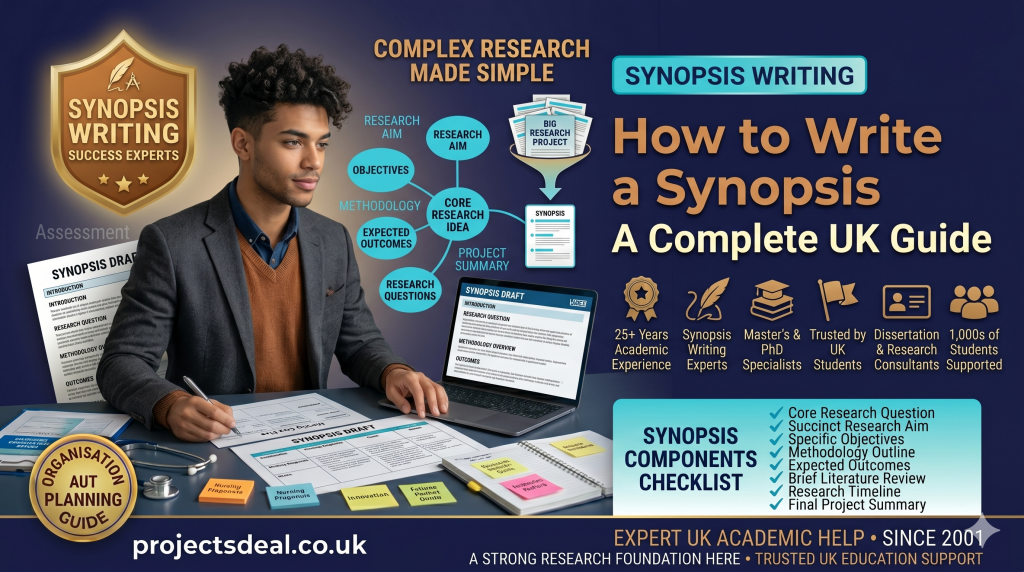
Learning how to write a synopsis is an essential skill for UK university students. A synopsis is a concise overview of a larger piece of work — a dissertation, thesis or research project — that sets out what you plan to do or have done, and why it matters. UK supervisors often ask for a synopsis before approving a project. This complete guide explains what a synopsis is, how it differs from an abstract and a proposal, what to include, and how to write one that wins approval.
How to write a synopsis: Step-by-Step Guide
What Is a Synopsis?
A synopsis is a short summary of a research project — its aim, scope, method and significance. For a dissertation it is often submitted in advance, so a supervisor can judge whether the project is focused, feasible and worthwhile before you begin.
For further guidance on how to write a synopsis, visit the Prospects guide to studying in the UK — a trusted resource for UK students and graduates.
Synopsis vs Abstract vs Proposal
These overlap but differ. An abstract summarises completed work. A research proposal is a detailed plan seeking approval. A synopsis sits between them — a concise overview of what the project is and why it matters, shorter than a full proposal. See our abstract guide and proposal guide.
What to Include
✓ Title and topic — the focus of the work.
✓ Background — brief context and the gap.
✓ Aim and objectives — what you intend to achieve.
✓ Method — how you will approach it.
✓ Significance — why it matters.
Keeping It Concise
A synopsis is short by definition — often one to a few pages. Every sentence must earn its place. State your aim and significance clearly and cut anything that does not help a reader quickly grasp and judge the project.
Writing for Approval
If the synopsis is for sign-off, make the case that your project is focused, feasible and worthwhile. Show a clear research question, a realistic method, and a genuine contribution. A vague or over-ambitious synopsis is the main reason projects are sent back.
Common Mistakes to Avoid
✓ Too long or too vague.
✓ No clear aim or research question.
✓ An unrealistic, over-ambitious scope.
✓ Missing the significance of the work.
✓ Confusing it with a full proposal.
Tips for a Strong Synopsis
State your aim and significance up front, keep it concise, show your project is feasible, and make the research question and contribution unmistakable.
The Three Contexts for Synopsis Writing at UK Universities
“Synopsis” is a term used in three distinct academic contexts at UK universities, and understanding which context applies to your assignment is essential before you begin writing.
1. The dissertation or research project synopsis — In many UK universities, particularly at postgraduate level, students are required to submit a synopsis of their proposed or completed dissertation before the full document is assessed. A dissertation synopsis is typically 500–1,000 words and covers the research question, the theoretical framework, the methodology, the key findings and the main conclusions. It differs from an abstract in that it is written for a supervising committee or academic panel rather than as a formal academic document prefix.
2. The creative or literary synopsis — In creative writing programmes, students may be required to submit a synopsis of a novel, short story collection, screenplay or other creative work as part of a professional development module or manuscript assessment. This type of synopsis is similar to the synopsis submitted to literary agents and publishers — a prose summary of the narrative, character arcs and thematic content of a creative work.
3. The reading synopsis — Some modules require students to submit a brief synopsis of a key text as evidence of reading and comprehension. This is essentially an academic summary — a concise, accurate representation of the argument and content of a source text.
Writing a Dissertation Synopsis
A dissertation synopsis is written for an informed academic audience that is already familiar with the field. It should be a model of concise academic writing — every sentence must earn its place. The following structure works well for most discipline contexts.
Research question and background (100–150 words) — State the research question clearly and provide brief justification for why it is significant and how it addresses a gap in the existing literature. No extended literature review — just enough to establish the intellectual rationale.
Theoretical framework (100–150 words) — Identify the theoretical framework(s) informing the research, explain why they are appropriate for the research question and note any key theoretical tensions or debates the research engages with.
Methodology (100–200 words) — Describe the research design, data collection approach, analytical method and any significant methodological decisions. Justify these choices briefly. Address ethical considerations if relevant.
Key findings (150–250 words) — For a completed dissertation, summarise the most significant findings. For a proposed dissertation, describe the expected or hypothesised findings and how they will be developed in the full work.
Conclusions and contribution (100–150 words) — State the main conclusions drawn from the findings and articulate the research’s contribution to knowledge — what it adds to the field that was not previously known or understood.
Want one-to-one support with your dissertation? Explore our dissertation writing service — trusted by UK students since 2001.
Writing a Creative Synopsis
A creative synopsis for a novel or screenplay requires a different approach than an academic synopsis. Its purpose is to persuade a reader — in an academic context, a module leader; in a professional context, a literary agent or publisher — that the creative work is compelling, well-structured and worth reading in full.
A creative synopsis must tell the whole story, including the ending. Unlike a blurb or jacket copy (which is deliberately vague to create mystery), a synopsis reveals what happens, how the conflict resolves and what the character arc achieves. This full disclosure is essential — readers of synopses need to assess the structural integrity and thematic coherence of the whole work, not just whether the opening is interesting.
The synopsis should be written in the present tense and in the third person (even if the novel is in first person). It should cover the main plot, the primary character arcs, the central conflict and its resolution, and the thematic concerns. It should not attempt to reproduce the prose style of the novel — synopses are functional documents, not demonstrations of writing craft.
Length for a creative synopsis varies: most agents and publishers expect one to two pages (400–800 words) for a novel. Academic creative writing module synopses will specify a length — always follow the specified word count.
Common Synopsis Errors and How to Avoid Them
Several errors are common across all types of synopsis writing at UK universities.
Being too vague — A synopsis that describes without specifics (“the research examines several important themes”; “the story follows a character who undergoes transformation”) fails its purpose. Be specific: name the themes, identify the transformation, state the findings.
Being too long — Concision is a core requirement of synopsis writing. If your synopsis significantly exceeds the word limit, the most likely problem is that you are including too much detail in the body rather than summarising.
Trying to impress with style — A synopsis is a functional document. It should be clear, precise and well-organised rather than stylistically elaborate. Clarity always takes priority over elegance in synopsis writing.
Omitting key elements — An academic synopsis that omits the methodology, or a creative synopsis that does not reveal the ending, is incomplete and will receive lower marks.
Frequently Asked Questions
What is a synopsis?
A concise overview of a research project covering its aim, scope, method and significance.
What is the difference between a synopsis and an abstract?
An abstract summarises completed work; a synopsis previews a planned or ongoing project.
What is the difference between a synopsis and a proposal?
A proposal is a detailed plan; a synopsis is a shorter, high-level overview.
What should a synopsis include?
Title, background, aim and objectives, method, and significance.
How long is a synopsis?
Usually one to a few pages, depending on the requirement.
What is the purpose of a synopsis?
To let a supervisor judge whether a project is focused, feasible and worthwhile before it begins.
How do I make a synopsis concise?
Include only what a reader needs to grasp and judge the project; cut everything else.
Does a synopsis need references?
A few key references may help, but it is far briefer than a literature review.
What makes a synopsis successful?
A clear research question, realistic method and genuine contribution, stated concisely.
When do I write a synopsis?
Usually before starting a dissertation or thesis, for supervisor approval.
What is the difference between a synopsis and an abstract?
A dissertation abstract is a brief, standardised summary (typically 150–300 words) that appears at the front of a completed dissertation, following strict academic conventions. A synopsis is typically longer (500–1,500 words) and may be written for different purposes — for a supervising committee, for a module assessment, or as part of a funding application. A synopsis may also be more informal and may be written before the work is complete.
How long should a dissertation synopsis be?
This varies by institution and purpose. Most UK university dissertation synopses for module or committee purposes are between 500 and 1,500 words. Check your module handbook or supervisor’s guidance for the exact word count required.
Should a creative synopsis reveal the ending?
Yes — always. A creative synopsis is a functional document for evaluators who need to assess the complete narrative arc and structure of the work. Unlike jacket copy or blurbs, synopses reveal the ending, the resolution of the central conflict and the character arcs. Withholding the ending makes a synopsis incomplete.
Can I use bullet points in a synopsis?
This depends on the type of synopsis and the module requirements. Academic dissertations and creative synopses are usually written in prose paragraphs. Some research project synopses may use a structured format with subheadings. Check your assignment brief or ask your supervisor about the expected format.
What is the most common reason a synopsis fails?
Lack of specificity is the most frequent weakness. Synopses that describe in vague terms — “interesting findings,” “significant themes,” “complex characters” — without identifying what is specifically interesting, significant or complex fail to demonstrate the clarity and command of material that a synopsis must convey.
Related Study Guides
How to Write an Abstract • How to Write a Research Proposal • How to Write a Research Question • How to Write a Dissertation
UK students who master how to write a synopsis gain a significant advantage in their academic career. Whether you are in your first year or final year, understanding how to write a synopsis thoroughly will improve your overall academic performance and help you achieve better grades.
Need Expert Academic Help?
ProjectsDeal provides trusted dissertation, thesis, and essay writing support for UK university students. Get matched with a specialist in your subject area.